
.webp)
.webp)
.webp)
.webp)

Personal injury firms face extensive paperwork, like demand letters and medical chronologies, which can slow down operations. Legal document generation software automates these tasks, transforming them from time-consuming to efficient processes. This allows your team to focus on winning cases rather than dealing with paperwork.
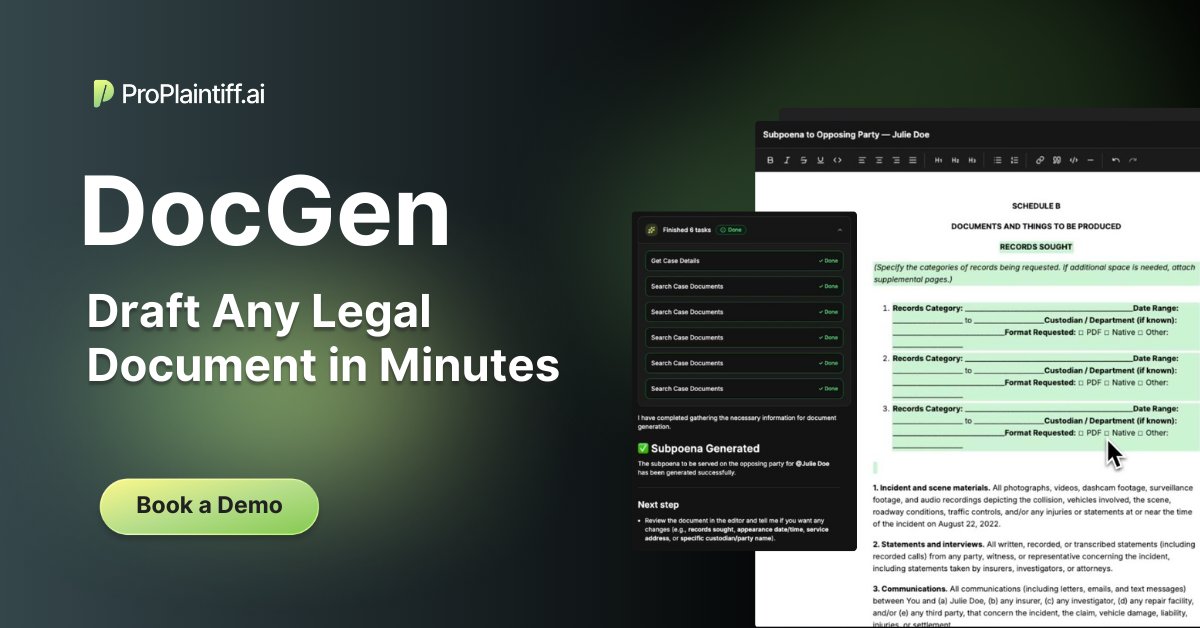
For any modern PI firm, AI is the answer to managing the daily flood of police reports, medical records, and client communications that have to be perfectly synthesized into persuasive legal arguments.
The old way of doing things was brutal. Creating a single demand letter or medical chronology involved days of painstaking work:
This process is slow, and error-prone. A misplaced decimal or an overlooked medical report can seriously weaken a case and slash its settlement value. Legal document software flips this entire script, turning a major risk into a competitive advantage. You can get a closer look at the mechanics in our guide on what is document automation.
The legal industry is catching on fast. The global market for this software is expected to explode, growing from USD 605.21 million to USD 1,551.92 million by 2033. This isn't surprising when you see that firms are cutting their document prep time by up to 70%. In fact, more than 65% of mid-to-large firms are already using these platforms to get ahead. For more insights, you can explore the full market research on legal software trends.
To really see the difference this makes, let's put the manual process side-by-side with an automated one. The table below shows just how dramatic the gains in speed and accuracy are when a firm moves from the old way of doing things to a modern, software-driven approach.
The contrast is stark. Automation not only makes the work faster, but makes your team smarter, more strategic, and ultimately, more effective at securing the best outcomes for your clients.
Not all legal document generation software is created equal. This is especially true when you measure it against the unique demands of a personal injury practice. Generic platforms might offer basic templates, but PI firms need specialized tools built to handle complex medical narratives, tricky damage calculations, and highly sensitive client data.
Let’s move beyond a simple checklist and dig into the non-negotiable features your firm needs to not just compete, but to win.

These are the core capabilities that separate a helpful tool from a practice-changing asset, turning weeks of manual work into a few focused hours of strategic thinking.
The demand letter is the cornerstone of any personal injury claim. Doing it manually is a painstaking process of weaving together police reports, witness statements, and medical records into a compelling story. It’s an art form that requires immense time and precision to get right.
ProPlaintiff.ai changes the game with an AI Paralegal that reads, analyzes, and drafts a comprehensive demand letter for you. It intelligently pulls out key facts, organizes the timeline of events, and calculates damages—all while maintaining a persuasive, professional tone. This isn't just about speed; it's about building a stronger, data-driven argument from day one.
Before: A paralegal spends 8-10 hours manually piecing together a demand letter, constantly jumping between documents and risking factual mistakes.
After: The AI generates a complete, fact-checked draft in under an hour. This frees the paralegal up to refine the legal strategy and manage client communication—the work that really matters.
A personal injury case lives and dies by its medical records. Creating a medical chronology is often the most dreaded task for any PI paralegal—a tedious slog through hundreds of pages of dense, jargon-filled reports. The risk of missing a key diagnosis or treatment date is incredibly high.
Effective legal document generation software must be able to ingest and understand unstructured medical data. The ability to automatically generate an accurate, easy-to-read chronology saves dozens of hours per case and eliminates the human error that can weaken a claim's value.
Advanced platforms use AI to scan, interpret, and organize every medical entry into a clear, chronological summary. This gives attorneys an at-a-glance understanding of the client's treatment journey, making it simple to pinpoint crucial evidence for negotiations.
Personal injury cases are built on a mountain of Protected Health Information (PHI). Using a tool that is not HIPAA compliant is a non-starter. It exposes your firm to severe legal penalties and can cause irreparable damage to your reputation. Data security can’t be an afterthought; it has to be a core feature.
A specialized platform like ProPlaintiff.ai is built with bank-grade encryption and strict access controls, ensuring that all client data is handled within a secure, private environment. This is a world away from general AI tools that might use your inputs for public model training—an unacceptable risk for any law firm.
The table below breaks down the crucial differences in data handling.
Trying to run a modern PI firm without these features is like trying to build a house on a shaky foundation. For today's personal injury practices, specialized AI tools for drafting, summarization, and security are fundamental to working efficiently, accurately, and achieving better outcomes for your clients.
With the explosion of powerful, public AI like ChatGPT and Claude, it’s tempting for law firms to see them as a quick fix for drafting legal documents. The logic seems simple enough—if an AI can write a blog post, why can’t it draft a demand letter?
This assumption, however, completely misses the critical risks that can threaten client confidentiality, wreck a case’s accuracy, and tarnish your firm’s reputation.
Think of a general AI tool as a multi-purpose pocketknife. It can handle a lot of different tasks reasonably well, but you wouldn’t want a surgeon using one in the operating room. When you're dealing with sensitive personal injury cases, you need that surgeon’s scalpel—precision isn't a luxury, it's an absolute necessity. Relying on consumer-grade AI for legal work opens up serious vulnerabilities that purpose-built legal document generation software is specifically designed to prevent.
The biggest and most immediate risk is data security. When you paste client information—medical histories, accident reports, settlement numbers—into a public AI model, you lose control over that data. Many of these platforms use your inputs to train their future models, a practice that is completely at odds with attorney-client privilege and HIPAA regulations.
For a personal injury firm, a data breach isn't just an IT headache; it's an ethical and legal disaster. Using a non-compliant tool to handle Protected Health Information (PHI) can lead to crippling fines and a total collapse of client trust.
In stark contrast, specialized legal software like ProPlaintiff.ai operates inside a secure, closed-loop system. It was built from the ground up to be HIPAA compliant, ensuring every piece of sensitive case information is locked down with end-to-end encryption and strict access controls. Your data stays yours, period. It’s never used for public model training.
To get a deeper look at these dangers, you can learn more about why ChatGPT isn't safe for legal work.
General AI models learn from the vast, messy, and unfiltered internet. That dataset includes everything from legitimate legal scholarship to Reddit arguments and decade-old blog posts. While this broad training makes them versatile conversationalists, it also makes them dangerously unreliable for the specific, nuanced demands of personal injury law.
These tools don’t understand jurisdiction-specific statutes, recent case law, or the precise language needed to build a compelling legal argument. This often leads to the AI "hallucinating" facts, citing non-existent cases, or generating language that is legally weak or just plain wrong. A flimsy demand letter can dramatically undervalue a claim or, even worse, get it thrown out entirely.
ProPlaintiff.ai’s AI Paralegal is different because it’s trained on a hand-picked, curated dataset of successful personal injury case files, relevant statutes, and medical terminology. This specialized training ensures the output isn't just grammatically correct, but legally and factually sound. It actually understands the context of a PI case, from calculating damages to framing a powerful narrative around negligence.
When you're choosing between a general tool and a specialized platform, you're really making a choice about how you manage risk and guarantee quality. The table below cuts through the noise and shows the fundamental differences and what they mean for your firm’s day-to-day work.
At the end of the day, while general AI tools are impressive pieces of technology, they are simply the wrong tool for the high-stakes, confidential nature of legal work. For personal injury firms, investing in specialized legal document generation software is a necessary step to protect your clients, ensure accuracy, and build a more efficient and profitable practice.
Choosing the right legal tech partner in a crowded market can feel overwhelming. A lot of platforms promise to fix your firm’s problems, but what they can actually do varies wildly. For personal injury firms, the goal isn't just to find a general case management system—it’s about finding a tool that crushes your biggest pre-litigation bottlenecks, especially document creation. To effectively compare solutions, start by auditing your current workflow to identify the most time-consuming tasks. Then, request demos from each vendor and come prepared with a list of specific questions about how their platform addresses those pain points, focusing on integration capabilities, data security protocols, and real-world efficiency metrics.
This is where you see a huge difference between broad case organizers and specialized AI. While platforms like CASEpeer, Filevine, and CloudLex are great at managing deadlines and client data, they treat document drafting as just one feature on a long list. ProPlaintiff.ai is different. We're a specialist, an agentic AI built for one single, focused purpose: to master the art of document analysis and generation for personal injury law.
Think of it like this: a general case management system is your family doctor. They’re fantastic for routine check-ups and keeping an eye on your overall health. But when you need complex heart surgery, you don’t go to your family doctor—you go to a cardiac surgeon, a specialist with deep, focused expertise.
For PI firms drowning in medical records and demand letter drafts, ProPlaintiff.ai is that surgeon. We don't try to be an all-in-one fix for every part of your practice. Instead, we give you a powerful, targeted AI that plugs directly into your most time-consuming pre-litigation tasks, delivering immediate and measurable gains in efficiency. This focused approach is a core principle in selecting the best document automation software for law firms.
When you're comparing platforms, you have to look past the marketing hype and focus on the AI features that actually impact a paralegal's daily workflow. EvenUp, for example, has made a name for itself in generating demand packages. Their model, however, often acts more like a service where the AI's output needs a lot of internal review before it's ready to go.
ProPlaintiff.ai, on the other hand, empowers your team directly with an AI Paralegal. This agentic AI works with your staff, not separate from them. It allows for real-time collaboration and gives your team full control over the final work product. That difference is huge for firms that want to keep their unique voice and strategic oversight while still getting the benefits of automation.
The growing demand for these kinds of sophisticated tools shows a major shift in the market. North America currently leads the Legal Document Management Software market, valued at USD 2.49 billion and projected to hit USD 9.67 billion by 2034. This explosion is driven by the sheer number of law firms needing secure, efficient digital solutions to handle massive document volumes and meet strict compliance standards like HIPAA.
To make the differences crystal clear, here’s a breakdown of how ProPlaintiff.ai stacks up against other common platforms in the personal injury space. This table gets straight to the point, highlighting the capabilities that matter most when you’re generating high-value legal documents.
Ultimately, the right choice comes down to your firm's biggest pain point. If your main challenge is just keeping case files organized, a traditional case management system is a solid pick. But if your biggest bottleneck is the grueling, time-sucking process of creating demand letters and medical chronologies, a specialized legal document generation software like ProPlaintiff.ai delivers a much more direct and powerful impact on your firm's efficiency and bottom line.
Thinking about new legal document generation software? It’s an investment, not just another line item on your expense report. To make it pencil out, you need a clear path to getting your money back—and then some. Calculating the return on investment (ROI) isn't about guessing. It's about putting a number on what really moves the needle: reclaimed hours, a bigger caseload capacity, and way less administrative drag.
This data-first approach shifts the conversation from, "Can we really afford this?" to "How can we afford not to?" When you track the real numbers, you can build a rock-solid business case that shows how automation directly fuels your firm's growth. And you wouldn't be alone—the Document Generation Software market is expected to jump from USD 3.62 billion to USD 6.86 billion by 2031, which tells you just how much value firms are getting from these tools. You can learn more about this expanding market and its drivers.
The most straightforward way to see your return is by looking at the clock. Manually prepping documents is one of the biggest time-sucks for any personal injury firm. The first step is to figure out exactly how many hours your team burns on tasks that a tool could handle.
Let's break it down:
Now, let that sink in and scale it up. If your firm takes on 30 cases a month, you’re getting back 210 hours of your paralegal’s valuable time. At an average billable rate of $150/hour, that comes out to $31,500 in recovered value. Every. Single. Month.
Getting that time back isn't just about cutting costs—it's about opening up capacity. When your paralegals aren’t drowning in paperwork, they can support more cases. This means you can grow the firm's caseload without immediately having to post a new job opening.
An investment in legal document generation software directly impacts your firm's scalability. By automating the most labor-intensive parts of pre-litigation, you empower your existing team to handle a higher caseload, turning operational efficiency into a direct revenue stream.
This newfound efficiency also means cases fly through the pre-litigation pipeline faster. You get to settlements quicker, which means cash flow improves—a game-changer for solo, small, and mid-sized firms where every dollar counts. If you want to dig deeper into the numbers, looking at guides on the general ROI calculation for AI investments can give you a great framework for your own firm's analysis.
Let's get down to brass tacks and look at some real-world numbers for firms of different sizes. This table shows just how quickly an investment in a platform like ProPlaintiff.ai can pay for itself many times over, based on time savings alone.
Honestly, these numbers are on the conservative side. They only factor in drafting demand letters. Once you add in the hours saved on building medical chronologies, summarizing dense records, and catching errors before they happen, the ROI becomes impossible to ignore.
The data is crystal clear: automation isn't just an expense. It's one of the smartest, most powerful investments a modern PI firm can make.
Bringing a new tool into your practice doesn’t have to feel like a massive disruption. A smooth, successful rollout of legal document generation software is entirely possible, but it takes a clear plan. By breaking the process into manageable stages, you can get your team on board, set realistic goals, and prove the tool’s value right from the start.
The transition really begins with prepping your people and your data. Start by picking a few tech-savvy paralegals to be your champions for the new software. Their early adoption and success will create a ripple effect, encouraging others to jump in. At the same time, get a few key case files organized to use as your first test cases. This lets your team see immediate results on material they already know inside and out.
Forget the firm-wide, top-down mandate. A gradual implementation is way more effective. This approach minimizes the chaos and builds genuine confidence in the new system.
This chart breaks down the core metrics that automation directly improves, turning saved hours into real financial gains.
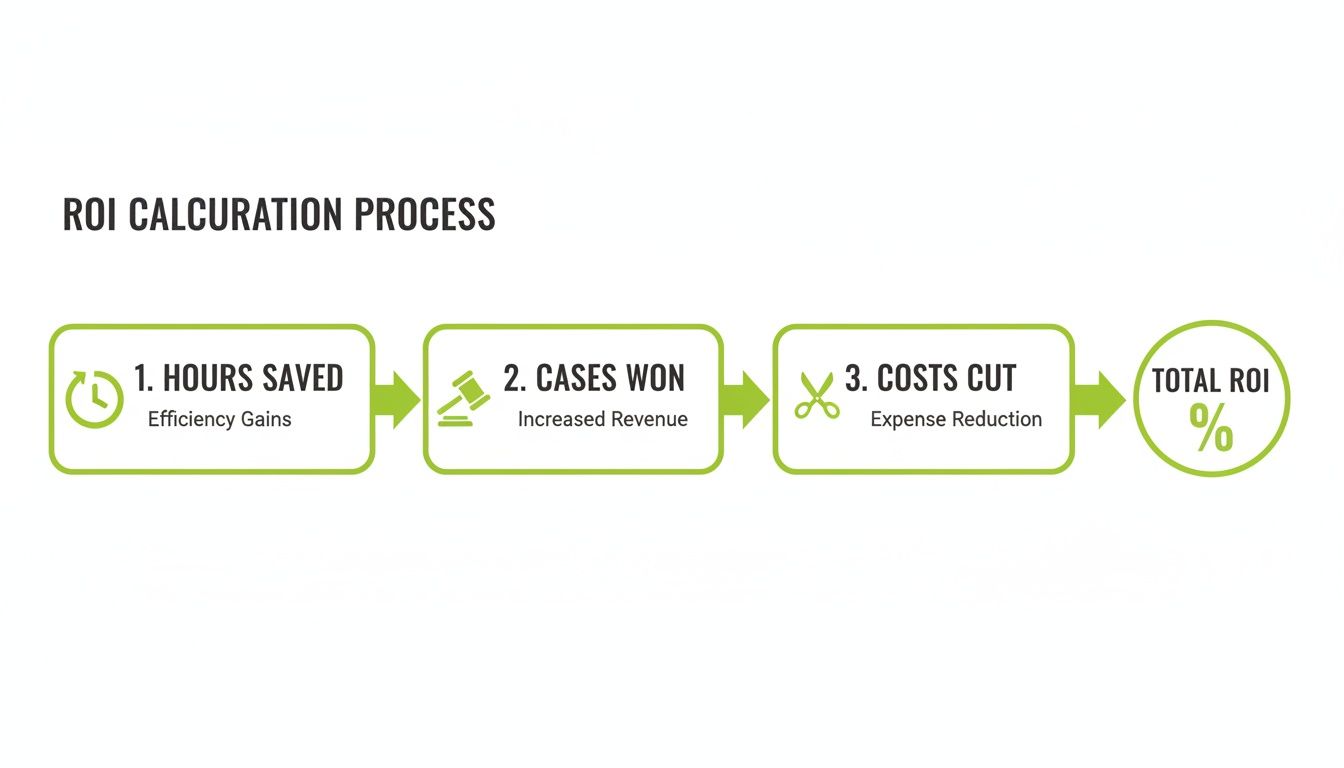
As you can see, the process is straightforward. Efficiency gains (Hours Saved) lead directly to handling more cases (Cases Won) and trimming operational fat (Costs Cut).
Once your team has document generation down pat, you can start looking at other areas where automation can help. Think beyond just documents. For instance, integrating tools like legal AI chatbots for transforming client interaction can completely change how your firm engages with potential clients from the very first click.
This creates a seamless, tech-forward experience that clients will notice.
When exploring new software, it's natural to have questions about security, compatibility, and the bottom line. Here are some straightforward answers to the questions we hear most often from personal injury firms.
This is the most important question, and the answer is simple: your data is completely secure.
Platforms like ProPlaintiff.ai aren't like the public AI tools you see online. They are built from the ground up with HIPAA compliance at their core. All your confidential case information operates in a closed, private environment and is protected by end-to-end encryption. Your inputs are never, ever used to train public models.
Yes, absolutely. The goal isn't to replace what's already working but to make it better.
Modern legal document software is designed to act as a powerful extension of your existing tech stack. Think of a tool like ProPlaintiff.ai as a specialist that handles the heavy lifting—like analyzing thousands of pages of medical records—before you easily export the finished work right back into your primary case management system, whether it’s CASEpeer or Filevine. It creates a seamless workflow without disrupting the system your firm relies on every day.
According to legal technology experts, the best platforms function as specialized plugins rather than replacements. They enhance your primary system's capabilities, allowing for a more powerful, integrated workflow without requiring a complete operational overhaul.
Definitely. The days of enterprise-only pricing are over. The market now offers flexible subscription models designed to fit your firm's specific size and caseload.
When you factor in the ROI—all those billable hours saved, the reduction in costly errors, and the ability to take on more cases without hiring more staff—the software often pays for itself within just a few months. For a small or solo practice, it’s one of the most effective ways to level the playing field against larger, better-staffed firms.
Very little. The best platforms are built with busy paralegals and attorneys in mind, which means they are incredibly intuitive.
You won't need weeks of training. Most firms find their teams are up and running, getting real work done, after just a few short sessions. The user-friendly design means you can start seeing the benefits almost immediately, minimizing downtime and speeding up your return on investment.
Ready to see how an AI Paralegal can give your firm back hundreds of hours? Explore ProPlaintiff.ai and discover how our specialized software can transform your team's efficiency and help you build stronger cases.




.svg)