Your Guide to an AI Legal Research Assistant

Discover how an AI legal research assistant can transform your law practice. This guide explains how they work, the key benefits, and how to measure ROI.

TABLE OF CONTENTS

An AI legal research assistant is a specialized software tool that uses artificial intelligence to help legal professionals find, analyze, and summarize case law, statutes, and other legal documents. Think of it less like a search engine and more like a highly efficient, context-aware paralegal.

Unlike a simple keyword search, it understands legal concepts and context, acting as a powerful partner to accelerate case preparation and strategy development. This technology is designed to augment, not replace, the expertise of attorneys and paralegals, a viewpoint supported by a 2023 study from the Stanford Institute for Human-Centered Artificial Intelligence and the Stanford Law School, which found that AI tools significantly boosted the productivity of legal professionals.

What Is an AI Legal Research Assistant?

Imagine standing in a massive law library, needing to find that one perfect precedent that will make or break your personal injury case. Now, picture an expert librarian who has already read every single book, understands your specific legal question, and instantly hands you the most relevant citations.

That’s essentially what an AI legal research assistant does for your firm.

These tools are a huge leap forward from the traditional legal databases we’re all used to. Instead of just matching keywords, they use advanced AI like Natural Language Processing (NLP) to actually comprehend legal context, nuance, and intent. This allows the tool to function more like a seasoned paralegal than a simple search bar.

Professional lawyer using holographic AI interface while reviewing legal documents at office desk

Beyond the Search Bar

The real magic is the AI's ability to handle cognitive tasks that used to burn hours of human effort. Some platforms even integrate sophisticated Speech to Text AI to process verbal input from depositions or client interviews, folding even more data into the research process.

This means the assistant can:

  • Analyze complex queries: You can ask questions in plain English, like, "Find cases where a plaintiff in California won a slip-and-fall lawsuit due to poor lighting on a commercial property."
  • Identify conceptual relationships: The AI connects related legal doctrines and precedents that might not share the exact same keywords but are thematically linked—something that takes a human researcher years of experience to master. For instance, it can connect a case about a faulty staircase to a broader legal principle of "constructive notice" even if those exact words aren't used.
  • Summarize vast amounts of text: It can distill lengthy judicial opinions, depositions, or medical records into concise, digestible summaries, pulling out the most critical information you need.

The legal industry is taking notice. The global AI Legal Services Market is projected to be worth $1.74 billion by 2025 and is on track to hit $10.43 billion by 2035, according to data from Fact.MR. This explosive growth shows just how much value these tools are bringing to law firms.

How It Changes Daily Work

For a personal injury firm, the day-to-day impact is huge. An AI assistant can slash the time spent on preliminary research. A study by legal tech provider Casetext (now part of Thomson Reuters) found that its AI tool, CARA A.I, could reduce legal research time by an average of 24.5%. This is consistent with other reports showing traditional methods can eat up between 17–28 hours per litigation matter, while with AI, that time can shrink to just 3–5.5 hours.

To see the difference clearly, let's compare the old way with the new way.

Traditional Research vs. AI-Powered Research

Aspect Traditional Legal Research AI Legal Research Assistant
Starting Point Keyword searches, Boolean operators Natural language questions, case descriptions
Process Manually sifting through hundreds of results AI analyzes, ranks, and summarizes relevant cases
Time Investment 17-28 hours per matter 3-5.5 hours per matter (Source: Industry Reports)
Discovery Limited to explicit keywords; easy to miss context Uncovers conceptually related but keyword-distinct cases
Output A long list of cases needing manual review A curated list of relevant cases with summaries
Outcome High risk of missing key precedents; time-consuming Faster, more comprehensive results; frees up attorney time

An AI assistant isn't about replacing human judgment; it's about amplifying it. By handling the exhaustive and time-consuming aspects of research, it frees up legal professionals to focus on what they do best: building winning case strategies and advocating for their clients.

Ultimately, an AI legal research assistant is a strategic partner. It empowers you to uncover deeper insights, build stronger arguments, and operate with an efficiency that was never possible before, giving your firm a real advantage in a competitive field.

How AI Enhances Personal Injury Case Research

Let's transition from theory to practice. The real impact of an AI legal research assistant becomes evident when observing its effect on the daily tasks involved in case preparation. Hearing about the technology is one thing; witnessing how it changes the operations of a personal injury firm is another. For plaintiff's attorneys, the challenges are familiar. You face tight deadlines, extensive documentation, and well-resourced opponents. Success isn't solely about legal knowledge—it's also about the speed and depth of your preparation. This is where AI becomes indispensable. ProPlaintiff's AI Paralegal, a natural language processing system trained on 6.7 million case files, is integrated into ProPlaintiff's suite of tools, providing essential support for these demanding tasks.

Finding the Needle in the Legal Haystack

Think about a complicated slip-and-fall case. Your client got hurt in a poorly lit parking garage, but the owner insists they followed all the local lighting rules. Old-school research means hours digging through case law databases with keywords like "premises liability" or "inadequate lighting." It's slow, and it often digs up hundreds of irrelevant cases a paralegal has to painstakingly review.

An AI paralegal changes the entire game. You can ask it a direct, specific question: "Find cases in this state where a property owner was found negligent for bad lighting, even though they complied with city codes, because the harm was foreseeable."

The AI doesn't just look for keywords. It understands legal ideas like negligence, compliance, and foreseeability. It instantly gives you a shortlist of the most relevant precedents. This helps your team find those obscure but powerful arguments a human researcher might miss under pressure—turning a decent case into an airtight one.

By pulling together huge amounts of legal data, an AI legal research assistant can spot patterns a person would never see. For instance, it might find a string of similar incidents at other properties owned by the same defendant, showing a pattern of negligence that strengthens your argument for punitive damages.

Turning Medical Records into Strategic Insights

Now, let's take a traumatic brain injury (TBI) claim. The case file is bursting with thousands of pages of medical records—ER reports, neurologist notes, MRI scans, physical therapy logs. Manually sifting through all of that to build a clear medical timeline is a massive job that can take weeks.

An AI legal research assistant can digest and analyze all those documents in minutes.

  • Spotting Key Evidence: The AI can instantly find every mention of symptoms like "memory loss," "headaches," or "cognitive deficits" and put them in chronological order. For example, it could trace the first mention of "dizziness" in an EMT report through to a neurologist's diagnosis of post-concussion syndrome six months later.
  • Finding Inconsistencies: It can flag when a treating doctor's notes don't line up with the defense medical examiner's report, giving you instant ammo for cross-examination. For example, it might highlight that the defense expert claims recovery is complete, while physical therapy notes from the same week show continued complaints of pain.
  • Summarizing Complex Info: The assistant can create a quick, clean summary of the entire medical history, making it easy for you to understand the full scope of your client's injuries and future needs.

This kind of fast, detailed analysis gives you a serious edge. The AI Legal Services Market is experiencing rapid adoption for these reasons, with a projected compound annual growth rate (CAGR) of 19.3% from 2025 to 2035. This growth shows just how big of a role AI is starting to play in the legal field.

This platform view shows how an AI assistant organizes case documents, making critical information instantly accessible.
The interface demonstrates a clear, centralized hub for managing case files, medical summaries, and demand letters, which is key for an efficient workflow.

Gaining the Upper Hand in Negotiations

These advantages carry right over to the negotiation table. When you can build a more complete, better-supported case in a fraction of the time, your firm gains incredible leverage.

Instead of waiting weeks for research and document review, you can get a solid demand letter out the door much faster. Insurance adjusters know when a firm has done its homework, and that often leads to higher, faster settlement offers. It's about getting better results for your clients and boosting your firm's bottom line.

Putting Your AI Assistant to Work in Daily Practice

Knowing what an AI legal research assistant can do is one thing. Actually weaving it into your firm’s day-to-day grind is where the real magic happens. This isn't about flipping a switch and changing everything overnight. It's about making smart, targeted upgrades to your existing process.

The goal is to stop drowning in the manual, time-sucking tasks that bog down case prep. By letting an AI handle the heavy lifting, your team can finally focus their energy on high-level strategy and client advocacy, where their expertise truly matters.

It really boils down to a simple, three-step flow: you feed the AI the raw data, it does the deep-dive analysis, and you get actionable insights back.
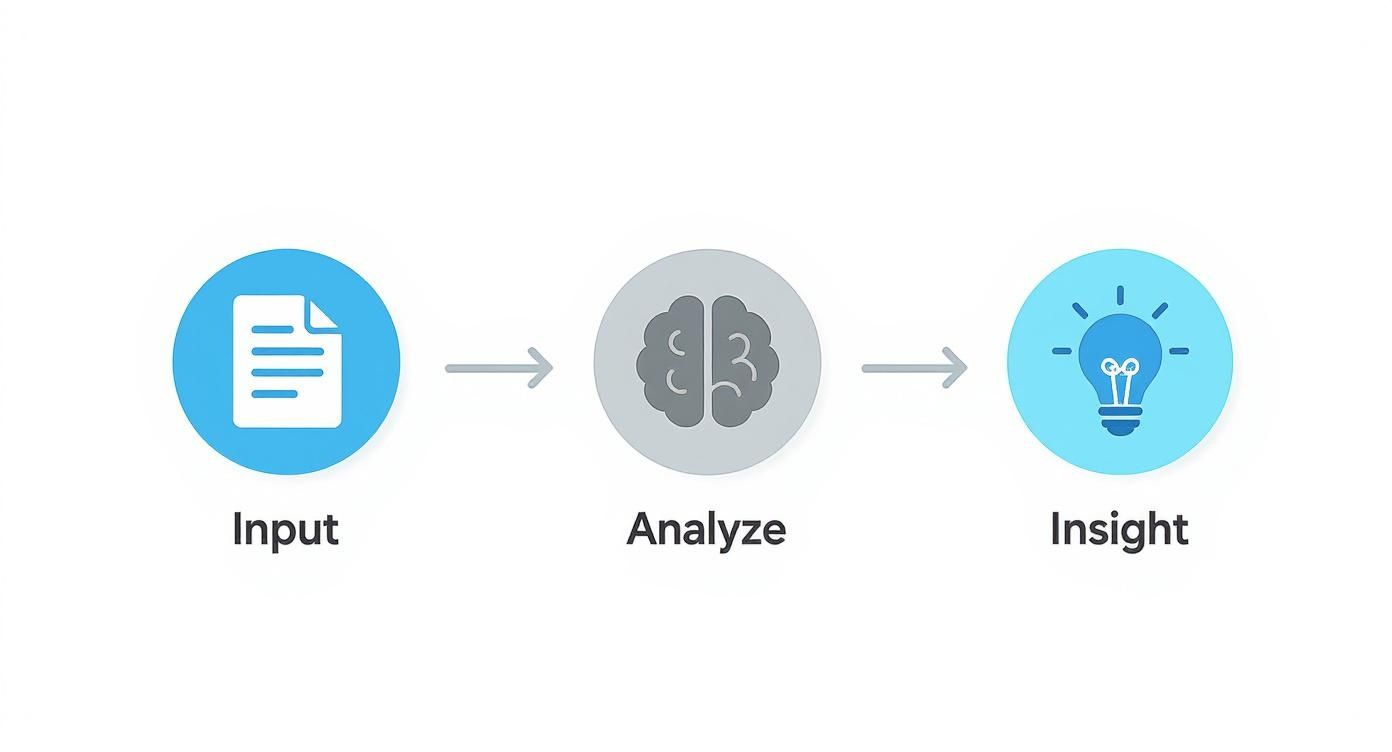
Three-step workflow diagram showing input document, brain analyzing data, and lightbulb insight generation process

Think of the AI as a bridge—one that turns a chaotic pile of documents into the strategic intelligence you need to build a winning case.

A Practical Workflow from Intake to Trial Prep

Where does an AI assistant actually fit into a typical personal injury case? Once you see these touchpoints, you’ll start spotting opportunities everywhere in your own firm.

  1. Initial Document Intake and Triage: We’ve all been there. A new case file lands on your desk, and it’s a jumbled mess of police reports, hastily written witness statements, and initial medical notes. Instead of a paralegal spending hours just sorting it all out, you can dump the entire batch into your AI assistant. It can instantly categorize everything, flag what’s missing, and spit out a preliminary case summary before you’ve finished your coffee.
  2. Deep-Dive Analysis and Summarization: With the documents organized, the real work starts. An AI's ability to digest huge volumes of information is a massive advantage. While tools like Recapio's YouTube Summarizer tool show this power in a different field, the legal application is a game-changer. You can feed it hundreds of pages of dense medical records and get back a clean, accurate medical chronology in minutes, not days.
  3. Strategic Legal Research: This is where your assistant becomes your secret weapon. Forget basic keyword searches. You can start asking complex questions in plain English. For example, you can ask, "What is the statute of limitations for medical malpractice in Florida for a case where the injury was not discovered for two years?" The AI can run jurisdictional surveys, uncover conceptually similar precedents you might have missed, and even analyze opposing counsel’s track record to help you predict their next move.
  4. Drafting and Preparation: When it’s time to draft a demand letter or prep for a deposition, the AI can pull together all the key facts, medical findings, and supporting case law into a structured outline. This gives you an incredible head start, saving dozens of hours of painstaking drafting time. For a deeper dive, our guide on how to leverage an AI paralegal has more strategies for this phase.

Ready-to-Use Prompts for Personal Injury Lawyers

Getting powerful answers from your AI legal research assistant all comes down to asking the right questions. Your prompts need to be specific, loaded with context, and crystal clear about the output you want. Vague questions get you vague, useless answers.

Here are a few battle-tested prompt examples you can swipe and adapt for your own cases.

Prompting Tip: Always over-explain. Give the AI the jurisdiction, the parties involved, and the precise legal question you're wrestling with. The more context you provide, the sharper and more relevant its response will be.

For Document Analysis:

Analyze the attached police report and two witness statements from the accident on [Date] involving [Client Name]. Identify and list all inconsistencies regarding the traffic light sequence, vehicle speeds, and points of impact.

"Review this 300-page deposition transcript of Dr. Smith. Summarize all testimony related to the plaintiff's prognosis and future medical needs. Extract and list direct quotes where Dr. Smith discusses the permanency of the injury.

For Legal Research:

"Summarize all case law in the state of [State] from the last five years related to foreseeability in premises liability cases involving criminal acts by third parties on commercial properties.

"Find and analyze statutes and case law in [Jurisdiction] that define a 'dangerous condition' on public property in the context of trip-and-fall incidents. Provide a bulleted list of factors courts in this jurisdiction consider.

For Case Strategy:

"Based on the attached medical records and liability report, generate a list of potential questions for the deposition of the defendant driver, focusing on their actions in the five minutes preceding the collision.

Review the attached expert reports from both plaintiff and defense. Identify the key points of disagreement between the experts regarding the cause of the structural failure and list supporting evidence cited by each.

Choosing the Right AI Legal Research Tool

Not all AI legal research assistants are built the same, especially when you're a personal injury firm with very specific needs. Picking the right tool isn’t about chasing the longest feature list; it’s about finding a strategic partner that actually fits how your team works. Get this decision right, and it will directly boost your efficiency, strengthen your cases, and ultimately, pad your bottom line.

The market for these tools is exploding. The AI Legal Assistant market report projects it will grow at a blistering 25% compound annual growth rate (CAGR), reaching nearly $10 billion by 2033. With new options popping up constantly, you have to know what to look for.

Must-Have Features for Personal Injury Firms

When you’re kicking the tires on different AI tools, focus on the features that solve your biggest headaches. A generic, one-size-fits-all AI won't cut it. You need a system that was designed with the plaintiff's side in mind.

Here's what you need:

  • Advanced Case Law Analysis: The tool has to do more than just match keywords. You need semantic search that understands legal concepts like negligence and foreseeability. It should let you ask plain-English questions and get back results that actually make sense in context. A truly great tool won't just spit out a list of cases—it will summarize their holdings and spot trends across different jurisdictions.
  • Efficient Medical Document Review: Personal injury cases live and die on medical evidence. Your AI assistant must be able to chew through thousands of pages of medical records and generate a clean, accurate chronology in minutes. It absolutely has to be HIPAA-compliant and smart enough to flag key medical events, treatment gaps, or conflicting opinions from different doctors.
  • Seamless Deposition Summarization: Having a paralegal spend days manually summarizing a long deposition is a massive time sink. A top-tier AI should knock this out in minutes. It needs to pull out key admissions, pinpoint inconsistencies in testimony, and create a time-stamped summary that links right back to the original transcript page.

A good starting point for your research is checking out curated lists. Our guide on the top 7 legal AI tools you should know in 2024 gives you a solid lay of the land.

Before you go too far down the rabbit hole with any single tool, it's smart to put together a checklist of what truly matters for your practice. This helps you compare apples to apples and avoid getting distracted by flashy but ultimately useless features.

Essential AI Assistant Feature Checklist

Using a structured checklist like this ensures you make a decision based on logic and your firm's real-world needs, not just a slick sales pitch.

Integration with Your Existing Systems

A powerful AI assistant shouldn't be a lonely island. If your team is constantly toggling between your case management software and your research tool, you're losing all the efficiency you were hoping to gain in the first place.

The best AI tools act as a central intelligence layer that connects with your existing software. This creates a unified workflow where case documents, research findings, and client data are all accessible from one place, preventing duplicate work and ensuring everyone on your team is on the same page.

Look for tools from providers like Clio, Filevine, or PracticePanther that offer deep, pre-built integrations or at least have a solid API. You need to ask vendors direct questions about their integration roadmap and how they keep data in sync. A seamless connection means less admin hassle and more time focused on winning cases.

Asking the Right Questions During a Demo

Before you even think about signing a contract, you have to see the tool in action with your own eyes. A product demo is your chance to put the platform through its paces using your firm’s real-world challenges. Don’t let the salesperson control the narrative with a canned presentation—show up with a sample case file and a list of tough questions.

Here’s what you need to ask:

  1. Security and Compliance: "How exactly do you ensure HIPAA compliance and protect attorney-client privilege? Where is our data physically stored, and who on your team can access it?"
  2. Accuracy and Verification: "Where does the AI get its information for legal research? Show me how I can easily click through to verify the original source for every summary or citation it gives me."
  3. Onboarding and Support: "What does the implementation and training process actually look like for a firm our size? Is real, human support included in our plan, or are we stuck with a knowledge base?"

By focusing on these core features, integration, and tough questions, you can cut through the marketing noise and choose an AI legal research assistant, like ProPlaintiff.ai, that will actually make a difference for your firm.

Navigating Security and Ethical Responsibilities

Let's talk about the serious side of this. Adopting an AI legal research assistant isn't just about efficiency; it's about upholding your professional obligations. When you're handling sensitive client information, the stakes are sky-high. Bringing new tech into your firm means making absolutely sure it protects—not exposes—that privileged data.

Thankfully, the leading AI platforms were built with this reality in mind. They aren't just powerful research engines; they're secure vaults designed from day one to uphold attorney-client privilege. This is done with robust, end-to-end encryption for all your data, both when it's being sent and when it's sitting on a server.

Legal professional viewing secure document icon with padlock on tablet next to gavel

Upholding HIPAA Compliance and Client Confidentiality

For a personal injury firm, this security layer is completely non-negotiable, especially when you're dealing with protected health information (PHI). A client’s medical records are the foundation of their case. Mishandling that data could trigger severe legal and financial penalties under the Health Insurance Portability and Accountability Act (HIPAA).

Reputable AI tools like ProPlaintiff.ai are built to be HIPAA compliant from the ground up. They use strict access controls, data anonymization where possible, and clear data residency policies so you know exactly where your client’s information is being processed. Think of this technical architecture as your first line of defense in maintaining client trust.

It makes sense that security is a major hurdle. According to the 2023 ABA Legal Technology Survey Report, 37% of legal professionals who haven't adopted AI yet cite confidentiality and security concerns as a primary barrier. This just underscores how critical transparent and robust security measures are from any AI provider you consider.

This concern is valid, but it's one that top-tier platforms have to address head-on. Before you commit to any tool, demand clear, direct answers about its security protocols. For a deeper dive, check out our in-depth article on the core principles of ethics in legal AI use.

The Ethical Imperative to Verify AI Output

Beyond security, there's a profound ethical responsibility on your shoulders. The American Bar Association's Model Rules of Professional Conduct—specifically Rule 1.1 on competence—now includes a duty of technology competence. This means lawyers have an obligation to understand the benefits and risks of the tech they use.

When you're using an AI legal research assistant, that duty boils down to one simple, critical action: you must always verify its work**.** An unfortunate but practical example of this risk is the 2023 case Mata v. Avianca, Inc., where lawyers were sanctioned for submitting a legal brief containing fictitious case citations generated by an AI chatbot.

An AI is a powerful assistant, not an attorney. It can find cases, summarize documents, and pull out key facts with incredible speed, but it cannot exercise professional judgment. Its output is a starting point, never the final product.

  • Check the sources. Every single case citation or statutory reference the AI gives you must be cross-referenced with the original source. No exceptions.
  • Analyze the context. The AI might find a relevant case, but it's up to you—the human lawyer—to decide if the facts and reasoning truly apply to your client's situation.
  • Own the final work product. The argument you file with the court is yours. You are fully responsible for its accuracy and integrity, regardless of how it was drafted.

Ultimately, these tools are here to augment your expertise, not replace it. They handle the exhaustive legwork, freeing you up to focus on strategy, analysis, and advocacy—the uniquely human skills that actually win cases. By pairing powerful technology with diligent professional oversight, you can meet your ethical duties while gaining a serious advantage.

Measuring the True ROI of Your AI Assistant

When you’re thinking about bringing a new tool into your firm, it all boils down to one simple question: what’s the return? With an AI legal research assistant, the return on investment (ROI) isn’t some vague promise of "efficiency." It’s about real, measurable dollars and cents that hit your bottom line.

Calculating that ROI isn't some dark art. It’s a straightforward look at how the right technology impacts your firm’s most valuable resources: your team’s time, your caseload capacity, and the quality of your case outcomes. Think of an AI assistant less as an expense and more as a powerful revenue driver.

Quantifying Saved Billable Hours

The most immediate and tangible way to see the ROI is by looking at the clock. Think about all the hours your paralegals and junior associates burn on routine, non-billable grunt work—summarizing dense medical records, running preliminary case law searches, organizing discovery.

Industry studies show AI can slash the time spent on a standard litigation research project from 17–28 hours down to a mere 3–5.5 hours. That’s not a minor tweak; it's a complete overhaul of your firm's operational horsepower.

To put a number on it, just use this simple formula:

(Hours Saved Per Week) x (Average Hourly Rate of Staff) x (52 Weeks) = Annual Savings

Let’s say you save a paralegal who makes $50/hour just five hours a week. That’s $13,000 a year in recovered value. That’s time they can now spend on high-value tasks that actually push cases toward resolution.

Calculating Increased Case Capacity

Here’s where things get really interesting. When your team isn't bogged down by administrative and research tasks, they can handle more cases without hitting burnout. This is the point where an AI assistant transforms from a cost-cutter into a revenue-generating engine.

Imagine your firm suddenly has the bandwidth to take on two extra cases each month—cases you previously would have had to turn away.

  • Increased Capacity: If your firm's average case value is $50,000 after fees, taking on just one additional case per quarter adds $200,000 in potential revenue to your year.
  • Faster Case Turnaround: By speeding up things like document review and demand letter drafting, you can resolve cases faster. That means better cash flow and happier clients.

This boost in capacity has a direct impact on your firm’s ability to grow, letting you scale your operations without having to scale your headcount at the same rate.

Estimating the Value of Stronger Outcomes

The final piece of the ROI puzzle is arguably the most powerful: getting better results for your clients. An AI legal research assistant helps you build stronger, more compelling arguments, which naturally leads to higher settlement offers.

The AI can dig up an obscure but highly relevant precedent or pinpoint the "smoking gun" detail buried in page 800 of a medical file that a human reviewer might have missed after hours of reading. For example, it might find a small note from a nurse practitioner mentioning the client complained of "tingling in the fingers" a week after an accident, which becomes critical evidence for a nerve damage claim that was otherwise hard to prove.

While this benefit is a bit harder to nail down with a precise number, you can track the average settlement value of your cases before and after bringing the tool on board. An increase of just 5-10% on a few of your bigger cases could easily cover the cost of the software for years.

At the end of the day, a tool like ProPlaintiff.ai isn't just about saving money; it’s designed to help you make more.

Got Questions About AI Legal Assistants? We’ve Got Answers.

When you're thinking about bringing an AI legal research assistant into your firm, it's natural to have questions. This is a big shift in how law firms work, and you need to be sure it’s the right move. We’ve pulled together the most common questions we hear to give you straight, clear answers.

Can AI Replace a Paralegal or an Attorney?

No. An AI assistant is a tool, not a replacement. Think of it as a force multiplier for your team's expertise. The American Bar Association is clear that lawyers have a duty of technology competence, and a huge part of that is verifying anything an AI produces.

The AI takes on the grunt work—sifting through documents for that one key fact, summarizing a thousand pages of medical records, or running initial research. But the real legal work? The strategic thinking, the final analysis, and standing up for your client—that stays firmly in the hands of your legal professionals.

A 2023 study from Goldman Sachs estimated that while generative AI could automate 44% of legal tasks in the U.S., it would augment rather than replace most legal roles. It takes a sharp human mind to check the work and figure out how to use it to win a case.

How Secure Is My Client's Data?

This is the big one, and for good reason. Any AI platform worth its salt is built with security as its absolute top priority. The best tools use end-to-end encryption and meet tough security standards like SOC 2 certification to keep attorney-client privilege locked down tight.

For personal injury firms, HIPAA compliance is the bottom line. Any AI legal research assistant you use must have the safeguards in place to protect sensitive health information. It’s not just a feature; it’s a professional and legal requirement.

Will This Just Add to My Firm's Overhead?

It's easy to see a subscription fee and think "expense," but you have to look at it through the lens of return on investment (ROI). When you automate hours of non-billable, repetitive work, you free up your team to focus on what actually drives revenue—moving cases forward and taking on more of them.

You can actually put a number on this ROI. Calculate the labor costs you're saving, the value of an increased caseload, and what it's worth to get to better settlements faster. For a practical example, a firm that saves 10 paralegal hours per week at an hourly rate of $50 would save $26,000 annually, likely far exceeding the cost of the software subscription. The goal isn’t to add another line item to your budget; it's to turn your case prep into a revenue engine.

Ready to see how an AI assistant can drive revenue and efficiency for your firm? Explore ProPlaintiff.ai to see how our platform transforms case preparation for personal injury lawyers. Visit https://www.proplaintiff.ai to learn more.

Feature What to Look For Importance Rating (1-5)
Case Law Search Semantic understanding of PI concepts (negligence, causation), jurisdictional filters, case summarization. 5
Medical Record Analysis HIPAA compliance, automatic chronology generation, ability to identify treatment gaps and conflicting diagnoses. 5
Deposition Summarization Extracts key admissions, identifies inconsistencies, provides time-stamped summaries with transcript links. 4
Document Q&A Ability to ask natural language questions about uploaded case files (police reports, discovery, etc.) and get cited answers. 4