The Ultimate Personal Injury Case Management Checklist: 8 Steps for 2026
Table of Contents
Managing a personal injury case is a marathon, not a sprint. From the initial client call to the final settlement check, every step is a critical data point that can make or break a case. In today's competitive legal landscape, the traditional approach of manual checklists, endless spreadsheets, and scattered files is a recipe for inefficiency and missed value. Disorganization leads to overworked paralegals, frustrated attorneys, and potentially lower settlement offers due to overlooked details. This is where a modern, technology-driven personal injury case management checklist becomes a strategic advantage.
This comprehensive guide moves beyond a simple to-do list. We will break down eight core stages of case management, from intake and medical records collection to demand preparation and settlement. More importantly, we will directly contrast the old way of doing things with a new, AI-powered approach. You will see practical comparisons of manual processes versus the agentic AI capabilities of ProPlaintiff.ai, illustrating how specific tasks are transformed.
We will provide actionable steps, real-world examples, and side-by-side analyses against general AI tools like ChatGPT and other legal tech platforms. This isn't just about checking boxes; it's about fundamentally rethinking the workflow to save time, reduce errors, and maximize case value. For paralegals buried in administrative tasks and attorneys seeking to build more profitable firms, this checklist provides a clear roadmap. It details how to shift from reactive case administration to proactive, data-driven strategy, ensuring no detail is missed and every case reaches its maximum potential. Let’s dive into the checklist that will define high-performing PI firms.
1. Initial Client Intake and Documentation
The initial client intake is the bedrock of any successful personal injury case. More than just a data-gathering exercise, this foundational step sets the tone for the entire attorney-client relationship, establishes the core facts of the case, and creates the organizational structure for every document and piece of evidence that follows. A meticulous intake process is the first, and arguably most critical, element in a comprehensive personal injury case management checklist, as it directly impacts case viability assessment and downstream efficiency.
This phase involves capturing comprehensive details about the client, the incident, specific injuries, and any preliminary medical treatment. Moving beyond traditional paper forms, modern firms leverage digital systems to ensure no critical piece of information is missed, from insurance details to witness contacts. For optimizing this critical initial phase, advanced communication solutions like an AI phone answering service for personal injury lawyers can be invaluable, ensuring that no potential client call is missed and that initial data is captured accurately around the clock.
Actionable Tips for Intake Excellence
Implement a Digital-First Intake Form: Create a dynamic online form that clients can complete before their first consultation. Use conditional logic to ask relevant follow-up questions based on their answers (e.g., if it's a car accident, prompt for vehicle information; if it's a slip and fall, ask about property conditions).
Establish a Document Capture Protocol: Immediately scan and digitize all physical documents provided by the client, such as police reports, photos, and medical receipts. Use a consistent naming convention and store them in a centralized, searchable case management system.
Schedule a Verification Follow-Up: A brief, secondary call a few days after the initial meeting can help clarify details, fill information gaps, and show the client your firm is attentive and proactive.
ProPlaintiff.ai vs. Traditional Intake Methods
Where traditional intake relies on manual data entry and paper files, ProPlaintiff.ai streamlines the process with intelligent automation. This AI-powered approach not only reduces administrative overhead but also enriches the case file from day one.
Feature
Traditional Manual Intake
ProPlaintiff.ai Automated Intake
Data Entry
Manual transcription from paper forms to software. Prone to human error and delays.
Automatically ingests data from digital forms, creating a structured, error-free case file instantly.
Information Structure
Inconsistent file organization, relies on paralegal's discretion.
Standardized, structured case files with dedicated sections for incident details, injuries, and providers.
Initial Analysis
Attorney or paralegal must manually review notes to assess case viability.
AI analyzes intake data to provide an initial case summary and flag potential red flags or missing information.
Time to Action
Can take hours or days to fully process and organize a new file.
The case file is structured and ready for review within minutes of the client submitting their information.
2. Medical Records Collection and Organization
The systematic collection and organization of medical records form the evidentiary backbone of any personal injury claim. This critical process involves gathering all documentation related to the plaintiff's injuries, from initial emergency room reports to long-term physical therapy notes. A meticulously organized medical file is non-negotiable; it is the primary tool used to establish causation, document the extent of injuries, and justify the financial damages sought. This step is a cornerstone of any effective personal injury case management checklist, as it directly substantiates the client's claim.
This phase requires a proactive and persistent approach to request, receive, and catalog records from numerous providers, including hospitals, specialists, imaging centers, and pharmacies. The goal is to create a complete, chronological history of the client's treatment. For instance, large plaintiff firms managing over 500 active cases rely on centralized digital databases to track request statuses and provider compliance, preventing crucial documents from falling through the cracks. The transition from manual review to automated analysis represents a significant leap in efficiency and accuracy.
Actionable Tips for Records Management
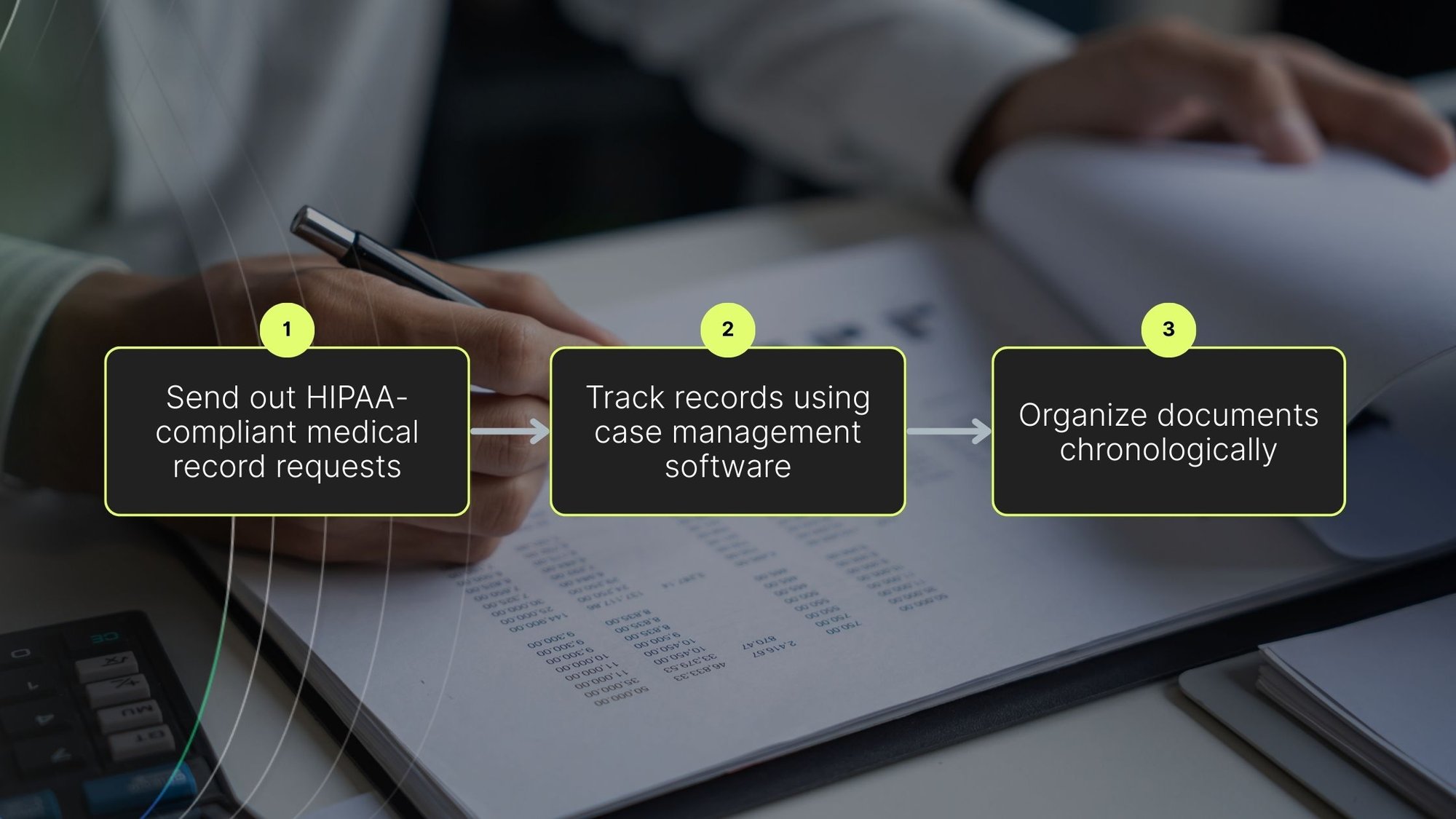
Initiate Requests Immediately: Send out HIPAA-compliant medical record requests as soon as the client signs the engagement letter. Early requests mitigate delays from provider processing times.
Track Everything: Maintain a detailed log or spreadsheet for each case, tracking every provider, the date a request was sent, follow-up actions, and the date records were received.
Go Digital First: Always request records in a digital PDF format. This eliminates scanning and facilitates the use of search functions and optical character recognition (OCR) tools for instant information retrieval.
Organize Chronologically: Upon receipt, immediately organize all documents by date. This creates a clear treatment timeline that is easy for attorneys, adjusters, and experts to follow.
ProPlaintiff.ai vs. Competitor Platforms (e.g., CASEpeer, Filevine)
While many case management systems help track record requests, ProPlaintiff.ai’s agentic AI goes a step further by actively analyzing the content of those records as they arrive, a key differentiator.
Feature
Competitor Platforms (CASEpeer, Filevine)
ProPlaintiff.ai Agentic AI
Core Function
Primarily a system for tracking request statuses and storing documents.
An active analysis engine that reads, understands, and organizes the medical content within the records.
Content Analysis
Limited to OCR for text searchability. Relies on human paralegal to read and interpret every page.
Automatically identifies medical providers, dates of service, diagnoses, and treatment types, creating a structured summary on ingest.
Chronology Creation
Requires a paralegal to manually build the chronology in a separate document or module by cutting and pasting information.
Generates an interactive, hyperlinked medical chronology automatically as records are uploaded.
Time to Insight
Days or weeks. Paralegal must wait for all records, then begin the lengthy manual review process.
Minutes. Insights begin generating the moment the first medical record is added to the file.
3. Demand Letter Preparation and Strategy
The demand letter is a pivotal moment in the personal injury lifecycle, transforming months of evidence gathering and medical review into a powerful, persuasive narrative. This document synthesizes case facts, liability arguments, medical evidence, and comprehensive damages into a formal request to the defendant's insurer. A meticulously crafted demand letter is not merely a formality; it is a strategic tool designed to anchor settlement negotiations favorably and demonstrate the strength of your case from the outset, making it a critical step in any personal injury case management checklist.
This phase requires a delicate balance of legal argumentation, factual storytelling, and precise financial calculation. It’s where the disparate elements of the case, from police reports to physician's notes, converge into a cohesive argument for compensation. Firms that excel here often see faster negotiations and higher initial offers. Mastering the art of the demand letter is essential, and for a deeper dive, you can explore this comprehensive guide to crafting a personal injury demand letter.
Actionable Tips for Crafting a Compelling Demand
Build a Narrative Framework: Structure your letter logically: a compelling summary of the incident, a clear assertion of liability with supporting facts, a detailed account of the injuries and treatment, a breakdown of all damages, and a firm demand.
Quantify Everything: Calculate and itemize all economic damages separately (medical bills, lost wages, future care costs). Use specific figures from medical records and bills to lend credibility to your calculations.
Incorporate Visual Evidence: Reference and include key visual aids, such as impactful photos of the accident scene, vehicle damage, or visible injuries. Describing what an MRI or X-ray shows can be more powerful than simply listing the test.
Set a Firm Deadline: Conclude the letter with a clear deadline for the insurer to respond, typically 30-45 days. This creates a sense of urgency and moves the case forward proactively.
ProPlaintiff.ai vs. Traditional Demand Preparation
The traditional demand letter process is notoriously time-consuming, often taking senior paralegals or attorneys 15-25 hours of manual work. ProPlaintiff.ai transforms this bottleneck into an efficient, AI-driven workflow that produces superior results in a fraction of the time.
Feature
Traditional Manual Preparation
ProPlaintiff.ai Agentic AI
Drafting Time
15-25 hours per letter. Involves manual review of all files and extensive writing.
2-3 hours per letter. AI synthesizes medical chronologies and case facts into a persuasive draft.
Evidence Integration
Manually pulling quotes and data from hundreds of pages of medical records. Prone to missing key details.
AI automatically identifies and inserts powerful quotes, key medical findings, and billing data directly into the narrative.
Damage Calculation
Manual calculations using spreadsheets. High risk of human error and omissions.
Automated and accurate calculation of medical specials, lost wages, and other economic damages.
Consistency
Quality and tone can vary significantly depending on the writer and their workload.
Ensures a consistently high-quality, persuasive, and professional tone across all demand letters for the firm.
4. Medical Chronology Development
A meticulously crafted medical chronology is the narrative backbone of a personal injury claim. It transforms a disorganized pile of medical records into a coherent, compelling story of the client's journey from injury to recovery. This detailed, time-ordered summary of all medical treatments, diagnoses, and provider communications is essential for establishing causation, demonstrating the severity of injuries, and substantiating the claim's value for demand letters, discovery, and trial.
This critical step in any personal injury case management checklist involves more than just listing dates; it requires extracting and synthesizing key clinical findings to build a persuasive argument. Law firms that automate this process often see dramatic improvements in case progression. For instance, firms using AI tools to generate chronologies report up to a 70% reduction in the time spent on this traditionally labor-intensive task, allowing paralegals and attorneys to focus on high-value legal strategy.
Actionable Tips for Chronology Excellence
Establish a Consistent Format: Use a standardized date format (e.g., MM/DD/YYYY) and structure for every entry. Include columns for the date of service, provider name, entry type (e.g., ER visit, MRI, PT), and a concise summary of findings or treatment.
Highlight Key Milestones: Use bolding or color-coding to flag significant events like the initial diagnosis, surgical procedures, or a declaration of Maximum Medical Improvement (MMI). This makes the timeline easily scannable for critical information.
Document Gaps and Context: Note any significant gaps in treatment. If the reason is known (e.g., waiting for insurance approval, client illness), include a brief note to proactively address potential defense arguments about mitigation of damages. For a deeper dive, explore our guide on how to build a personal injury medical chronology.
ProPlaintiff.ai vs. General AI Tools (ChatGPT, Claude)
While general AI can summarize text, it lacks the specialized training to accurately and reliably create a legal medical chronology. ProPlaintiff.ai is purpose-built for this high-stakes task.
Feature
General AI (ChatGPT, Claude)
ProPlaintiff.ai Legal-Specific AI
Accuracy
Prone to "hallucinations" and misinterpreting complex medical jargon. No guarantee of factual correctness.
99%+ accuracy, trained specifically on millions of medical and legal documents. Verifiable with source-linking to the original page.
Data Privacy
Uploading client medical records to a public AI model can pose significant HIPAA and data security risks.
Operates in a secure, closed environment designed to meet legal industry data privacy and compliance standards.
Output Format
Generates a block of text that still requires manual formatting, structuring, and verification by a paralegal.
Produces a structured, hyperlinked, and searchable chronology table, ready for use in demand letters or case management systems.
Contextual Understanding
Lacks understanding of legal significance (e.g., causation language, MMI) and may treat all data points equally.
AI is trained to identify and flag legally significant events, such as statements on causation or conflicting medical opinions.
5. Evidence Collection and Media Analysis
Effective evidence collection and analysis serve as the narrative backbone of a personal injury claim. This critical stage involves methodically identifying, gathering, preserving, and interpreting all physical and digital evidence, including photographs, videos, police reports, and witness statements. A robust evidence file not only substantiates the facts of the case but also provides the leverage needed to establish clear liability, demonstrate the full extent of damages, and fortify your position during settlement negotiations or trial. It is an indispensable component of any comprehensive personal injury case management checklist.
This process extends beyond simply accumulating files; it requires a strategic approach to organization and analysis. Modern firms are moving past manual review, which is often time-consuming and prone to oversight. Instead, they are adopting advanced tools to extract key details from media files, such as vehicle damage severity or environmental conditions at an accident scene. Utilizing technology for AI media analysis transforms legal evidence review, allowing legal teams to uncover critical insights faster and build a more compelling case narrative from the outset.
Actionable Tips for Evidence Excellence
Establish a Rapid Response Protocol: Immediately request and preserve all transient evidence, such as security camera footage from nearby businesses or traffic camera data, before it is overwritten.
Implement a Digital Chain of Custody: Use a centralized, cloud-based system to store all digital evidence. Ensure the system logs every access and modification to maintain the integrity and admissibility of the evidence.
Standardize Witness Statements: Create a standardized questionnaire for witness interviews to ensure all key points are covered consistently, including their location, line of sight, and detailed recollection of the event.
Preserve Metadata: Instruct clients and team members to preserve the original digital files of photos and videos. The embedded metadata (timestamps, GPS coordinates) can be invaluable for corroborating the timeline of events.
ProPlaintiff.ai vs. Traditional Evidence Review
Where traditional methods require paralegals to spend countless hours manually sifting through photos and videos, ProPlaintiff.ai automates this analysis, identifying and summarizing critical information instantly. This agentic AI approach ensures no detail is missed and significantly accelerates case development.
Feature
Traditional Manual Review
ProPlaintiff.ai Media Analysis
Photo/Video Analysis
Paralegal manually views each file, writes notes, and organizes them. This is slow and subjective.
AI automatically scans all media, identifies key elements (e.g., vehicle damage, stop signs, injuries), and generates summary reports.
Evidence Organization
Files are often stored in generic folders, requiring manual searching and sorting.
Automatically tags and categorizes media based on content, creating a searchable, structured evidence library.
Data Extraction
Relies on human observation to spot details like road conditions or the time of day from visual cues.
Extracts and logs specific data points like weather conditions, points of impact, and visible hazards directly from images and videos.
Time to Insight
Can take days to review a large volume of evidence, delaying demand letter preparation.
Provides actionable insights and a comprehensive evidence summary within minutes, enabling faster strategic decisions.
6. Damages Calculation and Documentation
Accurately calculating and meticulously documenting damages is the engine that drives a personal injury case toward a fair valuation. This critical stage moves beyond simply listing injuries; it involves a forensic accounting of every economic and non-economic loss the client has suffered. A comprehensive approach to damages forms the unshakeable foundation of your demand letter and negotiation strategy, directly influencing the final settlement or verdict. This item is a non-negotiable part of any personal injury case management checklist because without a precise and well-supported damages model, even the strongest liability case will fail to achieve its maximum potential.
This phase requires a systematic compilation of all financial losses, from medical bills and lost wages to projected future care costs, alongside a compelling narrative for non-economic damages like pain and suffering. Modern firms understand that a well-organized damages presentation can significantly impact outcomes; for example, practices that implement structured damages calculation worksheets report a notable increase in initial settlement offers because the opposing side can clearly see and verify the comprehensive scope of the losses.
Actionable Tips for Damages Excellence
Categorize All Economic Losses: Immediately upon receipt, scan and categorize all medical bills (hospital, physician, therapy, pharmacy), lost wage documentation, and out-of-pocket receipts. Use a consistent folder structure in your case management system for easy retrieval.
Verify and Itemize Medical Billing: Always request fully itemized medical bills, not just summary statements. Scrutinize these documents to identify and challenge any potential overcharges or unrelated treatments, strengthening the credibility of your claim.
Document Wage Loss Precisely: Go beyond simple pay stubs. Obtain an official wage verification letter from the client's employer that confirms their rate of pay, hours missed, and the value of any lost benefits like paid time off or 401(k) contributions. For serious injuries, retain a vocational expert early to project future lost earning capacity.
Systematize Non-Economic Calculations: Research recent verdicts and settlements for similar injuries within your jurisdiction to establish a reasonable range for pain and suffering multipliers. Document all evidence supporting these damages, including journal entries, photos, and statements from family and friends.
ProPlaintiff.ai vs. Traditional Damages Methods
While traditional methods involve manual spreadsheet entries and scattered document collection, ProPlaintiff.ai uses intelligent automation to build a comprehensive and dynamic damages model. This AI-driven approach ensures accuracy, enhances presentation, and saves dozens of paralegal hours.
Feature
Traditional Manual Calculation
ProPlaintiff.ai Automated Damages Module
Data Aggregation
Manually entering line items from hundreds of pages of medical bills into a spreadsheet. Extremely time-consuming and prone to errors.
AI-powered data extraction automatically pulls line items from medical bills, wage statements, and receipts, populating a structured damages ledger.
Calculation Updates
Requires manual recalculation of the entire spreadsheet every time a new bill or wage record is received.
The damages model updates in real-time as new documents are added to the case file, ensuring the total is always current.
Expert Reports
Manually reviewing a life care plan or economic report to find key figures and add them to the damages summary.
AI identifies and integrates key figures from expert reports, such as future medical costs and lost earning capacity, directly into the overall damages calculation.
Presentation
Creating charts and summaries manually in external programs like Excel or Word, a process that must be redone with every update.
Generates clear, professional-grade damages summaries, charts, and tables on-demand, ready for inclusion in demand letters or mediation presentations.
7. Insurance Coverage Analysis and Negotiation Strategy
A personal injury case is only worth what can be collected, making a thorough insurance coverage analysis a non-negotiable step. This critical investigation goes beyond simply identifying the at-fault party's insurer; it involves a deep dive into all potential sources of recovery, including policy limits, exclusions, and stacking opportunities. A robust coverage analysis defines the realistic settlement ceiling and is a foundational element of any effective personal injury case management checklist, shaping valuation and guiding all subsequent negotiation strategies.
This phase requires obtaining and dissecting complete insurance policy documents from all involved parties. Attorneys and paralegals must identify every applicable policy, from the defendant's primary auto or homeowner's insurance to potential umbrella policies and even the client's own uninsured/underinsured motorist (UIM) coverage. Failing to uncover all available coverage early on can lead to settling a case for a fraction of its true value, leaving significant money on the table and failing the client.
Actionable Tips for Coverage Analysis
Request Declarations Pages Immediately: As part of the initial discovery requests, demand the "declarations page" for all known policies. This one-page summary provides a quick overview of limits, covered individuals, and policy periods.
Map All Potential Policies: Create a visual diagram or spreadsheet listing every party and vehicle involved in the incident. Then, systematically investigate all potential policies connected to each, including auto, homeowners, umbrella, and relevant business policies.
Scrutinize Policy Exclusions: Don't just look at the limits; carefully read the policy's fine print for any exclusions that the insurer might use as a defense to deny coverage. Common examples include intentional acts or business-use exclusions in personal auto policies.
ProPlaintiff.ai vs. Traditional Analysis Methods
Traditional coverage analysis is a manual, time-consuming process that relies on a paralegal's experience to spot potential issues. ProPlaintiff.ai introduces agentic AI to automate and deepen this investigation, ensuring no source of recovery is overlooked.
Feature
Traditional Manual Analysis
ProPlaintiff.ai Agentic AI Analysis
Document Review
Paralegal manually reads through hundreds of pages of policy documents to find limits and exclusions.
AI ingests entire policy documents, instantly extracting and summarizing key terms, limits, and potential coverage gaps.
Policy Identification
Relies on discovery responses and manual investigation, which can miss non-obvious sources of coverage.
AI analyzes incident facts and party relationships to suggest potential additional policies to investigate (e.g., resident relative coverage).
Strategy Development
Strategy is based on attorney's manual review and experience, which can be inconsistent.
AI cross-references coverage limits with medical damages and liability facts to generate a data-backed negotiation strategy and settlement range.
Efficiency
Can take 5-10+ paralegal hours to fully analyze complex policies and document findings.
The core analysis is completed in minutes, freeing up paralegal time for strategic follow-up and client communication.
8. Settlement Negotiation and Resolution
The settlement negotiation phase is the culmination of every preceding step in your personal injury case management checklist. This is where meticulous evidence gathering, detailed medical chronologies, and a compelling demand letter are leveraged to achieve the primary goal: securing maximum and fair compensation for your client. Effective negotiation is both an art and a science, requiring a strategic synthesis of facts, legal arguments, and interpersonal skills to counter lowball offers and navigate discussions with insurance adjusters and defense counsel.
This critical stage transforms your case file from a collection of documents into a powerful persuasive tool. A well-prepared negotiator enters discussions not just with a number in mind, but with a data-backed valuation and a clear strategy for every potential counteroffer. It's about demonstrating the strength of your case so definitively that the opposing side sees the value in settling favorably rather than risking trial. This requires a systematic approach to presenting evidence, managing communications, and guiding the client toward an informed decision.
Actionable Tips for Negotiation
Establish a Realistic Settlement Range: Before initiating contact, work with your client to define a clear settlement range, including a target number and an absolute floor. This prevents emotional decision-making and aligns expectations early.
Set Firm Response Deadlines: When you submit a demand letter, include a clear deadline for a response, typically 30 days. This creates urgency and prevents the insurer from delaying the process unnecessarily.
Document Every Conversation: Keep a detailed log of every phone call and email with the adjuster. Note the date, time, topics discussed, and any offers or rejections made. This creates an invaluable record if negotiations stall or bad faith issues arise.
ProPlaintiff.ai vs. Competitor Valuation Tools (e.g., EvenUp)
While some tools focus solely on demand package creation, ProPlaintiff.ai provides a holistic, data-driven suite that supports the entire negotiation lifecycle from valuation to resolution.
Feature
Competitor Valuation Tools (EvenUp)
ProPlaintiff.ai Negotiation Suite
Core Focus
Primarily focused on drafting demand letters by summarizing medical records and bills.
Provides an end-to-end negotiation support system, including valuation, counter-offer strategy, and client communication tools.
Valuation Support
Generates a demand based on the provided records.
AI analyzes case facts against a vast, jurisdiction-specific database of verdicts and settlements to suggest data-backed valuation ranges.
Negotiation Strategy
The tool's primary function concludes once the demand is sent.
Systematically logs all offers and counteroffers, providing analysis on adjuster patterns and suggesting strategic next steps.
Client Communication
Focus is on the demand package, not ongoing client updates.
Generates automated client-facing summaries of negotiation progress, keeping them informed and managing expectations efficiently.
Personal Injury Case Management — 8-Point Comparison
Item
Implementation Complexity
Resource Requirements
Expected Outcomes
Ideal Use Cases
Key Advantages
Initial Client Intake and Documentation
Low–Moderate: standardized workflows and forms
Low: intake forms, front-desk/paralegal time, CRM
Solid case foundation; fewer info gaps; faster assignment
New engagements; high-volume firms; early triage
Early capture of facts; improved client communication
Medical Records Collection and Organization
Moderate–High: HIPAA procedures and multi-provider coordination
High: strategic dialogues, counteroffers, possible mediation
Moderate–High: attorney negotiation time, complete documentation
Certainty of recovery; faster resolution vs trial
Cases with complete preparation and clear settlement range
Avoids costly litigation; delivers client certainty and funds
The ProPlaintiff Advantage: Your AI-Powered Case Management Partner
Navigating the intricate landscape of a personal injury case demands more than just diligence; it requires a strategic, systematic approach. This comprehensive personal injury case management checklist has outlined the eight critical pillars that support a successful practice, from meticulous client intake and exhaustive evidence collection to the art of settlement negotiation and the science of damages calculation. Following these steps provides a robust framework, but the true competitive edge in today's legal environment lies in how efficiently and accurately your firm can execute each stage.
The underlying theme is clear: the era of purely manual processes and generic software is rapidly giving way to a new standard of AI-powered precision. As we've demonstrated throughout this guide, traditional methods are fraught with bottlenecks, human error, and immense administrative overhead. Generic AI tools like ChatGPT, while useful for general tasks, lack the specialized, domain-specific training required to handle the sensitive and complex nature of legal documents, often introducing compliance risks and inaccuracies. This is where a fundamental shift in strategy becomes essential.
Recapping the AI-Driven Workflow Transformation
Mastering this personal injury case management checklist is no longer about simply checking boxes. It’s about optimizing every action to build a stronger, more compelling case file. Let’s revisit the key takeaways and the transformative impact of a purpose-built AI partner:
From Hours to Minutes: The most significant takeaway is the radical reduction in time spent on routine yet critical tasks. Tasks that once consumed dozens of paralegal hours, such as drafting demand letters, summarizing medical records, and creating detailed medical chronologies, can now be accomplished with unparalleled speed and precision.
Data-Driven Negotiations: Effective settlement strategy hinges on having all the facts at your fingertips. Instead of manually sifting through thousands of pages, agentic AI analyzes insurance policies, medical bills, and police reports to arm you with a data-driven foundation for negotiations, helping you justify higher settlement demands with concrete evidence.
Enhanced Accuracy and Consistency: AI eliminates the variability inherent in manual data entry and document review. By automating the organization of medical records and the calculation of damages, it ensures a consistent, high-quality work product across every case, reducing the risk of costly errors and omissions that can weaken a claim.
Scalable Growth: For firms looking to grow, scalability is paramount. An AI-powered system like ProPlaintiff.ai allows you to handle a higher case volume without a proportional increase in administrative staff, enabling sustainable expansion while maintaining exceptional client service.
Ultimately, the value of integrating a legal-specific AI extends beyond mere efficiency. It empowers your team to focus on high-value strategic work: client relationships, legal strategy, and courtroom advocacy. By offloading the repetitive, data-intensive labor, you free up your most valuable resource, your legal talent, to do what they do best. Furthermore, integrating advanced technology can be complemented by other AI-driven tools. To further enhance your case management with artificial intelligence, consider exploring tools such as supportgpt, which can assist in streamlining client communication and internal support workflows. Adopting this forward-thinking approach is not just an operational upgrade; it is a strategic investment in the future and resilience of your practice.
Ready to transform your personal injury case management checklist from a manual chore into an automated, strategic advantage? See how ProPlaintiff.ai can generate demand letters in minutes, create flawless medical chronologies, and empower your firm to secure better outcomes for your clients. Schedule your personalized demo at ProPlaintiff.ai and discover the future of PI law.


.webp)
.webp)
.webp)
.webp)






.svg)