.webp)
.webp)
.webp)
.webp)


A personal injury demand letter is the formal document you send to an insurance company laying out the facts of your accident, detailing your injuries and losses, and requesting a specific amount to settle your claim. It's your first official shot across the bow in the settlement negotiation process.
Your personal injury demand letter is the opening move in a high-stakes chess match. This document is your first real chance to formally present your side of the story to the insurance company, and it sets the tone for everything that follows.
A well-crafted letter can be the difference between a quick, fair settlement and a long, drawn-out legal fight.

In a system drowning in millions of claims, a clear, compelling demand letter is your best tool for getting an adjuster’s serious attention right from the start. It doesn't just ask for money; it builds the foundation of your entire case.
The numbers alone tell the story. According to the Centers for Disease Control and Prevention (CDC), there were over 43.5 million injury-related emergency department visits in the United States in a recent year. With that kind of volume, a demand letter is essential to cut through the noise. And since about 95-96% of these cases settle before they ever see a courtroom, this initial step is often the most important one you'll take. For a deeper dive, you can explore more personal injury statistics on Grow Law.
To put it simply, your demand letter needs to achieve a few key goals right out of the gate.
Here’s a quick rundown of what this document is really designed to do.
Objective
Why It's Important
Practical Example
Present a Clear Narrative
It organizes the facts into a logical, easy-to-follow story of what happened.
"On March 5, 2024, at approximately 2:15 PM, my client was lawfully proceeding through the intersection of Pine Street and Maple Avenue when your insured ran a red light and T-boned her vehicle."
Establish Liability
It makes a firm, evidence-based argument for why the other party is at fault.
"The attached police report (#67890) cites your insured for a violation of Vehicle Code §21453(a), Failure to Stop at a Red Signal."
Document All Damages
It provides a complete, itemized list of every loss, from medical bills to pain and suffering.
"Enclosed you will find medical bills totaling $15,250 and a letter from my client's employer verifying $4,800 in lost wages."
Initiate Negotiations
It formally kicks off the settlement discussion with a specific monetary figure.
"Based on the foregoing, we hereby demand the sum of $75,000 to resolve this matter."
This table shows how the letter acts as your opening argument, setting the stage for a successful negotiation.
Let's make this real. Imagine your client stopped at a red light, and a driver—deep in a text conversation—slams into their car from behind. They end up with whiplash and a herniated disc, which means weeks of physical therapy, lost time at work, and a constant, nagging pain that keeps them from playing with their kids or going for a run.
Your personal injury demand letter is what takes that chaotic, painful experience and transforms it into a structured, undeniable argument for compensation.
It will state the exact date, time, and location of the crash. It will reference the police report that confirms the other driver was at fault. It will attach every single medical bill, a letter from your boss verifying your lost wages, and a personal account of how the chronic back pain has fundamentally changed your daily life.
A strong demand letter isn't an emotional plea. It’s a factual, evidence-based argument that tells the insurance adjuster, "Here are the facts, here is the proof, and here is what it will take to make this right."
This organized, professional approach forces the adjuster to see your client as a serious claimant with a well-documented case and not just another file number to push through the system. You're showing them you mean business from day one.
To write a personal injury demand letter that actually gets results, you have to understand its core parts. This isn't just about listing facts and figures; it’s about building a compelling narrative that walks the insurance adjuster from the crash to your final settlement number.
A truly powerful letter is more than a checklist. It's a structured argument designed to be clear, persuasive, and, frankly, undeniable. Let's break down each piece.
The opening of your letter sets the stage. It needs to be direct and professional, immediately locking in the key details of the claim. This is no place for suspense or a long, winding story.
Your intro should state, without any fluff:
Example: "This letter is a formal demand for settlement on behalf of my client, Jane Doe, for injuries she sustained in a motor vehicle collision on January 15, 2025, at the intersection of Main Street and Oak Avenue. The collision was caused by the negligence of your insured, John Smith." It’s professional, gets straight to the point, and leaves zero room for confusion.
This is the heart of your argument. The goal here is to lay out a chronological, fact-based account of what happened, proving the other party’s fault beyond any reasonable dispute. Take the emotion out of it and stick to a clean, objective retelling.
Assume the adjuster knows nothing. You need to walk them through the incident step-by-step, pointing to the evidence as you go.
Here’s an example of how to phrase it:
"On that date, Ms. Doe was driving eastbound on Main Street and was fully stopped at a red light. While she was lawfully stopped, your insured, Mr. Smith, was traveling at an unsafe speed and failed to stop, violently rear-ending her vehicle. The attached police report (Report #12345) confirms this account, citing Mr. Smith for 'Following Too Closely' in violation of state law."
This kind of narrative is powerful because it’s built on facts, backed by evidence (the police report), and uses specific legal language like "lawfully stopped" to cement negligence.
Once you’ve established who’s at fault, you have to connect their actions to your client’s injuries. This section tells the medical story—outlining the immediate pain, the long road of treatment, and the recovery process.
List every single injury diagnosed by a medical professional. Then, describe the entire course of treatment, from the first ER visit to ongoing physical therapy or specialist appointments. As the experts at John Foy & Associates point out, including specific medical terms, treatment dates, and provider names is absolutely crucial for showing the true extent of the harm.
Think of structuring this section in three parts:
This is where you translate your client's pain, suffering, and financial losses into a dollar amount. It’s best to break this down into two clear categories to give the adjuster a complete financial picture of the claim.
First, you lay out the economic damages. These are the tangible, verifiable financial losses and the hard numbers you can prove with receipts, bills, and records. This includes:
Next, you have to tackle the non-economic damages. These are intangible, but they are just as real. This is where you explain the human cost of the injury.
Don’t just write "pain and suffering." Describe the real-world impact. Example: "The constant pain from Ms. Doe's back injury prevents her from lifting her two-year-old son, a source of significant emotional distress. Furthermore, the persistent headaches from her concussion have made it impossible to read for more than ten minutes at a time, depriving her of her favorite hobby."
This level of detail turns a vague legal concept into a tangible loss that an adjuster can't just brush aside.
Finally, you get to the demand itself. After methodically building your case piece by piece, you must state a clear, specific settlement amount. This figure should be the total of all your documented economic damages and calculated non-economic damages.
Present the total as a firm, confident request. For example: "Based on the clear liability of your insured and the significant damages Ms. Doe has sustained, including $22,000 in economic losses and $63,000 in non-economic damages, we hereby demand $85,000 to settle this claim in full." This provides a definitive conclusion to your argument and officially opens the door to negotiations.
Coming up with the right settlement number isn't just pulling a figure out of thin air. It's a calculated process where you turn your client's losses, pain, and life disruptions into a concrete, defensible demand. The entire thing hinges on building that number from a solid foundation of documented losses.
You’re essentially working with two different buckets of damages, and each requires its own method of valuation.
First up are special damages, which you’ll also hear called economic damages. These are the straightforward, calculable losses you can prove with a paper trail. Think of these as the black-and-white numbers of your claim, illustrating the hard costs.
Your job here is to gather every single receipt, invoice, and statement related to the injury. You aren't just showing the adjuster a few bills; you're building an overwhelming, organized portfolio of evidence that leaves no room for doubt.
Your evidence file must include:
A meticulously organized presentation is non-negotiable. For clients with complex medical histories, knowing how to create accurate medical chronology reports for demand letters is critical. A clean, chronological report presents a compelling timeline of treatment that an adjuster can't ignore and builds the undeniable base of your settlement demand.
This infographic breaks down how all these pieces fit together to build a strong demand.
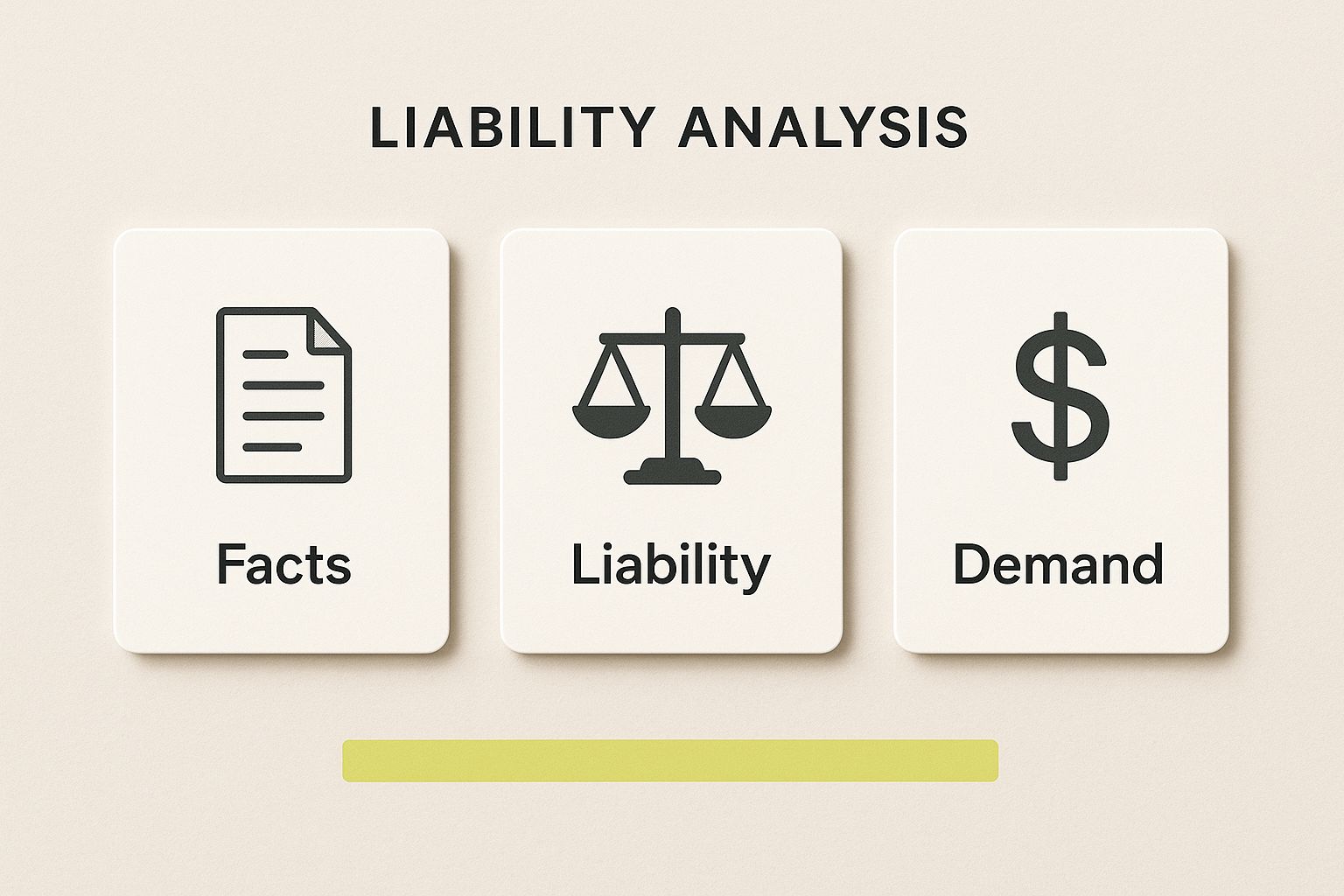
As you can see, a powerful demand is built methodically. You layer the facts of the case, establish clear liability, and then present a well-calculated financial ask.
Next, you have to tackle general damages, also known as non-economic damages. This is where things get more subjective, but it’s just as important. This category compensates your client for the human impact of the injury—the pain, suffering, emotional trauma, and loss of enjoyment of life.
Because there's no invoice for suffering, attorneys and insurance companies rely on a formula to assign a value. The most common approach is the multiplier method.
The multiplier method works by taking the total of your special (economic) damages and multiplying it by a number, usually between 1.5 and 5. The more severe, painful, and permanent the injury, the higher the multiplier. According to Nolo, a leading legal resource, this is the most common valuation method used in demand letters.
For instance, a minor whiplash injury that clears up in a few months might justify a multiplier of 1.5 or 2. But a more serious injury, like a herniated disc that requires surgery and results in chronic pain, could easily warrant a multiplier of 4 or 5.
To quickly tell the difference between these two categories and see what you can claim, this table breaks it down.
Damage Category
Specific Examples
How to Document
Economic (Special)
Medical bills (hospital, PT, prescriptions), lost wages, future medical costs, property damage, out-of-pocket expenses (e.g., mileage).
Receipts, invoices, pay stubs, employer letters, repair estimates, expert reports on future care costs.
Non-Economic (General)
Pain and suffering, emotional distress, loss of enjoyment of life, permanent disfigurement or disability, loss of consortium.
Medical records describing pain, psychiatric evaluations, personal journals, witness testimony, photos of injuries.
Think of the economic damages as the anchor for your claim, while the non-economic damages reflect the true, human toll of the accident.
Let's walk through a quick scenario. Imagine your client's total, documented special damages come out to $10,000. This covers all medical bills and lost wages.
The injuries were significant, causing daily pain that kept them from their usual activities for several months. After reviewing the case, you decide a reasonable multiplier for their pain and suffering is 2.5.
Here's how the math plays out:
This final $35,000 figure becomes your initial demand. It's a solid, defensible starting point for negotiations because it’s directly tied to documented financial losses and uses a standard industry method for valuing suffering.
Crafting a powerful demand letter is an art. It's about balancing firm negotiation with professional communication. Even a rock-solid case can get torpedoed by simple, avoidable mistakes.
Let's dive into some insider advice that can make or break your letter and flag the common traps that sink claims before they even get started.
First things first: your tone is everything. An insurance adjuster reads these letters all day, every day. Yours needs to command respect.
This is not the place for anger, threats, or overly emotional language. Your power comes from the cold, hard evidence, not the volume of your complaints. Think assertive, not aggressive.
Organization is just as critical. A messy, confusing letter signals that you're disorganized, which is the last impression you want to give. Package everything neatly—a cover letter, a clear narrative, and then tabbed exhibits like medical records, bills, and proof of lost wages. Make it easy for them to see you mean business.
The language you choose directly shapes how the insurance company sees your claim. Emotional appeals are easily dismissed. Objective, fact-based statements? Much harder to argue with.
Here’s what I mean.
See the difference? The second example is powerful because it’s precise, confident, and grounded in the language of liability. It shows you know what you're doing.
One of the most dangerous mistakes you can make is accidentally admitting even a tiny bit of fault. Adjusters are trained to pounce on any word or phrase that could reduce their company’s payout.
Be incredibly careful with your wording. Never apologize or speculate about what you could have done differently.
Comments like these can be twisted to suggest you weren't paying full attention. Stick only to the facts of the other party's negligence.
Key Takeaway: Treat your demand letter like the legal document it is. Every word matters. Focus on the defendant's actions and the resulting damages, leaving zero room for misinterpretation.
To really build an airtight case, it helps to think like the other side. Understanding the tactics of insurance claim investigators can give you a major edge by showing you what they look for to undermine a claim.
Beyond tone and accidental admissions, a few other mistakes can seriously devalue your claim. Steer clear of these, and your letter will be far more credible and persuasive.
For more tips on putting together a letter that gets results, check out our guide on demand letters made easy.
Let’s be honest, technology is changing just about every corner of legal practice, and the personal injury demand letter is no exception. AI-powered tools are here, and they offer a way to draft more comprehensive, data-driven letters that can seriously strengthen your negotiating position right out of the gate.
These platforms dig into your case details, automatically pulling crucial facts from medical records and police reports. They help you weave everything into a compelling story designed to get an adjuster's attention. The benefits are pretty clear: you save a ton of time, slash the risk of overlooking a critical detail, and use hard data to build a much stronger argument.
Think of a platform like ProPlaintiff.ai as a hyper-efficient paralegal. You feed it the raw case files—all those medical records, the police report, client intake forms. The AI then goes to work, extracting key information and organizing it into a coherent structure for your demand letter.
This kind of tech can instantly pinpoint dates of service, specific diagnoses, and treatment costs, saving you hours of tedious manual review. It then helps you weave these facts into a persuasive narrative that clearly establishes liability and documents the full scope of your client's damages.
Here’s a glimpse of what that looks like in action.
This screenshot shows how an AI tool can take a messy pile of case information and organize it into something you can actually use, making it far easier to build a solid claim. The goal is to turn that mountain of documents into a clear, actionable legal argument.
Crucially, these tools are powerful assistants, not replacements for your legal judgment. The final strategy and sign-off always rest with the attorney, ensuring professional oversight and accountability.
This shift reflects a bigger change in how personal injury cases are handled. With over 99% of cases settling before trial, the demand letter is the main event. AI-powered services can kickstart case progression by generating drafts in just a few days, getting you to the negotiation table faster.
Beyond just analyzing documents, some tools give you more dynamic ways to create content. For instance, you can integrate apps like speech-to-text with ChatGPT to dictate notes or flesh out sections of your demand letter on the fly. It's an incredibly efficient way to capture nuanced thoughts and turn them into polished text without getting bogged down in typing.
By automating the most time-consuming parts of the drafting process, you free yourself up to focus on what matters most: case strategy and client communication. Our detailed guide on how to use AI for effective demand letters dives deeper into these techniques. In the end, AI helps ensure your demand letter isn't just faster to produce, but more thorough and impactful, too.
You’ve sent your personal injury demand letter. That’s a huge step, but remember—this is the start of the negotiation, not the end. Once the letter lands in the insurance company's hands, the real back-and-forth begins.
Patience is your best friend right now. You’ve made your opening move, and now you have to wait for them to respond.

Generally, you can expect to hear back within a few weeks to a month. The adjuster needs time to review everything you sent, dig into the supporting documents, and figure out their insured's liability. Don’t start to worry if you don't get an immediate reply. A quiet period is totally normal.
Once the adjuster finishes their review, their response will usually fall into one of four buckets. Knowing what to expect will help you plan your next move.
Here’s what you might encounter:
No matter what they come back with, remember this is a process. Negotiation takes persistence and a clear head. An initial low offer or even a denial doesn't mean your claim is dead—it just means you’re moving into the next phase.
Knowing when to push back—and when it’s time to call in a professional—is critical. If the insurer denies your claim without a valid reason, starts using delay tactics, or just flat-out refuses to negotiate fairly, it may be time to consult with a personal injury attorney. They can level the playing field and force the insurance company to take you and your claim seriously.
Navigating the aftermath of an injury can feel like a maze. It’s completely normal to have questions about the process, especially when you're preparing something as important as a demand letter. Here are some quick, straightforward answers to the most common concerns we hear.
Timing is everything. You'll want to send your demand letter only after you’ve reached what’s called Maximum Medical Improvement (MMI). This is the point where your doctor says your condition is stable and can give a clear picture of any future medical needs or permanent limitations.
Sending it too early is one of the biggest mistakes you can make. If you jump the gun, you won't know the full cost and extent of your medical care, which means you could leave a lot of money on the table. Just be sure to keep an eye on your state’s statute of limitations—that’s the hard deadline for filing a lawsuit. For example, in California, you generally have two years from the date of the injury to file a lawsuit, while in Texas, the deadline is also two years. Missing this deadline can bar your claim forever.
For a tiny claim with cut-and-dry facts and minimal damages, you might be able to handle it yourself. But for just about every other situation, getting professional legal help is a smart move.
You should definitely think about hiring a lawyer if:
An experienced attorney knows exactly how to calculate the true value of a complex claim, particularly for things like pain and suffering. They’ve seen all the tricks adjusters use and can negotiate from a place of real strength.
A good attorney doesn't just send a letter; they level the playing field against massive insurance companies. They fight for what you actually deserve, making sure you aren't short-changed on future medical bills or lost earning potential.
By law, insurance companies have to respond to claims in a reasonable amount of time. If weeks are ticking by with no word, don’t just sit and wait.
First, send a follow-up letter via certified mail. This creates a paper trail and shows you’re serious. If they still give you the silent treatment, you might be looking at a "bad faith" insurance tactic.
At that point, it’s time to call a personal injury lawyer immediately. It's amazing how often the simple act of filing a lawsuit suddenly gets an immediate and formal response from an insurer who was happy to ignore you before.
Ready to build a stronger, more effective personal injury demand letter in a fraction of the time? The AI Paralegal from ProPlaintiff.ai can analyze your case files, construct precise medical chronologies, and help you draft a compelling letter that gets results. Stop drowning in paperwork and start focusing on strategy. Discover how ProPlaintiff.ai can transform your practice today.



.svg)