
.webp)
.webp)
.webp)
.webp)


A personal injury settlement is a formal agreement between you (the injured person) and the party responsible for your injuries, designed to resolve the dispute without ever stepping foot in a courtroom. It’s a final deal that provides financial compensation for things like your medical bills, lost income, and pain and suffering, officially closing the case for good.

It’s easy to get bogged down in legal jargon, but a personal injury settlement is less like a complex legal transaction and more like a negotiated peace treaty. It’s a structured agreement that brings a difficult chapter of your life to an end, letting you focus on recovery instead of a drawn-out court battle.
At its core, a settlement provides fair financial compensation after an accident caused by someone else's carelessness. It’s essentially a substitute for what a jury might award if the case went to trial. Both sides agree to a specific sum to avoid the uncertainty, time, and stress of litigation.
The primary objective of any settlement is to make the injured person "whole" again, at least financially. Of course, no amount of money can truly erase pain or undo trauma, but it can remove the massive financial burdens an unexpected injury creates.
A successful settlement should cover every angle of your harm, including:
The idea of settling injury claims isn't new; it has evolved over centuries to make the justice system more efficient. It’s a pragmatic solution that has been refined over time.
Historical trends, both in the U.S. and abroad, show a constant effort to balance fair compensation for victims with keeping the system from getting overloaded. For instance, data from the UK reveals how tort claim rates fluctuated throughout the 1990s and early 2000s, reflecting shifts in legal policies. Rules were even created to prevent someone from getting "double-paid" from both public benefits and a private settlement.
This long history shows just how vital settlements are for resolving disputes fairly and practically. If you want to dive deeper, this research paper from Cardiff University offers a detailed look at the evolution of these claims.
Figuring out what a personal injury claim is actually worth can feel like trying to solve a puzzle. But it’s not just guesswork. The process follows a clear path, focusing on two key types of harm: economic damages and non-economic damages.
Once you understand how attorneys and adjusters look at both, the potential value of your personal injury settlement starts to come into focus.

Economic damages are the easy part, at least on paper. These are the tangible, verifiable costs you've paid out of pocket because of the accident. Think of them as the black-and-white financial losses you can prove with receipts, bills, and pay stubs.
Non-economic damages are different. They cover the very real, but intangible, human cost of what happened. This is where we account for the pain, the emotional distress, and the ways your life has been turned upside down. It’s the law’s way of acknowledging that the real harm goes far beyond just the medical bills.
Calculating economic damages is all about meticulous record-keeping. You need to add up every single expense that can be directly traced back to your injury. In legal terms, these are often called "special damages" because they are specific and unique to your case.
Common examples of economic damages include:
A critical mistake is forgetting about future care. For a serious injury like a herniated disc that might need spinal fusion surgery, the costs don't stop at the hospital. You have to account for years of potential follow-up visits, pain management, and physical therapy. These future expenses must be expertly calculated and baked into the final settlement demand.
This is where things get more subjective. How do you assign a dollar value to chronic pain or the trauma of an accident? Non-economic damages, also known as "general damages," are meant to compensate for these very real, but hard-to-quantify, losses.
The most common method used by both sides is the multiplier method. Here's how it works: the total economic damages are multiplied by a number, usually between 1.5 and 5.
What determines that multiplier? Several key factors:
Before we dive into the specifics of how these two damage types are calculated, let's look at them side-by-side to make the distinction crystal clear.
Understanding both columns is essential for seeing the full picture of a potential settlement. One without the other tells only half the story.
While every case is unique, national data shows that personal injury settlements in the U.S. average around $40,500. But that number can be misleading, as it’s heavily skewed by the type of injury and where the case is filed.
https://www.youtube.com/embed/z3U0FRb9yr4
Once you’ve done the math and figured out what your claim is worth, it’s time to negotiate. This is where the rubber meets the road—the strategic back-and-forth where your case moves from a stack of paper to a real conversation with an insurance adjuster.
The entire game hinges on one thing: demonstrating the strength of your case and the fairness of your valuation. This isn't about yelling or making threats. It's about presenting a logical, evidence-backed argument that the insurance company simply can't ignore.
The first official shot across the bow is the demand letter. Don’t think of this as just a request for money. It's your opening argument, a comprehensive document that lays out your entire case in a clear and compelling narrative.
A powerful demand letter sets the tone for everything that follows. It's your first—and best—chance to frame the conversation and anchor the negotiation around a figure that truly reflects what you've lost.
So, what makes a demand letter effective? It needs to include:
For a closer look at how these elements come together in the real world, check out these sample personal injury demand letters.
After you send your demand letter, the insurance adjuster will come back with a counteroffer. Brace yourself, because it’s almost guaranteed to be a lowball number—far below what you demanded and what your case is actually worth. This is a standard tactic. They're testing you to see if you're desperate enough to take a quick, cheap payout.
Do not get discouraged by the initial offer. It is not a reflection of your claim's true value but rather the starting point of the negotiation. A low offer is an invitation to continue the dialogue, not end it.
The key is to respond strategically, not emotionally. Instead of just rejecting the offer, you or your lawyer should fire back with a written counteroffer. This response should systematically pick apart their low offer, pointing back to the evidence you’ve already laid out—the severity of your injuries, the months of medical treatment, and the real-world impact the accident has had on your life.
While you can negotiate a claim on your own, having an experienced personal injury attorney in your corner is a massive advantage. Insurance adjusters are trained professional negotiators whose entire job is to pay out as little as possible. They’ve handled hundreds of these claims and know every trick in the book to devalue your case.
An attorney completely levels the playing field. They know the tactics adjusters use and, more importantly, how to shut them down.
Here’s where a lawyer makes a critical difference:
Ultimately, the negotiation process is a marathon, not a sprint. It takes patience, solid preparation, and persistence to push the insurance company from their initial lowball offer to a final personal injury settlement that actually compensates you for everything you've been through.
To really get a feel for how a personal injury settlement works, you have to see the core ideas in action. While every case has its own unique story, most fall into a handful of common categories. Knowing these types can give you a much clearer picture of where your own situation fits.
The world of personal injury law is broad, but the numbers tell a clear story. According to data from the Bureau of Justice Statistics, motor vehicle accidents are the most frequent reason for tort claims. The National Center for Health Statistics also reports that unintentional falls are a leading cause of nonfatal injuries, often leading to premises liability cases. This data doesn't just show what's common; it shows how many different ways an injury can lead to a settlement. For a closer look at the stats on claim types and payouts, you can review this comprehensive breakdown of personal injury law statistics.
What these numbers really tell us is that no matter how an injury happens, the goal is always the same: to prove someone else was responsible for what you went through.
Since they're the most frequent type of claim, accidents involving cars, trucks, and motorcycles are a perfect example of how liability gets established. The whole process usually kicks off with the official police report, which gives an initial, objective take on who was probably at fault.
Practical Example: Picture this: a driver is sitting at a red light and gets rear-ended. The other driver swears their brakes went out, but the police report points out clear skid marks on the pavement and finds no mechanical problems with the car. That evidence makes it pretty obvious the driver was either distracted or following too closely. At that point, the negotiation isn't about if the other driver is liable, but about how much they owe for the victim's whiplash and herniated disc.
You probably know these as "slip and fall" cases. A premises liability claim is built on the idea of duty of care—a legal responsibility for property owners to keep their space reasonably safe for visitors. To get a settlement, you have to prove the owner knew (or really should have known) about a dangerous condition and did nothing to fix it.
Practical Example: A shopper slips on a puddle in a grocery store aisle where there's no "Wet Floor" sign. The store’s security camera shows an employee mopped that spot 20 minutes earlier but never bothered to put up a warning. That video is gold. It proves the store's own employee created the hazard and failed in their duty to warn customers. The settlement would then cover the shopper's broken wrist and all the medical bills that came with it.
The strength of a premises liability case often comes down to timing and notice. How long was the hazard there? If someone dropped a banana peel seconds before you walked by, the store might not be liable. But if it sat there for an hour, the store almost certainly breached its duty of care.
While they don't happen as often as car wrecks or slip-and-falls, other types of claims have their own unique legal hurdles and require different kinds of proof.
Each of these categories demands a specific strategy for gathering evidence and proving fault, but they all share the same fundamental goal: holding the responsible party accountable.
Getting a "yes" on a settlement number feels like the end of a long road, but it's not quite the finish line. Before any money actually hits your bank account, there are a few crucial administrative steps to turn that verbal agreement into a legally binding reality. This is where the details matter—every single one of them.
The most important part of this final stage is the settlement and release agreement. This is the formal, legally-dense document you'll need to sign to close out your personal injury claim for good. It's packed with legal jargon, and you absolutely need to understand what you're signing.
Think of the release agreement as the final word on your case. Once you sign it, you are officially giving up your right to ever pursue more legal action against the at-fault party for this specific incident. It's a total and complete release of all claims—past, present, and even future—connected to your accident.
The document will spell it out clearly: in exchange for the settlement money, you release the defendant and their insurance company from all liability. This is precisely why it's critical to be certain the settlement amount covers not just your bills today, but any potential medical care you might need down the road. Once that paper is signed, there are no second chances.
The entire journey, from the incident to the final check, follows a fairly predictable path.
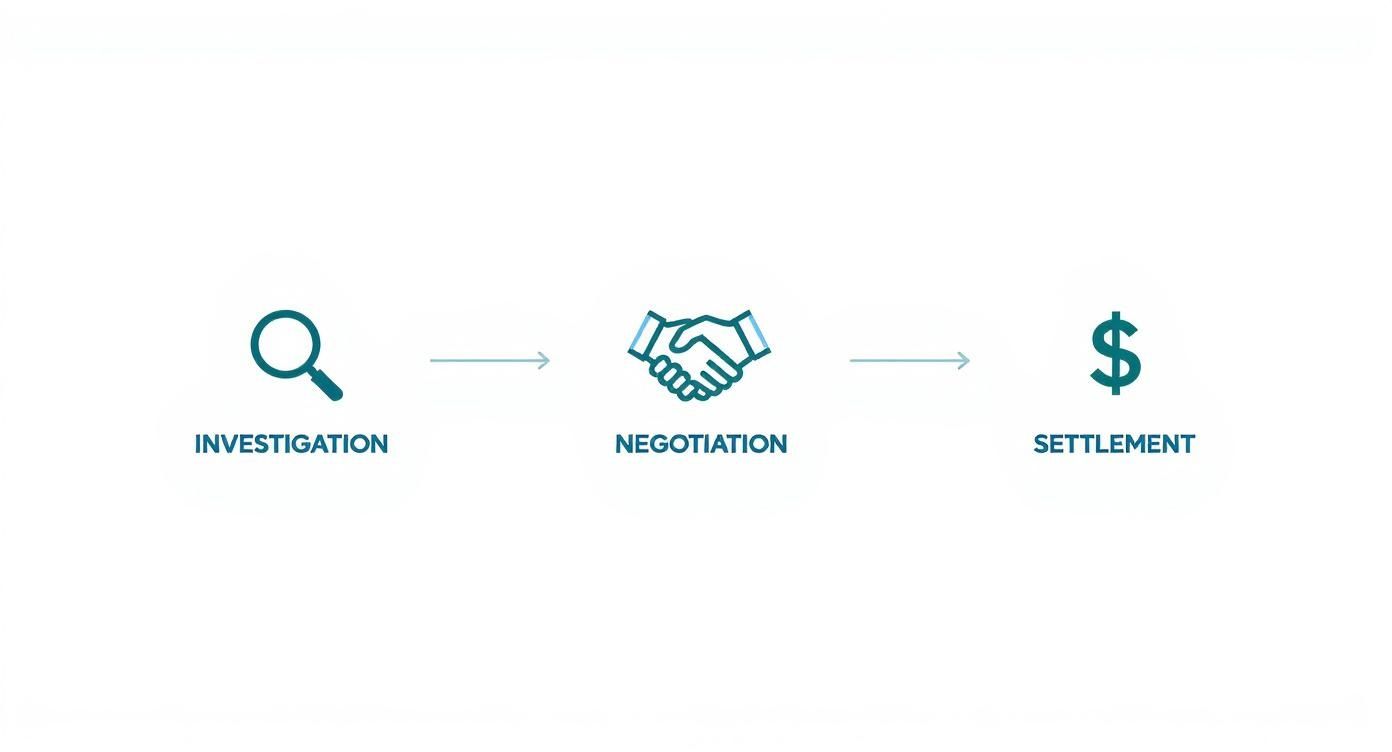
This process moves from building the case through investigation to the back-and-forth of negotiation, ultimately ending with the settlement agreement.
After you sign the release and the insurance company cuts the check, the money doesn't just appear in your account. First, the funds are sent to your attorney’s trust account, where a few required payments have to be made before you get your share. This whole process is called disbursement.
The most common deductions you'll see are:
Your attorney will almost always negotiate with your medical lien holders to try and reduce the amount you have to pay them back. A successful reduction can make a huge difference in the net amount of money you walk away with, making it a vital part of the final process.
Once these obligations are paid off, the rest is your net settlement. Your attorney will give you a detailed settlement statement that breaks down every single deduction, so you can see exactly where the money went.
One of the first questions clients ask is, "Do I have to pay taxes on this money?" For the most part, the answer is no, but there are a few key exceptions to be aware of.
According to the IRS, under Section 104(a)(2) of the Internal Revenue Code, any compensation you receive for physical injuries or physical sickness is not considered taxable income. This umbrella covers the money you get for medical bills, pain and suffering, and emotional distress that stems directly from the physical injury.
However, there are a few parts of a settlement that can be taxed:
Getting a handle on these final steps means there are no last-minute surprises. It makes the settlement number a concrete reality, finally letting you close this chapter and focus on what’s next.
Let's be honest: personal injury cases are built on a mountain of paperwork. For decades, legal teams had to manually sift through thousands of disorganized medical files, a process that could take hundreds of hours. Drafting every document from scratch was just part of the job.
But that’s changing. Today, smart tools give attorneys a serious edge in securing a fair personal injury settlement. This technology handles the most time-consuming tasks with speed and accuracy, freeing up legal professionals to focus on what really matters: building a winning strategy and fighting for their clients.
The biggest shift comes from automating the tedious, yet critical, parts of case preparation. For any personal injury claim, that means making sense of a client's entire medical journey after an accident.
This is exactly where AI-powered platforms like ProPlaintiff.ai shine. They can tear through thousands of pages of medical records in minutes, not days or weeks.
The platform’s dashboard acts as a central command center, helping law firms organize even the most complex case files quickly and accurately.
This visual shows how a central system can keep everything from medical records to demand letters in one organized, accessible space.
This isn't just about saving time—it's about building a much more powerful case. When an attorney can instantly create a detailed medical timeline, it becomes incredibly simple to draw a straight line from the accident to the injuries.
By presenting a clear, fact-based narrative supported by perfectly organized medical evidence, an attorney can make it much harder for an insurance adjuster to dispute the severity of the claim or delay the settlement process.
This level of detail and organization strengthens your negotiating position right from the start. When a demand letter lands on an adjuster's desk backed by a flawless chronology and comprehensive summaries, it sends a powerful message: this claim is well-documented, and this legal team is prepared to win.
To see exactly how this works, you can learn more about how AI medical chronologies benefit personal injury attorneys and drive better case outcomes. In the end, these tools help create better-prepared cases, which leads to stronger negotiations and, ultimately, faster and fairer resolutions for clients.
As you get closer to resolving your claim, it's completely normal to have a ton of practical questions pop up. Let's walk through some of the most common ones that come up during the settlement process and get you some direct, easy-to-understand answers.
This is the big one, isn't it? For most people, the thought of a courtroom battle is stressful. But here's the good news: the answer is almost always no.
The vast majority of personal injury claims are settled through negotiation long before they ever see a judge. In fact, data from the U.S. Department of Justice shows that only a small fraction—around 3%—of tort cases are resolved by a trial verdict.
The whole point of the settlement process is to find a fair middle ground and avoid the time, expense, and sheer uncertainty of a trial. Both sides—you and the insurance company—have a powerful incentive to agree on a number and move on.
A case usually only goes to trial when both sides are miles apart on what the claim is worth, or if there’s a major disagreement over who was at fault. Even then, many cases end up settling on the courthouse steps right before the trial is set to begin.
If only there were a simple answer. The truth is, the timeline for a settlement can swing wildly depending on the specifics of your case.
A straightforward car accident with clear fault and minor injuries might wrap up in just a few months. On the other hand, a complex case involving severe injuries, multiple parties, or a dispute over the facts could easily take a year or more to finalize.
A few key things really drive the timeline:
First things first: never, ever accept the first offer. It’s a standard move for insurance adjusters to open with a lowball number just to see how you’ll react.
If an offer lands in your lap and it just feels wrong, you have every right to say no and come back with a counteroffer. This back-and-forth is a totally normal part of the negotiation dance.
Your response should be a firm but professional letter that walks them through the evidence one more time—the seriousness of your injuries, the pile of medical bills, and the real-world impact this has had on your life.
Here’s a real-world example: A motorcyclist in Suffolk County, NY, sustained significant injuries, including multiple fractures, requiring surgery. The insurer’s final offer was far below what the case was worth. The case went to trial, and a jury awarded a $1,000,000 pain and suffering verdict, which was later affirmed by an appeals court. This case, highlighted in the New York Injury Cases Blog, is a powerful reminder of why you should never settle for less than what your case is truly worth.
Building a case that’s packed with solid evidence is the only way to get a fair settlement. Tools like ProPlaintiff.ai can give your legal team a serious edge by creating perfect medical chronologies, summarizing dense records, and drafting data-driven demand letters in minutes. When you're in the strongest possible negotiating position, you get better results. See how it works at ProPlaintiff.ai.




.svg)