.webp)
.webp)
.webp)
.webp)


An auto accident settlement is a formal agreement to resolve your claim without ever stepping foot in a courtroom. It’s the final resolution between you and the at-fault driver's insurance company, designed to compensate you for everything you've lost because of the crash. Think of it as a faster, more certain path to getting the money you need to recover.
It helps to think of a settlement less as a legal term and more as a final, detailed invoice for your entire ordeal. It's the comprehensive bill you send the other party's insurer, accounting for every single cost and disruption the accident forced on your life. This isn't just about the obvious damage—it covers the full spectrum of your recovery.
The moment the crash happens, the meter starts running. Your "invoice" will include all the tangible, easy-to-add-up costs like ambulance rides, hospital bills, prescriptions, and the mechanic's bill for your car. But it also has to account for things that are harder to see, like future physical therapy or ongoing treatments you'll need down the road.
Practical Example: A driver who suffers a whiplash injury might have an initial ER bill of $2,500. Their invoice must also account for the subsequent 12 weeks of physical therapy at $150 per session ($1,800), prescription muscle relaxers ($100), and any projected costs for future chiropractic care recommended by their doctor.
The vast majority of personal injury cases never see the inside of a courtroom. According to data from the U.S. Department of Justice, approximately 95% of pending personal injury lawsuits end in a pre-trial settlement. There are very good reasons why both sides usually prefer to settle.
A settlement provides certainty. Both you and the insurance company gain control over the outcome, avoiding the unpredictable nature of a jury trial where results can vary dramatically.
For you, the injured person, settling has some major upsides:
A settlement isn't just a random number. The final amount can vary wildly. While some statistics show the average car accident settlement is around $212,325, the median is a more realistic $25,000. That huge gap shows how a few catastrophic injury cases can pull the average way up. These figures reflect the wide range of damages you can claim. You can find more insights on settlement statistics at ConsumerShield.com.
A fair settlement is built to make you "whole" again by covering two main types of damages.
The table below breaks down these core components that determine your settlement's value.
Understanding these two categories is the first step in building a strong claim. It’s how you make sure your final "invoice" truly reflects the full cost of the accident.
Figuring out what your auto accident settlement is really worth is a lot more than just adding up medical bills and repair receipts. A fair valuation is a complete picture of every single loss you've suffered—both the ones with a clear price tag and the ones that are much harder to put a number on. Getting this calculation right is the single most important step in making sure you don't leave money on the table.
The whole process starts by splitting your losses into two buckets: economic damages and non-economic damages. Think of them as two sides of a ledger. Together, they tell the full story of how the crash has impacted your life.
Economic damages are the foundation of your claim. They're the concrete, out-of-pocket financial losses you can prove with a paper trail of invoices, pay stubs, and receipts. Your job here is to build a master list of every single expense connected to the accident.
This "master list" absolutely must include:
Now we get to non-economic damages, which are often the biggest piece of a car accident settlement. These damages are meant to compensate you for the human cost of the accident—the pain, the stress, the sleepless nights, and the loss of enjoyment in life. Since you can’t get a receipt for suffering, attorneys and insurance companies have methods to assign it a dollar value.
One of the go-to approaches is the multiplier method. Here's how it works: you take your total economic damages (usually just the medical bills) and multiply them by a number, typically between 1.5 and 5. That multiplier is a reflection of how severe your injuries are and how much they've upended your life.
Practical Example: The Multiplier Method in Action
Let's say your medical bills add up to $15,000. If your injuries were moderately severe—they caused a lot of pain and needed months of physical therapy—your attorney might argue for a multiplier of 3.
$15,000 (Medical Costs) x 3 (Multiplier) = $45,000 (Pain and Suffering)
In this scenario, your total settlement target would be $60,000 ($15,000 in economic damages + $45,000 in non-economic damages).
The multiplier isn't a hard-and-fast rule; it’s more of a starting point for negotiation. A higher multiplier might be justified for things like permanent scarring, a long-term disability, or serious psychological trauma. You can get a quick ballpark estimate of your claim's potential value by using an AI-powered settlement calculator.
It also helps to know how different types of accidents can influence settlement values. The data shows a pretty clear trend: car accidents often lead to higher average payouts than other incidents because of the kinds of injuries involved. For instance, the average car accident settlement can hit $212,325, while truck accidents average around $103,654. A huge reason for this is that the pain and suffering component often makes up 60-70% of the final award in serious cases. You can dig into more personal injury law statistics on runsensible.com to see these trends for yourself.
By carefully calculating both your economic and non-economic damages, you stop guessing and start building a valuation backed by real data. This puts you in a powerful position to write a strong demand letter and confidently know what a fair offer from the insurance company actually looks like.
The road from a car crash to a settlement check follows a surprisingly predictable path. While it can feel overwhelming, understanding the key milestones gives you a clear roadmap and helps you know what's coming next. Think of it as a series of connected stages, each one building on the last to construct your case.
It all starts the moment the accident happens. From there, a few critical actions kick everything into motion, beginning with getting medical help and filing an official report. These first steps are the foundation of your entire claim—they create the initial proof you'll need to move forward.
This timeline breaks down the main phases you can expect, from the crash itself to getting your demand package ready.
As you can see, it's a progression. Each step has to be handled properly before you can effectively move on to the next one.
Right after a crash, your first priority is always your health and safety. That said, the moves you make in the first 24 hours are absolutely crucial for your future claim. Documenting everything lays the groundwork for proving who was at fault and what your damages really are.
This first phase comes down to three non-negotiable actions:
Once the immediate chaos is over, the focus shifts to building the core of your case while you recover. Honestly, this is the longest and most patient-testing part of the whole process. During this time, you'll open a claim with the at-fault driver's insurance company, and they'll assign an adjuster to your case.
This is also when you'll be working toward Maximum Medical Improvement (MMI).
MMI is a clinical term for the point where your medical condition has stabilized and you aren't expected to get any better. Hitting MMI is a critical milestone because you can't possibly know the full value of your claim until you know the full extent of your medical bills and what your long-term prognosis looks like.
Settling your case before you reach MMI is a huge risk. If you do, you could be left paying for future treatments completely out of pocket. Patience here is essential to making sure your final settlement actually covers all of your needs.
After you’ve reached MMI and collected all the necessary paperwork—medical records, bills, proof of lost wages, and the police report—it’s time to move into the negotiation stage. This officially kicks off when you or your attorney sends a demand letter to the insurance adjuster.
The demand letter is a formal document that lays out:
The timeline for an auto accident settlement can vary wildly, often taking anywhere from 12 to 36 months. A simple fender-bender with clear fault might wrap up in under a year, but a crash involving serious injuries or a dispute over liability can easily stretch beyond two years. You can learn more about how different factors impact settlement timelines on richman-law.com.
Once your demand is sent, the insurance company will review it and come back with an initial offer. That's when the real back-and-forth of negotiation begins.
Your demand letter is arguably the most important document you'll create in the entire auto accident settlement process. Think of it as your opening argument—a detailed, evidence-backed narrative that makes a clear and compelling case for why the insurance company should pay what you're asking.
A well-written letter commands respect and tells the adjuster you're serious right from the start. This isn't just a simple note asking for money; it's a formal presentation that methodically lays out the facts of the accident, proves the other driver’s fault, details your injuries, and justifies every single dollar you're demanding.
Getting this right is crucial.
A strong demand letter is built on four core pillars. Each one supports the next, creating a logical and persuasive story that leaves very little room for an adjuster to poke holes in. If you miss any of these, you're weakening your own position and inviting a lowball offer.
Here are the non-negotiable components:
This structured approach shows the adjuster you're organized, prepared, and have built your case on a solid foundation of proof. You can find a deeper dive into this topic and more examples in this comprehensive resource on writing a personal injury demand letter.
A well-organized demand letter presents an airtight case. To make sure you've covered all your bases, here's a quick checklist of the critical components to include in your settlement package.
Following this structure ensures your demand is not just a number, but a well-supported claim that the adjuster must take seriously.
Beyond just the facts and figures, a great demand letter tells the human story of how this accident has turned your life upside down. This is your chance to explain, in your own words, the very real pain, suffering, and disruption the crash has caused.
Use clear, direct language to paint a picture of your experience. For instance, instead of simply stating, "I suffered a back injury," try something more personal and descriptive:
"The herniated disc in my lower back has made it impossible to lift my toddler without excruciating pain. I can no longer enjoy simple activities like gardening or taking long walks, which were a significant part of my life before the accident."
It’s this kind of specific, personal detail that helps an adjuster grasp the true, non-economic cost of your injuries. That understanding is absolutely critical to securing a fair settlement.
Putting together a powerful demand letter means getting incredibly organized, especially when it comes to medical records. Sifting through hundreds—or even thousands—of pages of doctor’s notes, bills, and reports to piece together a clear timeline is a huge undertaking. It can take weeks.
This is where modern AI tools can be a game-changer. Platforms like ProPlaintiff.ai are built to analyze massive stacks of medical data in minutes. They can automatically generate a precise medical chronology, pulling out key treatments and diagnoses so you don't have to search for them manually.
By using technology to handle the heavy lifting, you can ensure your demand letter is built on a rock-solid, error-free foundation of medical evidence. This doesn't just save you a ton of time; it also strengthens your negotiating position by presenting an impeccably organized and documented claim from day one.
Let's be clear: the first settlement offer you get from an insurance company is almost never their best one. Think of it as the opening move in a chess match. It’s a calculated, often insultingly low number designed to see if you’ll fold quickly.
Insurance adjusters are good at their jobs, and their job is to protect their company's money by paying out as little as possible. Your job is to be patient, organized, and ready to push back with a counteroffer built on solid facts. This is where you level the playing field and fight for a fair auto accident settlement.
When that lowball offer lands in your inbox, don't get angry—get strategic. The first thing you should do is ask the adjuster for a detailed breakdown of how they came up with that figure. Make them show their math. This simple request forces them to justify their valuation and often shines a light on the weak spots in their assessment.
Once you have their breakdown, pull out your demand letter and compare their numbers to yours.
Your counteroffer needs to address these weaknesses head-on. Don't just pull a higher number out of thin air. For every point they disputed, hit back with the evidence that proves your claim. This shifts the conversation from a shouting match over dollars to a grounded discussion based on facts.
Insurance adjusters have a playbook of common tactics they use to wear you down and chip away at your claim's value. Knowing what’s coming is half the battle. As you get into the back-and-forth, knowing how to review and revise their proposals is a huge advantage. If you want to get good at this, check out this great guide on How to Redline a Contract Like a Pro.
Here are a few of the adjuster’s greatest hits and how you can shut them down:
Expert Insight: Never, ever give a recorded statement to the at-fault party's insurance adjuster without talking to a lawyer first. They are trained to ask tricky, leading questions to get you to say something—anything—they can use against you later to devalue your claim.
By seeing these tactics coming, you can have your rebuttals ready to go, backed by medical records, expert opinions, and cold, hard facts. This keeps you in the driver's seat of the negotiation, steering it toward a settlement that actually covers what you’ve lost. Remember, in this game, patience and persistence are your superpowers.
In the fight for a fair auto accident settlement, technology is no longer just a nice-to-have—it’s a powerful ally. When you're up against a well-funded insurance company, you need more than just a good story; you need an organized, evidence-backed case. Modern tools, especially those powered by AI, are changing the game, giving you the ability to build a stronger claim far more efficiently.
Think about what it takes to create a perfect timeline of medical treatment. Manually sorting through hundreds, even thousands, of pages of records could take a paralegal weeks of painstaking work. Today, an AI paralegal can tear through those same documents in minutes, spitting out an accurate, detailed summary that strengthens your claim from day one.
The real magic of these tools is their ability to digest massive amounts of information with incredible speed and precision. They can instantly summarize deposition transcripts to pull out key admissions, or scan police reports for that one critical detail you might have missed.
This isn't about replacing legal professionals. It's about freeing them up to focus on what matters most: strategy.
For instance, a platform can generate a detailed medical chronology that clearly connects your client's injuries to the accident—an absolutely essential piece of evidence for your demand letter. When you present a perfectly organized case, you send a clear signal to the insurance adjuster: you are serious, prepared, and ready to prove every last dollar of your client's damages.
You can learn more about how this works in our detailed guide on harnessing AI for medical chronologies in personal injury cases.
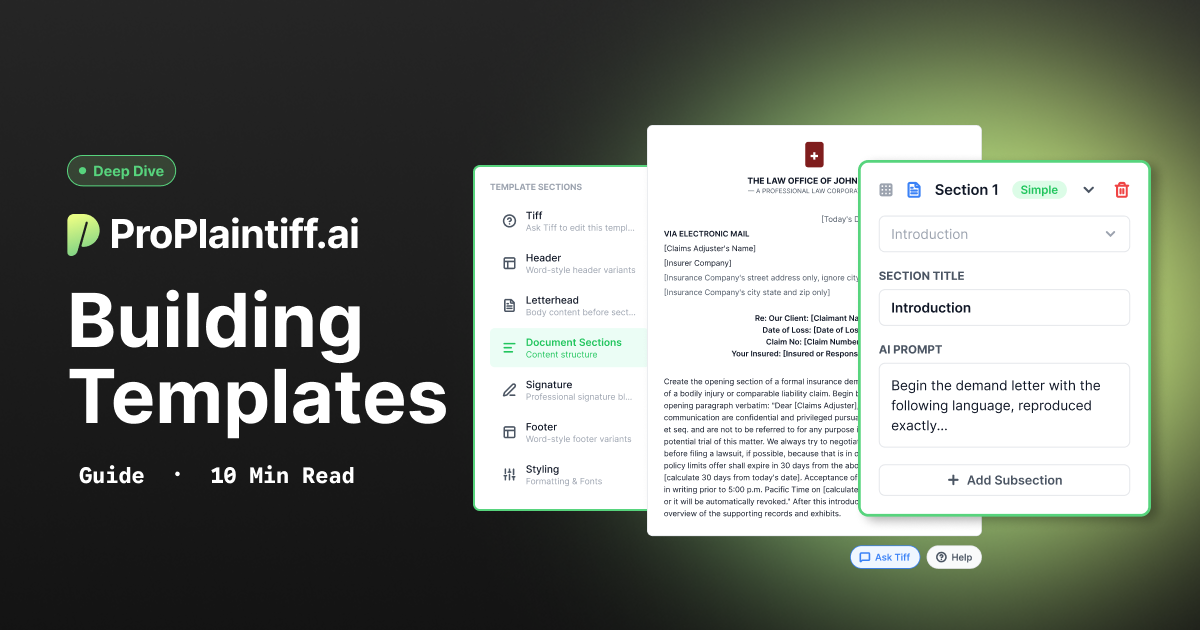
Here’s a look at how a platform like this is designed to handle these complex tasks.
This interface shows just how simple it is to get started. You upload case files like medical records and police reports, and the AI gets to work. This marks a huge shift from slow, manual document review to a fast, automated system that organizes everything you need to build a winning case.
By using these advanced tools, you can organize your evidence more effectively and build arguments that are far more persuasive. All this is done while maintaining strict HIPAA compliance, so you never have to worry about the security of sensitive medical information.
Consider using tools like AI-powered transcription services to quickly document phone calls with adjusters or witness statements. Having an accurate, searchable transcript makes everything easier to review and reference.
Ultimately, technology levels the playing field. It gives individual attorneys the same kind of high-level data analysis that giant insurance corporations have been using for years, leading to better-supported claims and much stronger settlement outcomes.
When your case is built on a foundation of impeccably organized evidence, your negotiating position improves dramatically. It’s a straightforward path to securing the full and fair compensation your client deserves.
When you're dealing with the aftermath of a car accident, a lot of questions come up. Let's walk through some of the most common concerns people have during the settlement process.
For the most part, no. The IRS is pretty clear that the portion of your settlement for physical injuries, the medical bills that come with them, and damage to your car is not considered taxable income. This usually makes up the largest part of any settlement check.
There are a few exceptions, though. If you receive compensation for lost wages or for emotional distress that isn't directly tied to a physical injury, that part is typically taxable. Punitive damages, which are meant to punish the defendant and are pretty rare, are also taxable. It's always a good idea to chat with a tax professional to see how this applies to your specific situation.
If you and the insurance company are at a standstill and can't land on a fair number, the next step is usually filing a lawsuit. This sounds more dramatic than it often is. Filing a suit doesn't mean you're headed straight for a courtroom showdown—in fact, very few cases ever make it to a full trial.
Filing a lawsuit often gets the insurance company’s attention and motivates them to come back to the table with a more realistic offer. A huge number of cases end up settling during mediation or through more negotiations long before a trial date is even on the calendar.
Every state has a non-negotiable deadline for filing a personal injury lawsuit, known as the statute of limitations. Depending on where you live, this window is typically anywhere from one to three years from the date of the accident.
Practical Example: In California, the statute of limitations for a personal injury claim from a car accident is two years from the date of the crash. In contrast, Texas provides the same two-year window, but Florida allows up to four years. This is a hard and fast rule. If you miss that deadline, you lose your right to sue for compensation forever. That's why it's so important to know the specific deadline in your state and get the ball rolling well before it's too late.
Ready to build a stronger, more organized case? ProPlaintiff.ai uses an advanced AI Paralegal to create precise medical chronologies, summarize case files, and generate compelling demand letters in minutes, not weeks. Discover how ProPlaintiff.ai can transform your personal injury practice today.



.svg)