
.webp)
.webp)
.webp)
.webp)


A bodily injury demand letter is the formal document you send to the at-fault party's insurance company. It lays out your client's injuries and damages, officially kicking off settlement negotiations. This letter is arguably the single most important document in the pre-litigation phase, as it frames the entire case and sets the tone for a successful resolution.

Many law firms treat the bodily injury demand letter as just another administrative task—a summary of facts and figures to be checked off a list. But that perspective misses its true power entirely. In a world where the vast majority of cases never see the inside of a courtroom, this document isn't just a formality; it's your primary battleground.
A masterfully crafted demand letter does so much more than state the facts. It serves several critical functions that can dramatically influence the outcome of your client's case.
When you get the demand letter right, you control the narrative from the very beginning. It's your first—and often best—chance to tell your client's story in a compelling way, humanizing their experience beyond medical jargon and billing codes.
A well-organized, detailed, and evidence-backed letter also signals something important to the insurance adjuster: your firm is professional, thorough, and absolutely prepared to litigate if necessary. That immediately establishes credibility and changes the dynamic of the negotiation.
Finally, the initial demand amount and its justification create a powerful psychological anchor. It sets the starting point for all talks and shapes the adjuster's perception of the case's value right out of the gate. For example, a well-supported demand of $150,000 immediately frames the case's value far differently than a vague request for "policy limits," forcing the adjuster to negotiate down from a strong, evidence-based position.
The sheer volume of personal injury claims in the U.S. highlights just how critical an effective demand process is. While between 300,000 and 500,000 personal injury cases are filed each year, only about 5% ever go to trial.
That means roughly 95% of cases are resolved through settlements, and those settlements are driven almost entirely by the strength of the demand package. For a mid-size firm managing hundreds of active files, the clarity and persuasiveness of its demand letters directly impact millions of dollars in potential recoveries. If you want a deeper dive, you can explore more personal injury law statistics on Clio's blog to better understand the market.
Before we move on, let's break down the essential components that make a demand letter truly effective. This table gives you a quick-glance reference to the key elements every winning letter should contain.
Each of these pieces works together to build a persuasive and undeniable case for your client, making it difficult for the adjuster to justify a lowball offer.
A demand letter is your opening argument, delivered directly to the decision-maker, without the constraints of a courtroom. Getting it right is non-negotiable for maximizing your client's recovery.
The problem is, manual drafting often leads to costly inconsistencies. Different paralegals might miss certain damages, use inconsistent language, or fail to present evidence persuasively. This is where a modern, structured approach is essential.
By using data-informed strategies and platforms like ProPlaintiff.ai, firms can transform this document from a simple summary into a high-impact instrument that consistently secures higher settlement values. It’s about creating a repeatable, powerful system for your most critical settlement tool.
The facts section of your demand letter is where the case is often won or lost. This is your chance to do more than just list what happened; it’s where you build a powerful narrative that pins down undeniable fault. Your goal is to paint such a vivid picture of the defendant’s negligence that the claims adjuster has no choice but to see things your client’s way.
This isn’t about just reciting a timeline. It’s strategic storytelling. You need to weave the police report, witness statements, photos, and your client's own account into a single, cohesive story. A well-told narrative makes it incredibly difficult for an insurer to downplay their insured's responsibility.
Start by setting the scene with a clear, chronological account. Describe the moments just before the incident, but focus on your client's reasonable, careful actions. This contrast is the key—you're not just telling a story, you're building a legal argument piece by piece.
For example, don't just say, "The defendant ran a red light." That’s flat. Instead, build the scene:
"Ms. Davis was on her usual route home from work, heading east on Maple Avenue. She was driving safely, well below the posted 35 MPH limit. As she neared the Oak Street intersection, she saw her traffic light was solid green. After checking for cross-traffic like any careful driver would, she proceeded into the intersection."
This level of detail shows your client was acting responsibly. It creates a baseline of prudent behavior that will make the defendant's negligence stand out in stark contrast when you introduce it.
Your story gets its real power when you embed evidence directly into the narrative. Every claim you make about the defendant’s fault should be immediately backed up by a specific piece of proof.
By layering evidence right into the story, you build an airtight argument. The adjuster isn't just reading your version of events; they're following a logical trail of facts backed by undeniable proof. It makes disputing liability a much harder job. This approach is fundamental to a successful bodily injury demand letter.
You know the playbook. Insurance companies will almost always try to shift some blame onto your client. Your liability narrative is the perfect place to get ahead of those arguments and shut them down before they're even made.
If you suspect the adjuster will claim your client was speeding, tackle it head-on. "Data from the vehicle's event data recorder confirms Ms. Davis was traveling at 32 MPH in a 35 MPH zone, which directly refutes any claim of excessive speed on her part."
This proactive move shows the adjuster you've thought through all the angles. You're prepared to counter any attempt to reduce the settlement. By closing these doors early, you put yourself in a much stronger negotiating position.
Ultimately, your narrative isn’t just about what happened—it's about demonstrating why it happened. It’s the story of a careful person who was injured by someone who wasn't paying attention. And today, tools can help you build that story faster. A platform like ProPlaintiff.ai can scan hundreds of pages of documents, automatically pulling the most critical facts from police reports and depositions. This ensures your liability narrative is built on a rock-solid foundation from the very first sentence.
Throwing a number into your demand letter without backing it up is just wishful thinking. If you want a claims adjuster to take your figure seriously, you have to show them the math. That means breaking down every single loss your client suffered into two key categories: special damages and general damages.
Special damages, also known as economic damages, are the easy part. These are the tangible, out-of-pocket financial losses with a clear paper trail. Think of them as the black-and-white numbers of the case.
General damages, or non-economic damages, are far more subjective. This is your chance to put a number on your client's intangible suffering—the pain, the emotional distress, the loss of enjoyment of life. This is where skilled advocacy really shines.
When you're calculating special damages, you can't afford to miss anything. A complete list not only gets your client the maximum possible recovery but also sends a clear signal to the adjuster that your firm is meticulous and prepared.
Here's a quick checklist of the economic damages you absolutely must account for:
This level of detailed documentation is non-negotiable. Research published by the Insurance Research Council shows that represented claimants receive, on average, settlements that are 3.5 times higher than those received by unrepresented claimants, a difference largely attributed to thorough documentation and negotiation.
The decision tree below maps out the essential workflow for building the kind of claim narrative that justifies a higher number.
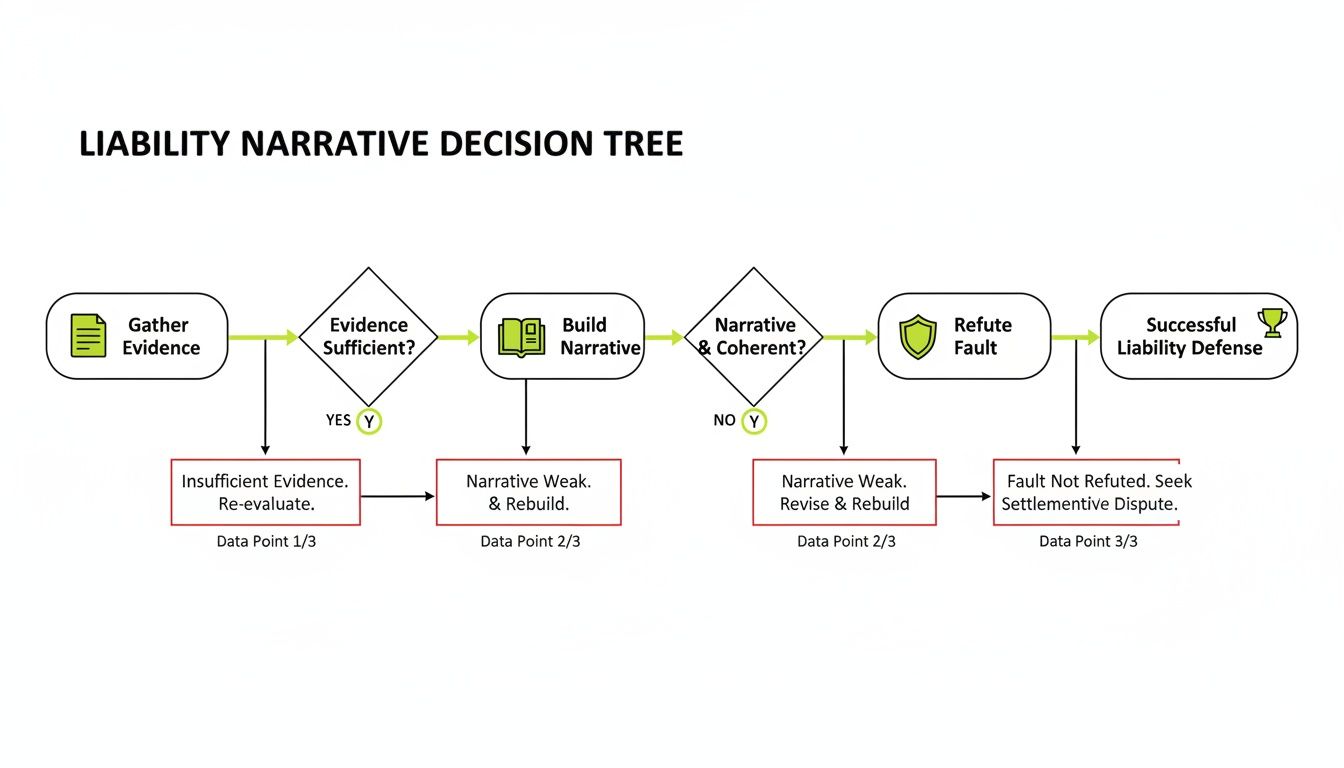
As you can see, a powerful justification starts with solid evidence, gets shaped by a compelling story, and is strengthened by anticipating—and shutting down—potential defenses before the adjuster can even raise them.
Calculating general damages is definitely more art than science, but there are established methods that adjusters know and respect. The two most common approaches are the multiplier method and the per diem method.
The multiplier method is the go-to for most firms. You simply take the total special damages and multiply it by a number, usually between 1.5 and 5. The right multiplier depends on the severity of the injuries, how long the recovery took, whether there's a permanent impairment, and the overall impact on the client's life. A minor sprain might only justify a 1.5 multiplier, but a catastrophic injury causing permanent disability could easily warrant a 5.
The per diem method takes a different tack. You assign a daily dollar amount for the client's suffering and then multiply that by the number of days they were in pain. A common way to set the daily rate is to tie it to what the client earned per day, arguing that enduring constant pain is at least as demanding as going to work.
Choosing the right method is a strategic call. The multiplier method works best in cases with high medical bills. The per diem approach can be more effective for painful injuries that had a long, grueling recovery but didn't necessarily rack up massive medical expenses.
No matter which method you use, the justification is what sells it. You have to connect the injury to your client's real-life struggles.
Don't just say your client has a herniated disc.
Describe how that herniated disc means they can no longer pick up their toddler, coach their daughter's soccer team, or even sit through a movie without wincing in pain. This emotional context gives your number weight and turns a dry calculation into a powerful story of human loss. For more on this, check out our guide on how to maximize your personal injury settlement value.

Your story of liability and your damages math are the heart of the demand, but the evidence you attach is the backbone. Without solid proof, your arguments are just words on a page. The goal isn’t just to dump a folder of records on an adjuster’s desk; it’s to build a case file so organized and compelling that it leaves no room for argument.
Imagine the adjuster on the other side. They’re juggling dozens of claims and looking for the clearest, easiest path to justify a payout. A well-built evidence package makes their job simple. When every claim is backed up by a tabbed and labeled document, you remove all the friction and make it easy for them to say "yes."
A truly persuasive package tells the complete story of liability and loss. It’s more than just a stack of medical bills; it's a 360-degree view of your client’s entire ordeal, documented from every angle.
Here’s what every solid evidence package needs:
When you provide this level of detail, your bodily injury demand letter stops being a request and starts becoming an undeniable statement of fact.
While gathering all relevant documents is crucial, prioritizing them can make your demand package even more effective. Some documents are non-negotiable for any case, while others add strategic weight, especially in higher-value or more complex claims.
This table helps illustrate how to scale your evidence-gathering efforts. For straightforward cases, the "Essential" column is your checklist. For claims involving permanent injuries or significant future damages, the "Strategic" documents provide the leverage needed for a top-dollar settlement.
If there’s one document that can make or break your demand, it’s the medical chronology. Think of it as the central pillar that connects the defendant's mistake directly to your client’s injuries, treatment, and total damages.
A sharp, well-drafted chronology gives the adjuster a clean, easy-to-follow timeline of every diagnosis, procedure, and medical bill. It lets them see the whole picture without having to dig through a thousand pages of disorganized records.
A medical chronology transforms a chaotic pile of records into a compelling story of injury and recovery. It’s the roadmap an adjuster uses to understand the case, and a clear map leads to a faster destination—settlement.
The problem? Building one manually is a soul-crushing task for any paralegal. This is where AI-powered tools like ProPlaintiff.ai completely change the game. Our platform can ingest thousands of pages of records and spit out a perfect, filterable medical chronology in minutes. You save dozens of hours and, more importantly, eliminate the risk of human error. No missed bills, no overlooked diagnoses.
Remember, you’re handling a massive amount of Protected Health Information (PHI). Security and compliance aren't optional. Every single document needs to be managed according to strict privacy rules.
If you’re still using older methods like faxing, you absolutely must know how to use a HIPAA-compliant fax cover sheet to keep that sensitive data protected. Following these protocols isn’t just about avoiding legal trouble; it shows the insurance carrier that your firm is professional, diligent, and operates at the highest standard. That kind of credibility pays dividends during negotiations.
You’ve gathered your evidence and crunched the numbers on damages. Now comes the most important part: writing for your true audience, the insurance claims adjuster.
This is where many demand letters fall flat. Adjusters aren't persuaded by emotional appeals or aggressive tones. They are professional risk managers. Their job boils down to one simple question: "What is our financial exposure if this case goes to trial?"
Your demand letter's sole purpose is to answer that question for them. It needs to frame a high-value settlement as the most logical, prudent business decision they could possibly make.
To get an adjuster on your side, you need a firm, professional, and relentlessly fact-based tone. Over-the-top, emotional language is a huge red flag. It often signals inexperience and can make an adjuster immediately defensive, shutting down any real chance of negotiation before it even starts.
Keep your writing direct and objective. Every single claim you make—about the defendant’s negligence, your client’s injuries, or the damages incurred—must be explicitly tied back to a piece of evidence you’ve included.
The most persuasive demand letters read less like a plea and more like a closing argument. They present an irrefutable case, backed by meticulous documentation, that leaves the adjuster with a clear understanding of their high litigation risk.
This approach shows you aren’t just hoping for a fair offer; you are fully prepared for a verdict. It reframes the entire conversation. It’s no longer about what you want, but about what a jury will likely award. To do this effectively, you have to master clear, impactful communication, often referred to as legal writing in plain English.
There’s a big difference between signaling your readiness to litigate and just making empty threats. An effective letter conveys its strength through its professionalism and sheer thoroughness, not by yelling.
Look at the difference here:
The second one is confident and professional. It simply states a fact about your next move without any bluster. To a seasoned claims professional, that measured tone is far more compelling.
As bodily injury claims get more complex and expensive, a well-documented, structured demand is your best leverage. A sloppy letter that doesn't precisely quantify the damages can easily leave 10–30% of your case's value on the table.
This is where a tool like ProPlaintiff.ai makes a real difference. It helps you generate letters with a consistent, organized format that immediately tells the adjuster your firm is serious, prepared, and ready to go the distance. When they see a polished demand, like the ones you can find in our library of sample personal injury demand letters, it instantly establishes your credibility and sets a much better tone for the negotiation.
Even with a solid game plan, drafting a high-impact bodily injury demand letter can feel like navigating a minefield. Getting the little details right is often the difference between a quick, fair settlement and a long, drawn-out fight.
Let's walk through some of the most common questions that pop up.
Hands down, the most critical error is failing to draw a bright, clear line connecting liability, the client's injuries, and the money you're demanding. Too many letters just list these things out separately: here's what happened in the accident, here's a list of diagnoses, and here's our final number. This lazy approach forces the adjuster to connect the dots themselves—and they have zero incentive to do that in your client's favor.
A truly powerful letter weaves it all into a single, cohesive story. Don't just list a "lumbar spine strain" and some therapy bills. You have to prove causation.
Here’s how to frame it:
"The defendant's failure to yield was the direct cause of the T-bone collision that resulted in Ms. Smith's acute lumbar spine strain. This specific injury, documented by Dr. Evans, is precisely why she couldn't lift anything over ten pounds for six weeks. That limitation prevented her from doing her job, causing $4,800 in lost wages. The $7,200 in physical therapy wasn't just a number on a bill; it was the necessary treatment that allowed her to perform basic daily activities again, like caring for her young child."
This leaves no room for interpretation. It shows the adjuster exactly how every single dollar you're asking for is a direct result of what the defendant did.
There’s no magic number. A demand letter needs to be as long as it takes to be persuasive and complete, but not a word longer. The complexity of the case is your guide. A minor soft-tissue injury case might only need 3-5 pages (plus exhibits), while a catastrophic injury case with multiple experts could easily hit 15-20 pages.
The real goal is impact. Every sentence has to earn its place.
Cut the boilerplate and ditch the repetitive phrasing. Adjusters who read hundreds of these things a week will thank you for a well-organized letter that gets straight to the point. A longer letter that's well-structured is always better than a short one that's a dense mess.
To make a longer document easy to digest, use formatting as a strategic tool:
These simple tricks make even a long letter far more scannable and persuasive.
Timing is everything. You send the demand letter only after your client has reached Maximum Medical Improvement (MMI) or their long-term prognosis is crystal clear. MMI means they've either recovered as much as they're going to, or their condition has stabilized.
Sending a demand too early is a rookie mistake that can cost your client dearly. You simply don't know the full scope of damages yet.
Think about it: you send a demand for a client with a back injury. Six months later, their doctor tells them they now need spinal fusion surgery. If you've already settled, you just left a six-figure sum on the table. Be patient. You absolutely must have the complete picture of damages—including expert estimates for any future care—before you start talking numbers.
Expect it. A lowball first offer is part of the game. Don't get angry or discouraged; it's just the opening move in the negotiation dance. What really matters is how you respond.
Your counteroffer can't be an emotional reaction. It needs to be a calm, strategic, evidence-based rebuttal. You have to pinpoint exactly what the adjuster ignored or undervalued in their offer.
For instance, your response could look something like this:
"Your offer of $25,000 seems to have overlooked Dr. Allen's report, which clearly outlines the need for future knee surgery with an estimated cost of $30,000. It also fails to account for the $15,000 in lost earning capacity detailed in the vocational expert's analysis. For your convenience, we’ve attached those documents again."
This data-first approach backs the adjuster into a corner. It forces them to justify their low number against your hard evidence, shifting the negotiation back to your terms.
Think of AI platforms as an entire operating system for your demand package, not just a fancy word processor. The real value is in how they synthesize data, organize everything, and prevent costly mistakes. An AI Paralegal can digest thousands of pages of medical records and spit out a perfect, filterable medical chronology in minutes. That's a job that can take a human paralegal days of mind-numbing work.
It can also summarize depositions and police reports to pull out the key facts you need for your liability argument. By analyzing all the case documents, it makes sure no doctor, bill, or future care recommendation gets missed in your final damages calculation. This level of automation kills human error, keeps your firm's work consistent, and frees up your team to focus on high-level strategy and taking care of your clients.
Crafting a winning bodily injury demand letter is a mix of powerful storytelling, rock-solid documentation, and smart negotiation. By automating the grunt work, ProPlaintiff.ai lets your firm build stronger cases, faster. Stop wasting hours on administrative tasks and start maximizing settlement values for every single client. See how our AI-powered platform can make your firm more efficient and profitable—visit ProPlaintiff.ai today.




.svg)