.webp)
.webp)
.webp)
.webp)


Personal injury cases usually stall before negotiation. A client finishes treatment, but no one updates the file. A provider request sits unanswered. Bills are missing. The demand is technically the next step, but the file is not actually ready.
That is the problem case readiness tracking solves. It gives PI firms a live view of what is blocking each pre-lit file. Think open treatment, missing records, unpaid or uncollected bills, liability documents, damages proof, client follow-up, and demand readiness.
AI helps by reading the file as it changes and surfacing the next bottleneck before the case goes quiet. The goal is to know which files are ready for demand, which files need one more record, and which files are drifting before they become a backlog.
See how ProPlaintiff helps PI firms track case readiness from intake to demand.
Case readiness means the firm has enough verified information to move the case to the next stage whether that's demand preparation, settlement negotiation, litigation review, or further investigation.
Readiness is a stack of conditions, and the stack depends on case type:
A personal injury case is typically ready for settlement demand when the client's treatment status is clear, key medical records and bills have been collected, liability evidence is organized, damages are documented, and the attorney has enough information to evaluate negotiation strategy.
Readiness isn't binary either. A case can be ready for demand without being ready for trial. A case can be ready for review without being ready for demand. The system has to surface where the file actually is and not just where the case manager last said it was.
A PI case is generally settlement-ready when the firm can confirm the following:
One nuance most checklists skip is that readiness doesn't always mean treatment is fully finished. Sometimes treatment has stabilized. Sometimes future care is documented through a life care plan. Sometimes case strategy calls for an earlier demand like policy limits, statute pressure, or a strategic anchor on negotiation.
In other words, the readiness criteria should serve the strategy, not the other way around.
Personal injury settlement readiness is hard to track manually because the facts that control demand timing live in different places. These include treatment records, bills, provider requests, client updates, lien documents, liability evidence, and attorney notes.
The case looks quiet until someone opens the record and finds missing bills, unexplained treatment gaps, incomplete provider responses, or no updated client status. By then, the firm could lose weeks and the carrier's internal valuation has been hardening without input.
Here's where the time leaks in most plaintiff firms:
Every one of those is a workflow leak. Each leak adds days, which kills settlement velocity.
If your average time from treatment-complete to demand-sent is more than a few weeks, you most likely have a readiness problem.
AI-powered case readiness tracking works by reading the case file as it changes, comparing the file against the next required step, and showing the case team what is ready, what is missing, and what needs review.
The workflow has five practical signals.
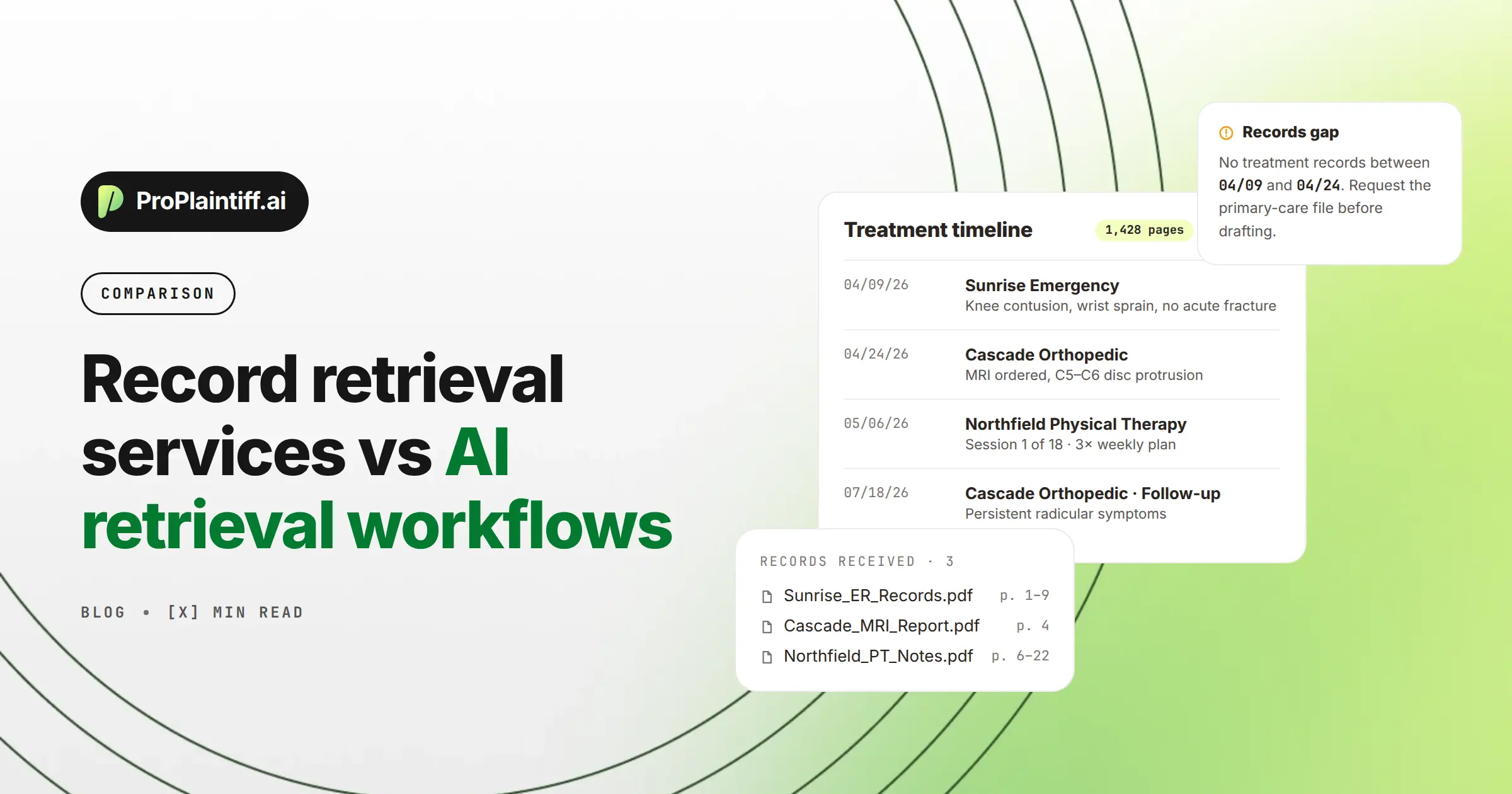
Treatment progress tracking for law firms should connect client updates, provider records, bills, appointments, and follow-up notes. Specifically, it should show whether treatment is active, PT is ongoing, surgery is pending, follow-up care is scheduled, MMI has been reached, or future care has been recommended.
This matters because demand timing starts with treatment posture. A file with active care needs different handling than a file where treatment ended three weeks ago and the final records are missing.
The system tracks what has been requested, what has arrived, and what still needs follow-up. Medical records, itemized bills, imaging reports, specialist notes, hospital records, pharmacy records, liens, and subrogation responses should all be tied to the providers and treatment dates they support.
The useful signal is final bill missing from the PT provider, imaging report missing for the MRI mentioned in the notes, lien response still outstanding, or records received without matching billing.
AI helps by comparing known treatment events against the documents in the file. If the file shows an ER visit, there should be an ER record and a bill. If a progress note mentions an MRI, the imaging report should be in the file. If the client missed work, wage documentation should exist.
The best tools tell the team exactly what to chase next and why.
The system should flag timeline issues before demand drafting starts: long treatment gaps, sudden treatment stops, new providers without referral context, follow-up recommendations with no follow-up record, changing complaints, or pain scores that need a closer look.
AI should surface the issue early. The case manager or attorney decides what it means, whether it needs an explanation, and whether the file can still move.
See how AI medical chronology surfaces gaps and timeline issues.
Demand readiness software should show the blocker, the supporting document trail, and the next owner for the task. The final output is a case status with reasons attached:
|
Readiness Status |
What It Tells the Case Team |
|
Not ready |
Specific records, bills, treatment updates, or liability documents are still missing |
|
Needs review |
Core materials are present, but a gap, inconsistency, or strategy question needs human review |
|
Demand-ready |
The file has enough treatment, records, bills, liability proof, and damages context to start demand preparation |
|
Negotiation-ready |
The demand materials are prepared, reviewed, and ready for carrier communication |
A readiness signal should trigger the next action. Not ready means chase the missing item. Needs review means route the issue to the right person. Demand-ready means start the package. Negotiation-ready means the file has moved from preparation to carrier-facing work.
Personal injury settlements are delayed most often by missing records, missing bills, unresolved treatment status, unclear liability, treatment gaps, lien issues, and attorney review bottlenecks. Most of these problems happen before negotiation begins.
A case may look active because treatment is ongoing or records have been requested, but the common settlement blockers include:
Notice how many of these are pre-demand problems. The case can't move because the file isn't ready, and the file most likely isn't ready because nobody knew what was missing.
Yes, AI can identify missing records and treatment gaps by comparing the treatment timeline against the documents in the file.
AI can compare known treatment events against documents currently in the file and flag missing records, gaps, and timeline inconsistencies. It can pattern-match across hundreds of pages without losing attention. That's exactly the kind of work humans do badly at scale.
What AI shouldn't do:
The best AI readiness tools show why an item was flagged and link back to the source. If the system says a bill is missing for the ER visit on a specific day, the attorney should be able to see the record entry that proves the visit happened.
In other words, if it isn't documented, it didn't happen.
Attorneys know a personal injury case is ready for demand when the file has enough documented treatment, liability evidence, damages proof, and client-status information to support a settlement position.
Practical checklist attorneys typically run through:
Software can tell you the file meets readiness criteria. It can't tell you whether the case is worth more in 60 days or worth less. That's still your call.
|
Workflow Area |
Traditional Case Management |
AI-Powered Case Readiness Tracking |
|
Treatment status |
Manually updated in notes or tasks |
Monitored against records and communications |
|
Records tracking |
Staff check requests and folders manually |
System flags missing or incomplete records |
|
Treatment gaps |
Found during review or demand drafting |
Surfaced earlier in the case timeline |
|
Demand timing |
Depends on staff memory and manual checks |
Supported by readiness indicators with reasons |
|
Attorney review |
Often triggered after manual preparation |
Triggered when the file meets readiness criteria |
|
Bottleneck visibility |
Scattered across tasks, notes, and emails |
Centralized around what blocks settlement progress |
|
Cross-case visibility |
One file at a time |
Whole caseload at a glance |
Traditional case management tracks what was done. Readiness tracking tracks what's still missing.
See how plaintiff firms scale pre-lit with AI.
|
Readiness Item |
Why It Matters |
|
Treatment status |
Determines whether the case is ready for demand or still developing |
|
Medical records |
Supports the injury, causation, treatment, and recovery narrative |
|
Medical bills |
Supports economic damages and settlement valuation |
|
Liability evidence |
Establishes fault and strengthens negotiation posture |
|
Treatment gaps |
Lets the attorney prepare explanations before adjusters raise them |
|
Lost wages |
Supports income-related damages |
|
Liens and subrogation |
Drives net-recovery math and settlement strategy |
|
Client status update |
Captures current pain, limitations, recovery, and future care |
|
Prior injuries |
Helps attorneys address causation or defense arguments |
|
Future care needs |
Supports valuation when treatment is ongoing or long-term |
|
Insurance and policy info |
Confirms exposure ceilings before demand framing |
Run the case against the list. Anything missing is a blocker. Anything blocked is a delay. Anything delayed is leverage you don't have.
AI for personal injury firms is useful when it turns scattered case activity into specific next actions.
AI case readiness tracking helps PI firms move files by showing what each case needs next. The overall benefit is visibility. Missing records, stalled treatment updates, incomplete bills, and review issues surface while the team still has time to fix them.
The case team can see when treatment has ended, what records are still missing, and what needs to happen before demand drafting starts. That shortens the dead time between treatment completion and demand preparation.
Missing bills, incomplete provider responses, and treatment gaps get flagged before the file reaches the attorney. The attorney reviews the case strategy instead of discovering basic file problems at the last step.
Staff can work from a specific blocker instead of digging through notes, emails, portals, and PDFs. The next task becomes concrete: call the client, chase the PT bill, request the imaging report, update wage loss, or route a gap to the attorney.
Readiness criteria make demand timing less dependent on memory or individual work habits. Similar files move through the same checkpoints, which helps the firm avoid cases sitting because one person forgot to follow up.
A readiness-tracked file reaches demand drafting with fewer missing pieces. Records, bills, liability proof, client status, treatment gaps, and damages support are easier to review before the package goes to the carrier.
When clients ask what is happening, the case team can give a real answer. “We are waiting on the final PT bill” or “we need your wage loss form” is better than “we are still working on it.” Specific updates reduce frustration and keep the client involved in moving the case forward.
AI case readiness tracking works best when the firm treats every flag as a prompt for review, not a final answer. The first risk is trusting a readiness score without the reason behind it.
Avoid these traps:
AI can help identify what the file appears to be missing but cannot replace attorney judgment about case value, litigation risk, causation, or negotiation strategy.
Implement case readiness tracking by starting with one repeatable case type, defining what “ready” means for that file, and tying each readiness status to a next action.
Pick a case type where the workflow repeats often enough to test the system properly. Motor vehicle collisions, soft-tissue cases, workers’ comp files, dog bites, premises liability claims, and medical-heavy injury files are good starting points.
Each case type needs its own readiness profile. A soft-tissue MVA may be ready once treatment status, records, bills, liability, and gaps are clear. A workers’ comp case may need impairment ratings, wage documentation, carrier forms, and work-status updates before it can move.
Build a checklist for each case type before the system goes live. The checklist should cover treatment status, records, bills, liens, liability evidence, wage loss, client status, prior injuries, future care, and attorney review triggers.
The goal is a file status the team can trust. “Demand-ready” should mean the file has the core materials needed to start the demand. “Needs review” should mean a specific issue needs human judgment. “Not ready” should name the missing item.
Readiness tracking only works when the signal moves the file.
A readiness label without a next step becomes another dashboard. The status should tell the team what to do next.
Some files need human review before they follow the normal path. Route exceptions when the file shows pending surgery, future care, policy-limit pressure, disputed liability, unexplained treatment gaps, prior injuries, missing client contact, or complex lien issues.
Clean files can move through the standard workflow. Exception files get attorney or senior case manager attention earlier.
Track the rollout by movement, not usage. Useful metrics include time from treatment completion to demand sent, time from records received to attorney review, missing records caught before review, cases blocked by provider delays, demand preparation turnaround, settlement cycle length, and staff hours spent on readiness checks.
After 60 to 90 days, the test is whether more files are reaching demand review with fewer missing records, fewer late surprises, and clearer next actions.
ProPlaintiff helps personal injury firms track case readiness from intake through demand preparation. By monitoring treatment progress, records, bills, gaps, and missing documents, your team can see which cases are blocked, which need review, and which are ready to move toward settlement demand.
Stop discovering missing records at attorney review. Surface the gaps when there's still time to close them.
A PI case is ready for settlement when the firm has enough verified treatment, medical records, bills, liability evidence, damages documentation, and client-status information for attorney review. The exact readiness standard depends on the case type. A soft-tissue MVA, workers’ comp claim, and catastrophic injury file each need different proof before demand.
Law firms track treatment progress through client updates, provider records, appointment notes, medical bills, records requests, and case management entries. AI readiness tools help by comparing those updates against the file, so the team can see whether treatment is active, completed, missing documentation, or ready for attorney review.
Personal injury settlements are delayed most often by pre-demand file problems: missing records, missing bills, slow provider responses, treatment gaps, unclear liability, incomplete damages proof, lien issues, and attorney review bottlenecks. These delays usually start before negotiation because the file is not ready to support a demand.
AI can identify missing records and treatment gaps by comparing known treatment dates, provider names, bills, and records already in the file. If a PT note references an MRI, the tool should flag a missing imaging report. If treatment stops for six weeks, the tool should flag the timeline issue for human review.
Attorneys know when to send a demand when the file supports the settlement position: treatment status is clear, records and bills are collected, liability proof is organized, damages are documented, and timing makes strategic sense. Readiness software surfaces the file status. The attorney decides whether to draft, wait, investigate, or negotiate.
AI-powered case readiness tracking is appropriate for medical records only when the vendor supports HIPAA-conscious handling of PHI and signs a Business Associate Agreement. PI firms should confirm the BAA, security controls, access permissions, and data-retention policy before uploading client records.
Case readiness tracking works alongside case management software. The case management system remains the place for tasks, contacts, deadlines, and case data. Readiness tracking focuses on movement: what is missing, what is blocking the file, and what action should happen next before demand or negotiation.

Agentic case management platform designed to streamline the work of law firms.


Join our Newsletter
Welcome to ProPlaintiff!
Oops! Something went wrong, please try again


.svg)