.webp)
.webp)
.webp)
.webp)

A demand letter in a personal injury claim is your official opening to settlement talks. It's the formal document sent to the at-fault party's insurance company that outlines the facts, establishes liability, details your client's injuries and damages, and demands a specific monetary sum to resolve everything before a lawsuit gets filed.
Think of your demand letter less as a document and more as the first move in a high-stakes chess match. It sets the tone for every single interaction you'll have with the insurance adjuster and establishes the credibility of your claim from the moment it lands on their desk.
A well-crafted letter, backed by solid evidence, can stop lowball offers before they even start. It steers the entire case toward a fair and swift resolution. The difference between a letter that gets a serious response and one that gets brushed aside is massive, and mastering this first step is non-negotiable for any PI practice aiming to maximize client outcomes.
An effective demand letter does more than just list facts—it builds a compelling narrative. It logically connects the defendant's negligence to your client's injuries and suffering, leaving zero room for misinterpretation. This initial presentation frames the entire negotiation, signaling to the adjuster that you have a serious, well-documented claim.
A powerful demand letter is your firm’s first and best chance to demonstrate competence and preparedness. It tells the insurance company that you have meticulously built your case and are ready to litigate if a fair settlement is not offered.
This level of preparation is more critical than ever. The legal industry is seeing a historic surge in client demand, with litigation rising 4.9% in just the third quarter of last year alone. You can dig into the data on this historic demand surge at Thomson Reuters. This trend puts immense pressure on firms, especially those handling high-volume personal injury cases where every document must be persuasive.
This letter is where you pull all your evidence together into one coherent, powerful argument. It's the blueprint for your case, containing everything from medical records and expert opinions to detailed calculations for lost wages and pain and suffering.
Presenting a polished, thorough, and professional case from the very beginning puts your firm in the best possible position for a better outcome. For firms looking to create persuasive, data-driven demand letters more efficiently, a platform like ProPlaintiff.ai can be a game-changer. It's designed to help automate the creation of compelling demand letters, a critical advantage in today's high-demand legal market.
A powerful demand letter isn’t built on arguments; it’s built on a mountain of undeniable proof. Before you even think about writing, your first job is to gather every single piece of evidence that tells your client's story. This isn't about ticking boxes on a checklist. It's about weaving a narrative so tight and well-supported that it leaves no room for an adjuster to poke holes in it.
The goal here is to connect the dots for them. Don't just show a picture of a mangled car door. Pair it directly with the mechanic's invoice for a "door replacement and frame alignment," which cost $3,450. That simple connection transforms a vague claim into a concrete, verifiable loss they can’t ignore.
Think of these documents as the bedrock of your case. Each one tells a piece of the story, and when you put them all together, they create an irrefutable account of what happened and the chaos that followed.
Every file should start with these essentials:
An adjuster’s job is to question everything. Your job is to answer their questions before they even ask them, using overwhelming evidence. The more organized and thorough you are, the fewer reasons they have to dispute liability or damages.
To get even more out of your visual records, especially if you're dealing with grainy surveillance footage, consider using tools like forensic video analysis software. It can help clarify blurry details and highlight critical moments that might otherwise be missed.
The real heart of any personal injury claim is the injury itself. You have to meticulously demonstrate the client's entire medical journey and its financial consequences. This is non-negotiable.
Your medical file needs to be complete and perfectly organized:
The financial fallout rarely stops at medical costs. Capturing these other losses is absolutely critical to calculating a fair settlement demand, and this part of your evidence file must be just as detailed.
Gather definitive proof of lost income and other related expenses:
A high-impact demand letter isn’t just a list of facts and numbers. It's a carefully crafted argument. Each section must build on the one before it, walking the insurance adjuster down a logical path that makes your settlement demand feel like the only reasonable conclusion.
If you’re still using generic templates, it's time to move on. Your goal is to build a narrative that’s clear, legally sound, and compelling. You want to show the adjuster from the very first sentence that you have a complete command of the case and are ready to prove every last detail.
The whole process comes down to collecting your evidence, organizing it logically, and then using it to tell a powerful story.
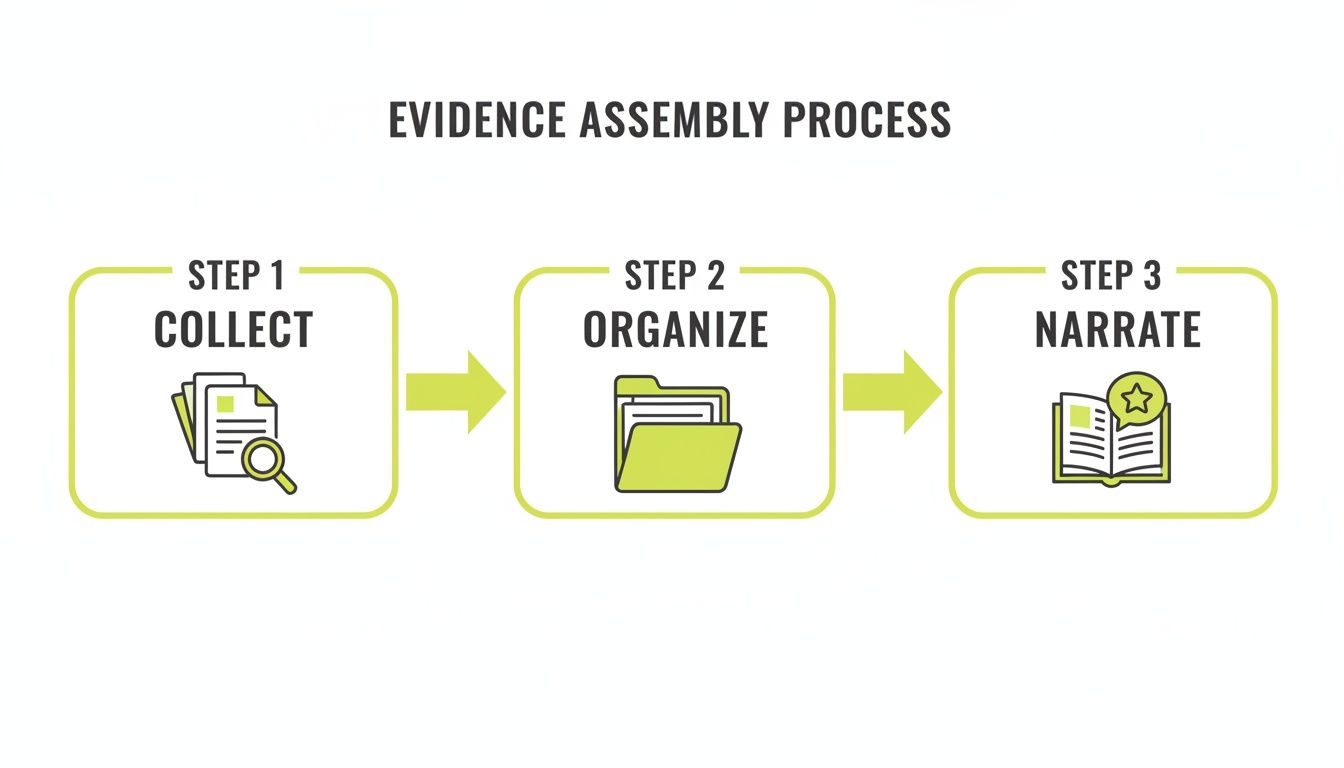
Think of this simple flow as the blueprint for your letter's entire structure. It turns a pile of raw data into a narrative that demands to be taken seriously.
A well-structured letter guides the adjuster from the incident to your settlement number, making your logic undeniable. Here's a breakdown of the key sections and their objectives.
Each part plays a crucial role in building your argument. Let's look at how to execute each one.
Your opening needs to be direct and professional. Get straight to the point by identifying your client, the date of the incident, the claim number, and the insured party. This isn't the time for a long-winded story—it's about setting the stage and establishing purpose.
A good opener looks something like this:
This letter serves as a formal demand for settlement on behalf of my client, Ms. Jane Doe, for the injuries and damages she sustained as a direct result of the motor vehicle collision on January 15, 2024, involving your insured, Mr. John Smith. This demand is made pursuant to [State] law.
Clarity is everything here. Focusing on legal writing in plain English will make your letter far more persuasive and ensure there's no room for misinterpretation.
Next, you need to lay out exactly what happened in a clean, chronological story. Write from your client's perspective but stick to the verifiable facts—things you can back up with the police report, photos, and witness statements. Your goal is to create an unambiguous account of the events.
Paint a clear picture. Instead of saying, “Mr. Smith hit my client’s car,” be more specific and descriptive.
For example: “As Ms. Doe proceeded lawfully through the intersection on a green light, Mr. Smith, traveling eastbound, failed to stop for his red light and violently struck the driver's side of Ms. Doe's vehicle.”
Once the facts are on the table, it's time to connect the dots and explicitly state why the other party is legally responsible for your client’s damages. This is where you draw a direct line from their actions to the harm your client suffered.
This is your chance to really anchor your argument in the law.
If you’re looking for real-world examples, reviewing a few sample personal injury demand letters is a great way to see how experienced attorneys frame this critical section.
This is often the longest and most detailed part of the letter. You need to give a complete overview of every injury, the medical treatment received, and the client’s recovery journey so far.
List every diagnosis from the medical records. Walk the adjuster through the treatment timeline, from the ER visit to ongoing physical therapy appointments. Use descriptive language to convey the reality of the injuries without being overly dramatic.
The adjuster needs to understand the human cost. Don’t just list a 'lumbar strain.' Describe it as 'debilitating lower back pain that prevented Ms. Doe from lifting her toddler or sitting for more than 20 minutes without significant discomfort.'
This section is all about translating cold medical terms into a relatable human experience. It's what justifies the damages you'll demand next.
Finally, you get to the number. This section must clearly state the total amount you’re demanding and—just as importantly—give a concise breakdown of how you got there.
Present your economic damages (medical bills, lost wages) as hard figures backed by your documentation. For non-economic damages (pain and suffering), explain the calculation method you used, whether it's a multiplier or a per diem approach. Always tie it back to the severity and duration of the suffering you detailed in the previous section.
A well-structured conclusion provides a logical, defensible basis for your settlement figure, leaving little room for the adjuster to push back.
A demand number sits at the core of your letter. It must cover every expense and loss your client suffered, yet stand up to an adjuster’s scrutiny.
Begin by cataloging every outlay—medical bills, lost wages, travel costs—then translate the pain and disruption into a concrete figure. That dual focus is what makes a demand letter both bold and unassailable.
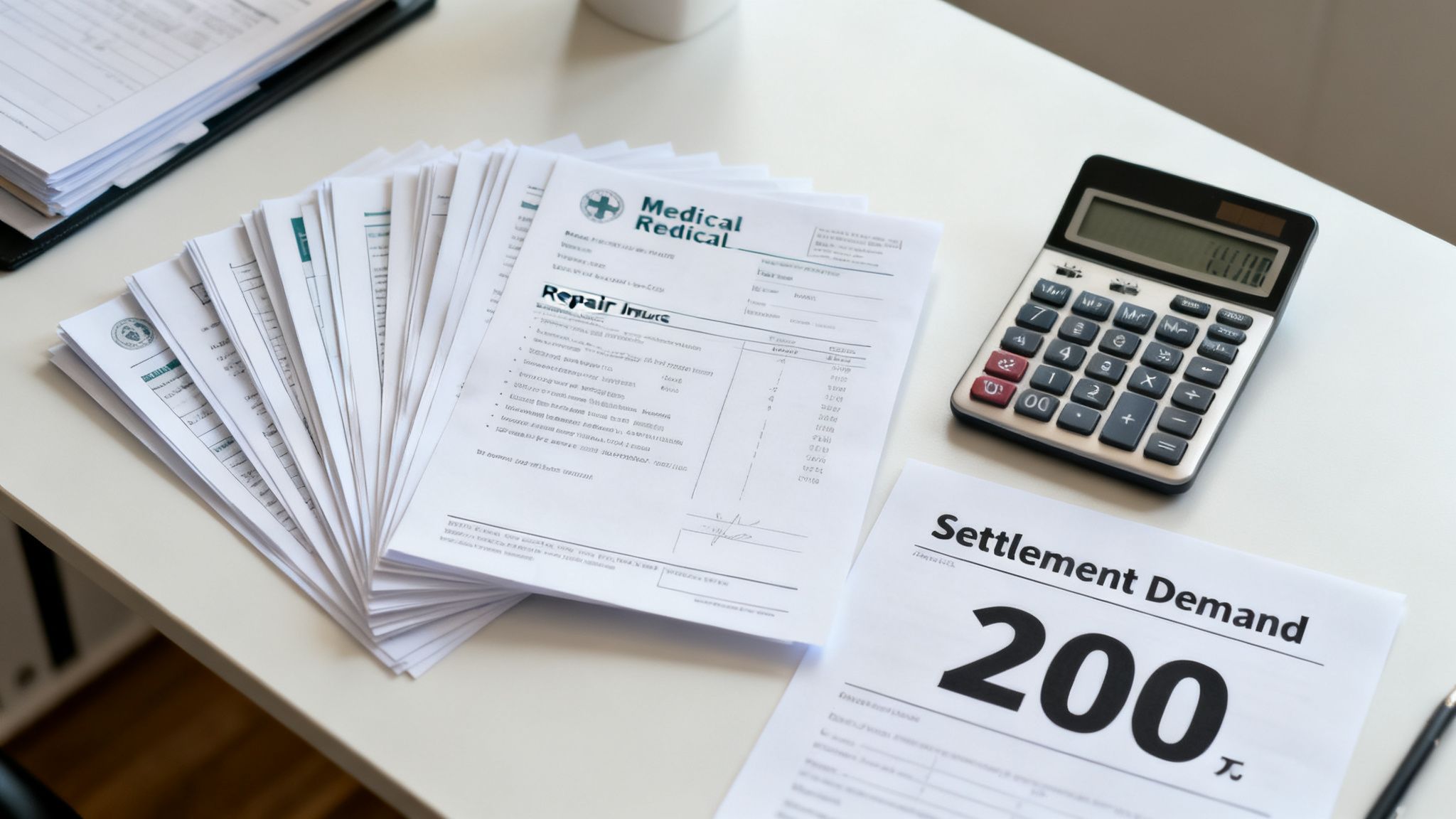
Economic losses—sometimes called specials—are the easiest to justify because you have hard numbers. Receipts, invoices, pay stubs: they all add up to an exact dollar figure.
Every entry must tie back to real documentation you’ve already gathered. No estimates, no rounding up.
Pro Tip: Build a detailed spreadsheet that lists every expense, then attach it as an exhibit. It shows you’re organized—and takes away any excuse for an adjuster to challenge your math.
Once you’ve locked in tangible costs, turn to those intangibles: pain, suffering, emotional distress, loss of enjoyment of life. No receipts here means your math has to feel both logical and empathetic.
The most reliable route is the multiplier method—multiply total economic damages by a factor that reflects your client’s ordeal, usually between 1.5 and 5.
Picking the right multiplier isn’t guesswork; it’s based on real case factors. A simple sprain that healed in weeks might call for a 1.5x multiplier. A life-altering injury, one that leads to chronic pain or permanent disability, could justify a 5x or even higher.
Keep these points in mind:
Imagine a client with $50,000 in medical bills and lost wages who endured six painful months recovering from a broken leg. A 3x multiplier for pain and suffering adds $150,000, bringing the total demand to $200,000.
Numbers don’t tell a full story on their own. Your demand letter must connect those figures to real human experience. Paint a scene that makes the adjuster pause and see your client’s life through their eyes.
Use concrete examples:
Instead of saying, “My client experienced pain and suffering,” try:
Ms. Davis’s fractured wrist was more than a broken bone—it stole her independence for three months. This 68-year-old gardening enthusiast couldn’t tend her roses, and even tying her shoes became an ordeal, forcing her daughter to step in for everyday tasks.
And swap “The client suffered emotional distress” with:
Mr. Chen now wakes in cold sweats and shuns his usual 15-mile commute. Night terrors and panic attacks make every drive a gamble, pushing him into expensive rideshares and keeping him from returning to work at full capacity.
That narrative makes the math feel inevitable. When your demand reads like the only fair conclusion, it’s hard for an adjuster to argue against it.
In a competitive legal market, efficiency isn't just a nice-to-have; it's a requirement for survival. We all know the traditional process of drafting a demand letter is a grind. It's time-consuming and manual, often burning hours on meticulous record review, chronology building, and crafting the perfect narrative. For any modern personal injury firm with a growing caseload, this old-school approach is a serious bottleneck, slowing down case velocity and pushing settlements further down the road.
This is exactly where technology is stepping in to make a real difference. The move toward AI-powered tools isn't just a trend; it's a smart, strategic response to the pressures we all face. Personal injury firms are increasingly turning to AI for demand letter drafting to handle skyrocketing caseloads. In fact, 37% of PI lawyers now report using generative AI, outpacing the 31% across all other practice areas.
Among those using it, 52% are drafting correspondence and 39% are creating documents—both core tasks in building a compelling demand letter for an injury claim. You can dig into more data on this industry shift by reviewing the full report from 8am.
Think about the typical workflow for a minute. A paralegal or an attorney has to manually sift through hundreds, sometimes thousands, of pages of medical records, police reports, and witness statements. They have to piece together a coherent timeline, decipher dense medical jargon, and then somehow translate all of it into a persuasive story. This process is not only slow but also ripe for human error, where one missed detail could undermine the entire claim.
ProPlaintiff.ai completely changes this dynamic. As an agentic AI operating system built specifically for personal injury firms, it automates the most labor-intensive parts of the job. Instead of a paralegal spending half a day building a medical chronology, the AI Paralegal can generate a precise, accurate report in just a few minutes.
The real power of AI here is its ability to chew through high-volume, data-heavy tasks with a speed and accuracy that a human team simply can't match. It frees up your legal professionals to focus on what they do best: strategy, negotiation, and building client relationships—the high-value work that actually wins cases.
This shift lets firms handle more cases without ever sacrificing the quality of each demand letter. By automating the foundational work, you ensure every single letter is built on a solid, data-driven framework.
Let's imagine two PI firms, both just signed a new car accident case.
The result is a massive competitive advantage. Firm B gets its demand letter out the door days earlier, accelerating case velocity and starting negotiations while Firm A is still buried in paperwork. And this speed doesn't come at the cost of quality. If anything, the AI-generated letter is often more detailed and accurate because the system can spot and correlate data points across massive document sets in an instant.
For any firm looking to grow, the ability to scale operations efficiently is everything. ProPlaintiff.ai gives you the power to take on more cases without needing to proportionally increase your staff. The AI Paralegal acts as a force multiplier, letting your existing team manage a larger caseload with less stress and fewer administrative headaches.
Here are a few key functions that make this growth possible:
By adopting tools like ProPlaintiff.ai, you aren't just drafting a better demand letter for your clients; you're building a more resilient, efficient, and profitable practice. For a deeper dive into crafting these crucial documents, check out our guide on the fundamentals of a personal injury demand letter. Ultimately, this technology empowers you to deliver superior results for your clients while positioning your firm as a leader in a rapidly evolving industry.
Even seasoned legal pros run into tricky situations when drafting a demand letter for an injury claim. The process is full of nuances, and one small misstep can throw off the entire negotiation. Let's walk through some of the most common questions and sticking points that come up.
Think of this as your quick-reference guide. From timing your delivery to handling a ghosting adjuster, these insights will help you navigate the process and steer clear of common traps that can weaken your client's position.
Timing is everything. One of the biggest mistakes you can make is sending a demand letter before your client has reached Maximum Medical Improvement (MMI). This is the point where a doctor confirms the client’s condition is stable and isn't likely to improve further.
If you jump the gun, you're working with an incomplete picture of the damages.
Wait until your client's medical journey is clear. Only then can you put together a comprehensive package that reflects the true, full value of their claim. A little patience shows you're thorough and puts you in control of the negotiation from the start.
It's infuriating. You send a well-documented, detailed demand, and all you get back is… crickets. While insurance companies are legally required to act in good faith, going silent is a classic delay tactic. Don't let it rattle you.
First, follow up. A phone call and a certified letter referencing the original demand and restating your deadline should be your next move. If they still don't respond, you have your answer. The adjuster is likely testing your resolve, hoping you’ll get tired and either drop it or accept a lowball offer later. This is often the signal that it's time to file a lawsuit to show them you mean business.
If your firm is feeling the squeeze, you're not alone. The demand for specialized legal services, including outsourced drafting, has skyrocketed to nearly $25 billion—that’s a tenfold jump in the last 20 years. This isn't just random growth; it's fueled by litigation that's getting more and more complex, completely overwhelming in-house teams.
As overall legal demand ticks up 3.9% and litigation rises 4.9%, firms are hitting a serious bandwidth crunch. You can read more about the global complexities driving this legal demand at Protiviti. This constant pressure makes it nearly impossible to pump out high-quality, effective demand letters for every single case without falling behind.
Ready to eliminate the bottlenecks in your demand letter process? ProPlaintiff.ai uses an agentic AI operating system to generate precise medical chronologies, case summaries, and persuasive demand letters in minutes, not days. Free up your team to focus on strategy and win bigger settlements by visiting https://www.proplaintiff.ai to see how it works.



.svg)