.webp)
.webp)
.webp)
.webp)


In personal injury law, legal documents are the scaffolding you build your entire case on. These official, written records define the rights, obligations, and facts of the matter, serving as the strategic tools you'll use to negotiate a settlement or argue in court.
We can think of your case file like an architectural blueprint. Without a solid, well-drafted plan, the whole structure is at risk of collapsing. From that first client meeting all the way to the final settlement check, every single step is defined, communicated, and locked in through specific legal documents. It’s a methodical process that ensures every action is recorded and legally sound.
For solo attorneys and paralegals, mastering this documentation isn't just about administration—it's about strategy. Each document you create is a critical milestone, moving the case forward while building a stronger and more compelling argument for your client.
In this field, accuracy and clarity aren't just nice-to-haves; they are your most powerful weapons. A single vague sentence in a demand letter or a simple error in a medical summary can instantly weaken your negotiating position or even put the entire claim in jeopardy. As noted by the European Law Blog, the precision of legal language is everything, because you can bet opposing counsel will scrutinize every word to find a weakness.
When you draft precise, well-supported legal documents, you’re not just filing paperwork—you’re controlling the narrative. This allows you to:
Mastering the creation and management of these documents means you are not just reacting to the case; you are actively directing its course. This proactive approach is fundamental to achieving favorable results for your clients.
When you're building a personal injury case, you're really telling a story with paper. The legal documents are the chapters that take a claim from an initial incident to a final resolution. These aren't just formalities; they are the strategic tools you use to frame your arguments, present your evidence, and ultimately, persuade the other side. Each document has a specific, vital job to do.

Knowing what these documents are and when to use them is fundamental. It lets you anticipate what's coming next and prepare proactively, keeping the case moving forward and building a powerful narrative for your client.
To give you a clearer picture, here’s a quick rundown of the most common documents you’ll encounter and their roles in a typical personal injury case.
Each of these documents builds on the last, creating a comprehensive file that supports your client's claim from start to finish. Let's dig into each one.
Think of the demand letter as your opening move in a high-stakes negotiation. It's a formal, detailed document you send to the at-fault party's insurance company, laying out your entire case before ever setting foot in a courtroom. It's your best shot at getting a fair settlement without filing a lawsuit.
A great demand letter does more than just throw out a number. It tells a compelling story, backed by cold, hard facts. It carefully explains what happened, proves why their insured is at fault, and quantifies every dollar of your client's damages.
An impactful demand letter absolutely must include:
The goal is simple: present the adjuster with such a well-organized, undeniable case that they see the financial risk of taking you to trial. A powerful demand letter makes settling feel like their smartest, most cost-effective option.
If the demand letter is the argument, the medical chronology is the human story behind it. It takes a mountain of disorganized medical records and transforms it into a clean, easy-to-follow timeline of your client’s journey, from the moment of injury onward.
This isn't just a list of dates. A well-crafted chronology connects every single doctor’s visit, diagnosis, and procedure back to the incident. For instance, it would show the initial ER visit for whiplash, followed by a referral to a neurologist, the subsequent MRI confirming a herniated disc, and the resulting course of physical therapy. It creates a powerful narrative of pain, recovery, and ongoing struggles, showing the real-world impact the defendant's negligence had on your client's life. This document is indispensable for proving the severity of injuries to an adjuster or a jury.
This is one area where technology is making a huge difference. According to the American Bar Association's 2023 Legal Technology Survey Report, AI adoption is steadily increasing, with a notable interest in tools that streamline document analysis and drafting. For plaintiff attorneys, this is more than just a trend—tools like ChatGPT are already being used to draft documents like demand letters and chronologies. You can learn more about these legal AI trends to see just how quickly things are changing.
When settlement talks stall, the case moves into a formal lawsuit. This phase kicks off with pleadings—the official documents filed with the court that initiate the legal battle.
The two main pleadings are:
These documents are foundational. They draw the legal battle lines and define the core arguments that will be fought over for the rest of the case.
Once the pleadings are filed, the discovery phase begins. This is the formal process where both sides are forced to exchange information and evidence. It's how you unearth the facts you need to prove your case, using specific legal documents to compel the other side to hand over information.
Key discovery documents include:
Discovery is all about leaving no stone unturned. The information you gather here is often what wins or loses a case, giving you the critical proof needed to establish liability and justify your damages.
Knowing the different types of legal documents is only half the battle. To truly win for your clients, you have to craft and review these documents with an obsessive focus on persuasive power. Every word, every sentence, and every piece of evidence must work together to build an argument that isn't just complete, but compelling.

This isn’t about using fancy legal jargon; it’s about strategic communication. A well-drafted document can convince an adjuster to offer a fair settlement, while a poorly written one invites skepticism and lowball offers. We'll explore three core pillars that transform standard paperwork into powerful legal instruments.
The words you choose are your primary weapons. Ambiguity is the enemy of persuasion—it creates loopholes for opposing counsel to exploit. The goal is to replace vague, passive language with clear, forceful statements that leave no room for misinterpretation.
Think about the difference between these two statements:
The second version is more than just descriptive; it’s powerful. It connects cause and effect, specifies the nature of the pain, and cites an authoritative source. This level of precision eliminates doubt and builds a much stronger foundation for your claim.
As the American Bar Association (ABA) Model Rules of Professional Conduct, particularly Rule 1.1 on competence, imply, clear and concise legal writing isn't just a stylistic choice—it's an ethical obligation. Your duty is to advocate effectively, and that begins with clarity.
A strong legal document doesn't just list evidence; it weaves it into a coherent, convincing narrative. Dropping in a medical record or an expert opinion without context is like handing someone a box of puzzle pieces without showing them the final picture. You have to connect the dots for the reader.
Instead of just attaching a pile of medical bills, you should embed the key findings directly into your argument. For instance, when describing your client's injuries in a demand letter, you can integrate evidence like this:
"The force of the impact resulted in a herniated disc at the L4-L5 level, a diagnosis confirmed by the MRI conducted at Central Imaging on June 1, 2023. As noted in the attached report from Dr. Smith, this injury is the direct medical cause of the chronic sciatic pain that has prevented Ms. Davis from returning to work."
This technique accomplishes two crucial things:
Even the most skilled writer makes mistakes. A single typo, an incorrect date, or a factual error can undermine your credibility and damage your case. That’s why a systematic, multi-layered review process is non-negotiable for producing high-quality legal documents.
Your workflow should be a safety net designed to catch any and all errors before a document ever leaves your office. A solid process ensures consistency, accuracy, and professionalism across every single case file.
A quality-control workflow should include several distinct stages:
Adopting a structured approach like this is essential for consistent excellence. For those looking to improve their document management, you can learn more about how technology can provide a smarter way to ensure compliance.
Your duty to protect client information isn't just a professional courtesy—it's a non-negotiable ethical obligation. In personal injury law, you’re handling a person's most private details, from medical records to financial statements. Safeguarding these sensitive legal documents is everything.
This is about more than just dodging penalties. It's about earning and keeping the client trust that your entire practice is built on. A data breach doesn't just create legal headaches; it can shatter your firm's reputation overnight.
When you're dealing with personal injury claims, the Health Insurance Portability and Accountability Act (HIPAA) is always in the room. This federal law sets the gold standard for protecting sensitive patient health information. Since nearly every PI case is built on a foundation of medical records, your firm is a custodian of this protected health information (PHI), and the rules are strict.
Failing to comply comes with steep consequences, from massive financial penalties to civil lawsuits. It’s a common misconception that HIPAA is just for hospitals—it applies to any organization that handles PHI, and that absolutely includes law firms.
"Protected health information (PHI) under HIPAA includes a wide range of identifiers, from names and addresses to medical record numbers and biometric data," explains the U.S. Department of Health & Human Services. The responsibility for securing this data extends through its entire lifecycle within your firm, from receipt to final archival.
To keep your practice compliant, you need clear, enforceable protocols. Thinking through your data security is essential, and you can learn more about the specifics of HIPAA compliance for law firms in our detailed guide.
Making sure your handling of legal documents with PHI is airtight comes down to a few key practices. Here’s a quick checklist to help you stay on the right side of the regulations:
While HIPAA is a huge piece of the puzzle, your security duties also cover every client communication under the umbrella of attorney-client privilege. This legal shield protects conversations between you and your client from being exposed. Keeping that shield strong in a digital world demands proactive security.
To really get a handle on this, you need to conduct thorough risk assessments. A great starting point is a cybersecurity risk assessment template, which can help you turn vague worries into a concrete, defensible plan. This isn't just about protecting medical data; it's about protecting all sensitive case details.
The pressure to manage this data securely is only growing. According to the 2023 Report on the State of the Legal Market by Thomson Reuters, law firms face increasing pressure to adopt technology for efficiency and security, with client demands for data protection being a major driver.
Imagine having a highly skilled co-pilot handling the most time-consuming parts of preparing legal documents. That’s what modern AI brings to personal injury law. Instead of replacing legal expertise, these tools augment it, turning tedious manual tasks into efficient, simplified workflows.
This shift frees up your team's most valuable asset: time. By automating the repetitive grind of document creation, firms can operate with more speed and precision. The result is a direct impact on your bottom line, better productivity, and the ability to manage a larger caseload without burning out your staff.
We’ve all been there. The traditional process of drafting a demand letter or summarizing hundreds of pages of medical records is a black hole for billable hours. It’s a painstaking process of reading, synthesizing information, and carefully crafting a persuasive narrative from a mountain of disorganized files.
This is where AI acts as a powerful force multiplier.
For example, a paralegal might spend four hours manually sifting through 500 pages of medical records to build a chronology. An AI platform like ProPlaintiff.ai can ingest that same file and generate a detailed, hyperlinked chronology in under 10 minutes. This lets your legal team start with a structured, fact-filled document, allowing them to focus their brainpower on refining legal arguments and strategic positioning.
The move toward AI in legal work is happening fast, and personal injury firms are seeing huge benefits. A report by Goldman Sachs estimates that generative AI could automate up to 44% of legal tasks in the U.S. This isn't just theoretical; firms are seeing practical results. For example, some early adopters report slashing document preparation time by 40-60%.
These aren’t just vanity metrics. This efficiency means faster case turnarounds and increased firm capacity without piling on overhead. It’s about working smarter, not just harder.
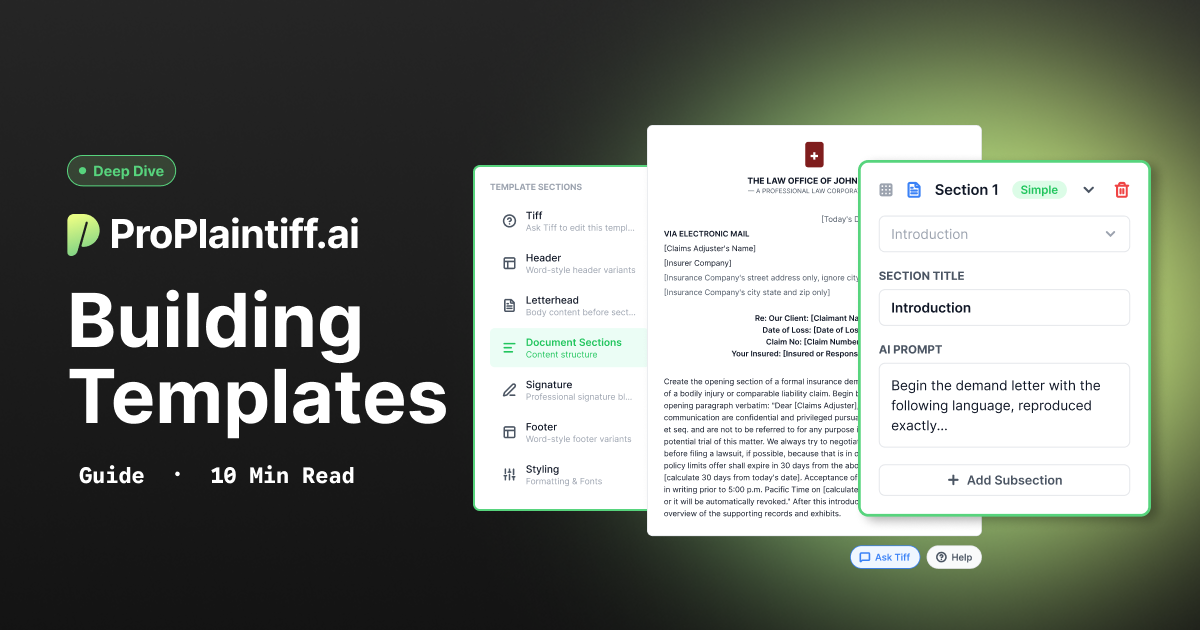
The interface below shows how a modern AI platform organizes case files, making complex information instantly accessible.

This kind of centralized dashboard allows attorneys to see all critical documents at a glance, ready for AI-powered analysis and summarization.
AI isn't a single magic button; it's a suite of specific capabilities designed to solve different document-related headaches. While there are many general AI applications out there, the tools built for personal injury law are hyper-focused.
In our world, the key functions include:
By delegating the initial heavy lifting of document creation to AI, attorneys and paralegals can dedicate their time to what truly matters: building winning case strategies and advocating for their clients. This strategic shift is fundamental to scaling a modern personal injury practice.
Diving into a personal injury claim brings up a lot of questions about all the paperwork involved. Getting straight answers is the best way to cut through the legal jargon and see the strategy behind every document. Here, we'll tackle some of the most common things attorneys and paralegals ask.
Every single document, from an initial demand to a formal court filing, has a specific job to do. Knowing what each one is for—and when to use it—is what keeps a case moving toward a strong settlement or verdict.
That's a great question, and the answer really depends on where you are in the case. Before a lawsuit is ever filed, the demand letter is hands-down the most important document you'll create. It's your first real shot at settling the case on your terms, and it sets the stage for everything to come. A powerful demand letter frames the entire story, lays out your best evidence, and makes a clear, fact-based case for why the insurer should pay up.
But if negotiations break down and you have to file suit, the Complaint takes center stage. This is the document that officially kicks off the lawsuit. It outlines the legal foundation of your claim and puts the defense on formal notice. Both are absolutely pivotal—just at different points in the journey.
A truly persuasive medical summary is more than just a list of appointments and procedures. It has to tell a story. The goal is to connect the cold, clinical facts from the records to the very real, human suffering your client has endured. You want to create a narrative that an adjuster or juror can follow, understand, and feel.
To give your summaries that kind of impact, try focusing on these three things:
A great medical summary isn't just a record; it's an argument. It demonstrates causation and damages so clearly that it leaves little room for the opposing side to dispute the severity of the client's injuries.
Templates can feel like a good shortcut, but they come with some serious risks. They're built to be generic, which means they almost always fail to capture the unique details and strategic angles of your specific case. When you lean too heavily on a one-size-fits-all template, you're often left with a watered-down argument and missed opportunities.
This is where AI-powered platforms really shine. Instead of just giving you blanks to fill in, tools like these generate customized drafts using the actual evidence from your case file. It’s the best of both worlds—you get the speed of a template but with the personalized, detailed approach needed to create truly high-impact legal documents.
Confidentiality isn't just a priority; it's a non-negotiable. Any reputable legal AI platform is built from the ground up with security at its core. As the European Law Blog points out, data protection is a critical and complex field. The best legal AI providers tackle this head-on by integrating robust security protocols into every feature.
Your first question for any vendor should be whether their platform is HIPAA compliant. This is the federal standard for protecting sensitive patient health information. Look for systems that use end-to-end encryption, secure cloud infrastructure, and strict user access controls. Partnering with a provider that takes these safeguards seriously means you can get the benefits of the technology without ever compromising your ethical and legal duties to your client.
Ready to transform your document creation process? With ProPlaintiff.ai, you can generate powerful demand letters, medical chronologies, and case summaries in minutes, not hours. Our secure, HIPAA-compliant AI platform is designed specifically for personal injury firms to increase efficiency and maximize case value. Discover how ProPlaintiff.ai can help your firm today.



.svg)