.webp)
.webp)
.webp)
.webp)


A medical chronology is the spine of a personal injury case. It carries the story of what happened, when symptoms appeared, who treated the client, how care progressed, and what the records actually support. When that timeline is built from summary language and unsourced facts, the demand package built on top of it has nothing to fall back on.
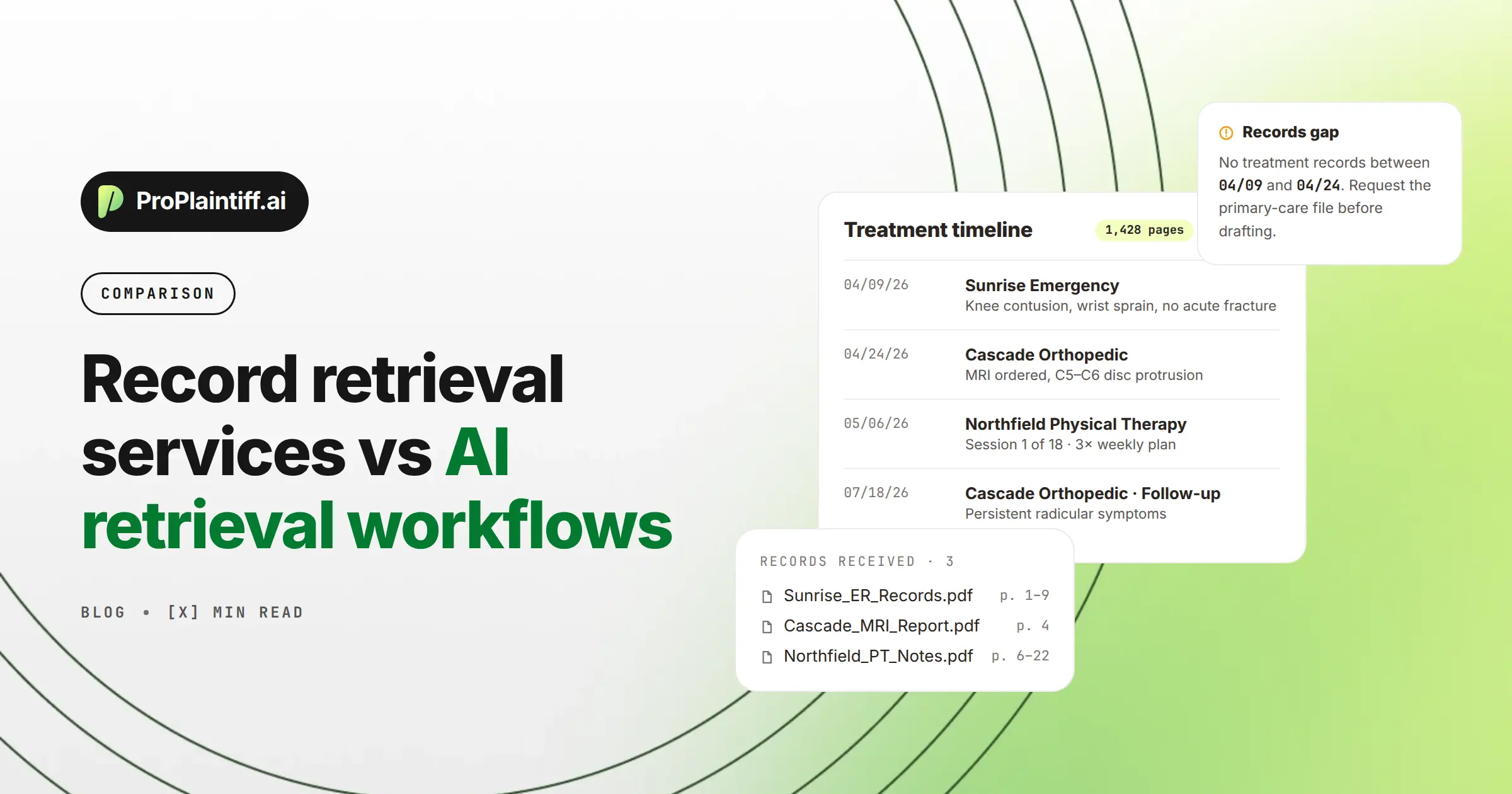
A medical chronology with citations links each entry back to the source record. Think diagnoses, bills, imaging findings, treatment dates, restrictions, follow-up recommendations.
Every important fact points to the page or document where it came from. That changes what the chronology can do. It becomes a document the attorney can verify in minutes, the adjuster has to take it seriously, and the file can defend if anything in it gets challenged.
This guide breaks down what a cited medical chronology contains, why citations protect the file, how AI fits into the build, and where the line sits between automation and attorney judgment.
See how ProPlaintiff helps plaintiff firms build cited medical chronologies faster.
A medical chronology with citations is a timeline of medical events where each entry references the source record that supports it. Instead of listing treatment dates alone, a cited chronology shows where the fact came from, such as provider note, imaging report, hospital record, billing entry, discharge summary, or therapy record.
A complete cited chronology entry typically includes:
The citation is what turns the entry from internal shorthand into proof. A stuck surgery case can be moved by up to $100K because a paralegal could point the adjuster to a four-word entry deep in the operative report. The fact might exist somewhere the whole time. The citation made it usable.
Skip citations and the cost shows up later. At the demand review when the attorney cannot verify a diagnosis. At the negotiation call when the adjuster questions a treatment date. At the deposition when defense counsel asks where the timeline says what it says. Each of those moments is a question with one acceptable answer.
Citations matter any time accuracy, verification, negotiation, or litigation readiness is on the table.
For plaintiff firms specifically, citations let attorneys confirm the injury narrative is supported by records rather than assumed from them, verify treatment dates against provider documentation, check diagnoses against what the provider actually wrote, spot treatment gaps without re-reading the full file, connect symptoms to documented care, support damages with anchored facts, respond to adjuster or defense challenges in minutes rather than days, and review AI-generated outputs without taking the output on faith.
Without citations, every claim in the chronology has to be accepted on trust or chased through the medical file by hand. Trust does not survive a defense challenge. Hand-chasing burns hours that should be going to actual case work.
The practical effect of an uncited chronology is that attorney review time goes up because nothing can be verified without going back to the source documents. A cited chronology removes that step. The reviewer confirms each entry against the cited page rather than reconstructing the file from scratch.
When a chronology says the client reported severe neck pain on March 14, the attorney's next question is where the record says that. Without a citation, somebody has to hunt for the answer. Sometimes that is the paralegal mid-week. Sometimes it is the attorney at nine at night before a demand goes out.
The predictable problems uncited chronologies create:
Each of these is a workflow leak that compounds across a caseload. If it is not documented, it did not happen for purposes of negotiation. If it is not cited, it cannot be defended when the defense tests it.
A strong medical chronology is date-based, uses consistent fields across every entry, and carries a citation on every meaningful claim.
|
Chronology Field |
What to Include |
|
Date |
Date of service, visit, test, procedure, or medical event |
|
Provider or facility |
Treating physician, hospital, clinic, therapist, or specialist |
|
Record type |
Visit note, imaging report, bill, discharge summary, operative report, PT note |
|
Complaint or symptom |
What the patient reported: pain, numbness, mobility limits, headaches |
|
Findings or diagnosis |
Provider findings, diagnosis, imaging results, clinical impressions |
|
Treatment or recommendation |
Medication, therapy, procedure, referral, restrictions, follow-up plan |
|
Relevance |
Why the event matters to injury, causation, damages, or recovery |
|
Citation |
Page number, record name, exhibit, Bates number, or source link |
|
Review note |
Gaps, inconsistencies, or issues flagged for attorney review |
Consistency across entries is what makes the chronology usable. When every entry follows the same pattern, attorney review moves quickly because the reviewer knows where to look for each field. When entries vary in depth and format, review becomes friction, and the chronology loses the time savings it was supposed to create.
The same structure should hold across attorneys, paralegals, case managers, and case types within the firm. A chronology that looks different depending on who built it loses its value as a system.
Citation format matters less than citation consistency. The reviewer needs to find the source quickly, and the format only needs to make that mechanical.
|
Citation Format |
Example |
|
Document plus page |
ABC Orthopedics records, p. 14 |
|
Exhibit plus page |
Exhibit 3, p. 22 |
|
Provider, date, and page |
Valley Imaging, MRI report, 03/12/2026, p. 2 |
|
Direct source link |
Linked to the uploaded record in the case file |
|
Bates number |
MED-000143 |
The right format is the one that matches how the firm organizes records, exhibits, and demand packages. If exhibits are how the firm thinks about case materials, cite by exhibit. If Bates is how documents move once the case progresses to litigation, cite by Bates. Direct source links work best inside workflow tools where the reviewer can click straight to the record.
The mistake is mixing formats inside the same chronology. The team should pick one citation format and use it consistently across the case. Verification needs to be mechanical, not a scavenger hunt through three different conventions.
Turn records into source-backed medical timelines.
Attorneys verify chronology accuracy by checking entries against the underlying records. The cited chronology is what makes that pass fast rather than brutal.
The standard verification pass covers whether each date matches the source record, whether symptoms are summarized accurately without exaggeration or softening, whether diagnoses are stated correctly with their qualifiers and any uncertainty preserved, whether imaging results are paraphrased faithfully, whether bills match the treatment events they are attached to, whether treatment gaps are visible rather than smoothed over, whether future care recommendations are documented in the record, whether the chronology overstates or understates what the records actually say, and whether each citation points to the correct document and page.
A cited chronology does not eliminate attorney review. It focuses the review on the claims that drive the case rather than reconstructing the file from scratch. The attorney confirms the specific entries that matter for liability, damages, and demand framing. The rest moves through faster because the structure of the chronology already does the cross-referencing work.
That is where the time savings come from. The review depth stays the same. The review effort drops.
AI can read uploaded medical records, extract treatment events, organize them by date, and link each entry back to a source document. Done well, that produces a chronology that covers the full record set rather than the portion a paralegal had time to extract, with citations attached to every meaningful entry, treatment gaps flagged rather than buried, inconsistencies between bills and treatment surfaced, and a first-pass timeline ready for attorney verification in hours rather than days.
What AI should not do in this workflow:
The useful AI medical chronology tool is the one that flags uncertainty rather than hiding it. If two records disagree on a diagnosis, the chronology should show the disagreement. If a treatment date appears in a bill but not in a provider note, that should appear as a flag for review. The system's job is to make the file easier to verify, not to produce a clean-looking output that papers over the gaps.
For plaintiff firms, the safest AI medical chronology is the one that shows its work. Every entry traceable. Every gap visible. Every claim something the attorney can confirm against the source.
A cited chronology turns the medical file from a document pile into a negotiation map. The adjuster, the attorney, and the case team can see the treatment story and exactly where the records support it. That changes how the demand gets evaluated.
Specifically, cited chronologies help firms show a clean treatment timeline the adjuster can evaluate without sending follow-up requests, connect injuries to documented care with the citation visible inside the demand, support damages with source-backed facts rather than summary language, reduce back-and-forth over records because the source is already shown, build demand letters anchored to specific record pages, anticipate adjuster questions and answer them inside the package, address treatment gaps before negotiation with an explanation already attached, highlight key medical moments like surgery, MMI, or permanency findings without burying them, give attorneys a cleaner negotiation summary to work from, and make the demand package easier for the adjuster to evaluate quickly.
The adjuster's job is to find reasons to discount the claim. A cited chronology removes the easiest reasons. The demand is no longer asking the adjuster to take treatment summaries on faith. It is showing the adjuster where each claim is supported by the file.
Request a demo of the AI demand letter generator.
|
Workflow Area |
Standard Medical Summary |
Medical Chronology With Citations |
|
Structure |
Narrative or bulleted summary |
Date-based timeline with consistent fields |
|
Verification |
Requires hunting through the record set |
Each entry points back to a source page |
|
Use in demands |
Helpful background context |
Direct support for demand claims |
|
Treatment gaps |
Often missed or buried in narrative |
Visible by timeline at a glance |
|
Attorney review |
Slower when facts are uncited |
Faster because facts are traceable |
|
Dispute handling |
Harder to defend specific facts under pushback |
Easier to show record support on demand |
|
AI review safety |
Riskier without source linking |
More reliable when citations resolve to the record |
|
Cross-attorney consistency |
Varies by who wrote it |
Standardized across the firm |
Both formats have a role. A medical summary works for quick orientation, intake handoffs, and high-level case discussions. A cited chronology is what feeds demand packages, mediation briefs, expert witness preparation, and any document that has to defend specific facts under challenge.
Most plaintiff firms benefit from using both. The summary for context. The cited chronology for proof.
This is the internal checklist before any chronology moves into a demand package.
|
Item |
Why It Matters |
|
Initial treatment date |
Anchors the timeline after the incident |
|
Chief complaints |
Documents reported symptoms and injury progression |
|
Diagnoses |
Supports the medical basis for the claim |
|
Imaging results |
Adds objective evidence where available |
|
Procedures and treatment |
Shows the scope and intensity of care |
|
PT and follow-up visits |
Demonstrates ongoing recovery efforts |
|
Pain and limitation notes |
Supports non-economic damages |
|
Work restrictions |
Documents functional and income impact |
|
Referrals |
Shows escalation or specialist involvement |
|
Future care recommendations |
Supports future damages or ongoing treatment exposure |
|
Treatment gaps |
Helps attorneys prepare explanations before adjusters raise them |
|
Prior injuries to same body part |
Lets the attorney address causation arguments early |
|
Citations on every meaningful claim |
Makes each key fact verifiable |
|
Review notes |
Flags inconsistencies for attorney attention |
Running the chronology against the list before the demand goes out catches the gaps in the chronology itself. A chronology missing prior-injury notes leaves a causation argument the carrier will raise unaddressed. A chronology missing future care notes understates damages the records support. The checklist is what protects the file from those omissions.
AI helps. It also creates new failure modes when the tool is not built carefully or the workflow does not include verification.
Traps to avoid:
The risk is not that AI helps build a chronology. The risk is using a tool that cannot show where its facts came from.
Rather than overhaul every case at once, build the system on a repeatable workflow and then scale it across the caseload.
Lock the template before the system goes live. Date, provider, record type, complaint, diagnosis, treatment, relevance, citation, and review note. The same structure across every file, every attorney, and every paralegal in the firm.
Standardization is what makes the chronology a system rather than a one-off. When every chronology looks the same, attorney review gets faster, paralegal handoffs get cleaner, and the firm's outputs become recognizable to carriers as documented and consistent.
Not every administrative line in a record needs heavy citation. The claims that drive case value do. Citations should be required for diagnoses and clinical impressions, imaging findings, procedures and surgeries, surgery recommendations and pre-op evaluations, work restrictions, pain ratings and functional limitations, treatment gaps and their explanations, future care recommendations, causation-relevant notes, and permanency findings.
The rule is simple. If a fact in the demand depends on it, the chronology should cite it.
AI builds the first pass. Attorneys or trained staff verify the entries against the source records before the chronology moves into a demand package, mediation brief, or litigation file.
The verification step is the workflow. The AI shows the entry. The reviewer opens the source document. The reviewer confirms the entry matches the record. The chronology gets approved and feeds downstream.
The chronology should not live in isolation. It feeds demand letter narratives, medical summaries, damages summaries, exhibit lists, negotiation notes, attorney review packets, and mediation briefs.
When the chronology connects to everything downstream, the rest of the demand package gets built on top of a verified foundation rather than reconstructed from the same records each time.
See how AI summaries connect to case review.
ProPlaintiff helps plaintiff firms turn medical records into cited medical chronologies attorneys can review and use in demand preparation. The team works from a source-backed timeline that shows treatment history, key findings, gaps, and supporting citations in one workflow.
The chronology becomes the foundation the rest of the demand package builds on. Every entry tied back to the record. Every gap flagged before the file reaches the attorney's desk.
Book a demo for your plaintiff firm.
Medical chronologies should include citations when they are used for attorney review, settlement demands, case evaluation, or litigation prep. A citation lets the attorney check the exact record behind each date, diagnosis, treatment note, bill, or restriction. Without citations, the chronology may be easier to skim, but it is harder to defend.
Attorneys verify chronology accuracy by checking each entry against the source record. A cited chronology makes that faster because the attorney can jump directly to the record, page, provider, and date behind the entry. The review should confirm that the timeline, medical facts, and citations all match the file.
The best way to structure a medical chronology is by date, with the same fields used for every entry. A useful chronology usually includes the date, provider, record type, complaint, diagnosis or finding, treatment or recommendation, case relevance, citation, and review note. The value is consistency: every attorney should know where to look.
AI can generate cited medical timelines by extracting treatment events from medical records, organizing them by date, and linking each entry to the source document. The timeline still needs human review before it is used in a demand package, case evaluation, or litigation file. Good AI tools flag gaps or uncertainty instead of filling them in.
Cited chronologies improve settlement negotiations by making the treatment timeline easier to prove. They connect injuries, treatment, bills, gaps, and damages claims back to the medical records. That gives the attorney a cleaner demand package and gives the adjuster fewer reasons to ask for basic backup.
AI-generated medical chronology software is appropriate for medical records only if the vendor can handle PHI securely and sign a Business Associate Agreement. Before uploading records, the firm should confirm the BAA, access controls, security documentation, and data-retention policy.
A medical chronology is a date-based timeline of treatment with citations. A medical summary is a shorter narrative or bullet-point overview of the case. Plaintiff firms usually need both: the summary for quick context, and the cited chronology for proof.

Agentic case management platform designed to streamline the work of law firms.


Join our Newsletter
Welcome to ProPlaintiff!
Oops! Something went wrong, please try again


.svg)