.webp)
.webp)
.webp)
.webp)

A workers compensation settlement demand letter is a state-specific negotiation document that typically summarizes the claim, treatment history, benefit exposure, and proposed settlement terms to help the carrier evaluate and resolve the claim. Settlement mechanisms, impairment methodologies, and approval processes vary significantly by jurisdiction.
This guide includes an annotated sample demand letter structure attorneys can use as a template, plus an overview of how AI tools generate and automate workers comp demands faster and with more consistency than manual drafting.
Request a demo of an AI demand letter generator.
A workers comp settlement demand letter must include the claim summary, injury description, treatment history, impairment rating, wage loss calculation, and settlement demand amount
AI generates workers comp demand letters automatically from uploaded medical records, impairment reports, and wage documentation
AI summarizes treatment timelines and extracts impairment ratings directly from source documents
AI calculates settlement value across medical expenses, temporary disability, permanent impairment, and future medical care
AI assembles complete settlement packages including the demand letter, medical chronology, impairment summary, and damages table
In practice, many workers' comp settlement demands include six common sections: a claim summary identifying the parties and the compensable injury, an injury and treatment description, a medical treatment summary with chronology, an impairment rating analysis, a damages and benefits calculation, and the formal settlement demand with a specific dollar amount.
The right structure for your jurisdiction may vary based on state procedure, carrier requirements, and settlement posture. Missing key sections gives the adjuster a reason to request more information before making an offer.
Unlike personal injury demands, workers' comp settlements center on statutory indemnity and medical exposure rather than tort-style non-economic damages. You're calculating benefits the carrier owes under the applicable state schedule, then building the case for why those benefits support your demand number.
|
Demand Letter Section |
Purpose |
|
Claim summary |
Identifies the claimant, employer, claim number, date of injury, and compensable body parts |
|
Injury description |
Documents how the workplace injury occurred and why it's compensable |
|
Treatment summary |
Summarizes all medical treatment from date of injury through most recent visit |
|
Impairment rating |
Presents the permanent impairment rating assigned by the treating or evaluating physician |
|
Damages and benefits |
Calculates all owed benefits: medical expenses, temporary disability, permanent impairment, future medical |
|
Settlement demand |
States the specific settlement amount requested and the basis for the number |
Generate workers comp demand letters with AI.
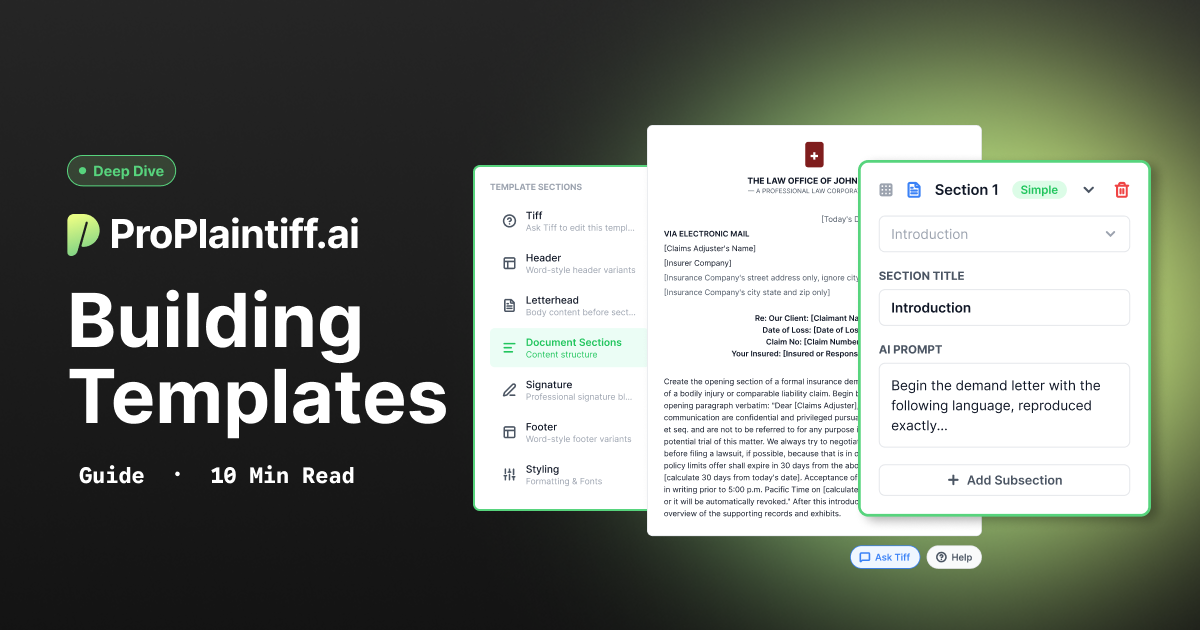
The annotated sample below shows what each section of a workers comp settlement demand should contain. Placeholder language is shown in brackets. Use this as a drafting template or as a reference for evaluating whether your current demands include all required components.
RE: Workers Compensation Settlement Demand Claimant: [Full Name] Date of Birth: [DOB] Claim Number: [Carrier Claim Number] Date of Injury: [Date] Employer: [Employer Name] Insurer/TPA: [Insurance Carrier or Third-Party Administrator] Adjuster: [Adjuster Name, if known]
Dear [Adjuster Name or Claims Department]:
This letter constitutes a formal demand for settlement of the above-referenced workers compensation claim. [Claimant name] suffered a compensable [describe injury type, e.g., lumbar spine injury] on [date of injury] while employed as a [job title] at [employer]. This demand is submitted on behalf of [Claimant] and requests settlement in the amount of $[X] as detailed below.
What this section does: Identifies all parties, anchors the claim, and puts the adjuster on notice that a formal settlement demand is being made. Include the claim number on every page.
Injury Description On [date], [Claimant] was [describe the mechanism of injury, e.g., lifting a [weight] object when he felt immediate pain in his lower back]. [Claimant] reported the injury to [supervisor name] on [date] and sought medical treatment at [facility] on [date].
Medical Treatment History Following the injury, [Claimant] received the following treatment:
[Date]: Initial evaluation at [facility]; diagnosis of [diagnosis]
[Date]: MRI of [body part] revealing [findings]
[Date]: Physical therapy initiated; [X] sessions completed
[Date]: Orthopedic evaluation with Dr. [Name]; recommendations for [treatment]
[Date]: [Surgery/procedure if applicable]
[Date]: Maximum medical improvement (MMI) declared by Dr. [Name]
What this section does: Establishes the compensable injury, the mechanism of harm, and the complete treatment record. Every entry should be documented and traceable to a medical record. Gaps in the timeline invite adjuster questions.
Permanent Impairment On [date], Dr. [Physician Name] assigned a permanent impairment rating of [X]% whole person impairment (WPI) to the [body part], based on [AMA Guides edition or applicable state methodology]. This rating reflects [brief description of the basis, e.g., limited range of motion, positive MRI findings, surgical history].
[If applicable:] An independent medical examination (IME) conducted by Dr. [IME Physician] on [date] assigned a rating of [X]%, which [claimant disputes / is consistent with treating physician findings].
The applicable permanent disability rate under [state] law for a [X]% WPI rating is $[X] per week for [X] weeks, totaling $[X].
What this section does: This is the most technically complex section of a workers comp demand. The impairment rating directly drives the permanent disability calculation. Present the rating, the methodology, the physician's basis, and the dollar calculation in one place. If there's a disputed IME, address it here rather than leaving it for the adjuster to raise.
|
Benefit |
Amount |
|
Medical expenses to date |
$[X] |
|
Temporary total disability (TTD) benefits |
$[X] ([X] weeks at $[X]/week) |
|
Temporary partial disability (TPD) benefits |
$[X] |
|
Permanent disability based on [X]% WPI |
$[X] |
|
Future medical care (life care plan or estimate) |
$[X] |
|
Vocational rehabilitation (if applicable) |
$[X] |
|
Total documented claim value |
$[X] |
Based on the above, and accounting for [any litigation risk factors, comorbidities, or disputed issues], we are prepared to resolve this claim for a lump sum settlement of $[DEMAND AMOUNT].
What this section does: Gives the adjuster a clean, itemized table they can take to their supervisor or reserve committee. Every line needs a source: a bill, a wage record, a life care plan, or a benefit calculation under the applicable state fee schedule. Undocumented numbers don't move reserving.
Formal Settlement Demand Claimant [Name] hereby demands $[AMOUNT] to settle all claims arising from the [date] workplace injury, including all past medical expenses, temporary disability benefits, permanent disability benefits, and future medical care. This settlement, if accepted, will resolve the claim in its entirety and release [Employer] and [Carrier] from all further liability under this claim.
This demand is open for acceptance until [DATE, typically 30 days]. We reserve the right to withdraw this demand or modify the settlement amount if the carrier does not respond within the specified timeframe.
Please confirm receipt of this demand and advise as to the carrier's response.
What this section does: States the number, defines what it resolves, and creates a deadline. The deadline is important: it creates urgency without being adversarial and gives you grounds to move if the carrier doesn't engage.
The AI workflow for generating a workers comp demand letter runs in four steps:
Upload the source documents
Let the AI summarize treatment and extract the impairment rating
Calculate damages
Generate the final letter
Platforms in this category often market first-draft generation in minutes, subject to document volume and attorney review. From upload to a reviewable first draft, the process is significantly faster than manual assembly.
You upload everything: medical records, the impairment rating report, billing statements, wage records, any IME reports, and the life care plan if one exists. The AI reads the full document set.
The AI reads the records and builds a treatment timeline from date of injury through MMI. It extracts the diagnosis, treating providers, significant findings, and the impairment rating percentage and methodology. What you get back is a structured summary ready for the demand, not a raw records dump.
The AI extracts medical bills, calculates temporary disability benefits from wage records and treatment dates, applies the applicable state permanent disability schedule to the impairment rating, and flags future medical recommendations for the life care estimate. Every figure is tied to a source document.
The AI drafts the letter in your firm's format, with the treatment summary, impairment analysis, damages table, and formal settlement demand assembled into a single document. The attorney reviews, adjusts the demand number and any strategic framing, and sends.
|
Demand Generation Step |
What Happens |
|
Upload documents |
Records, impairment reports, bills, wage records entered into system |
|
AI summarizes treatment |
Chronology, diagnosis, MMI date, treating providers extracted |
|
Extract impairment |
Rating percentage, body part, methodology, physician identified |
|
Calculate damages |
TTD, permanent disability, medical expenses, future medical totaled |
|
Draft demand letter |
Complete letter generated in firm format with all sections assembled |
Automate your workers comp demand drafting.
AI summarizes medical records for workers comp demands by reading the full record set, identifying clinically and legally significant entries, and producing a structured treatment narrative covering the diagnosis, treatment history, providers, work restrictions, and prognosis. This replaces the manual process of reading hundreds of pages and extracting relevant entries by hand.
For workers comp specifically, the AI also flags maximum medical improvement (MMI) determinations, work restriction notes, and return-to-work status, all of which affect the benefits calculation and the settlement demand framing.
|
Medical Summary Element |
What's Included |
|
Diagnosis |
Primary compensable diagnosis, secondary findings |
|
Treatment timeline |
Date of injury through MMI, chronologically organized |
|
Treating providers |
All physicians, therapists, and facilities |
|
Work restrictions |
Functional limitations assigned by treating physician |
|
Prognosis |
MMI status, future treatment needs, permanency findings |
Any platform that processes client medical records must be evaluated for HIPAA compliance. Confirm a Business Associate Agreement is in place and that the platform operates in a secure, closed environment before uploading ePHI.
See how AI medical record summarization works for workers comp claims.
AI calculates workers comp settlement value by extracting documented benefit components from uploaded records and applying the applicable state benefit schedule to each. Economic damages (medical bills, TTD, permanent disability) are extracted and totaled from source documents. Future medical care is estimated from physician recommendations and, where available, a life care plan.
AI can assist with extracting benefit inputs and drafting a baseline calculation, but counsel must verify the applicable state schedule, impairment methodology, and settlement rules before finalizing any number. Workers comp settlement value is more formulaic than personal injury settlement value because most benefit components are defined by state statute, but those statutes differ significantly across jurisdictions.
|
Settlement Component |
How AI Calculates It |
|
Medical expenses |
Extracted from billing statements; total billed and paid separated |
|
Temporary total disability |
Calculated from wage records, TTD rate, and treatment dates |
|
Permanent impairment |
Impairment percentage applied to applicable state benefit schedule |
|
Future medical care |
Extracted from physician recommendations and life care plan estimates |
Calculate workers comp settlements with AI.
Where permanent impairment is in play, the demand should clearly identify the impairment rating, the rated body part, the rating methodology, the physician who assigned it, and the benefit impact under the applicable state schedule.
Impairment rules and methodologies vary by jurisdiction: some states follow AMA Guides, others use their own systems, and settlement exposure doesn't reduce to a single universal formula. Verify which methodology applies in your state before building the calculation.
Where a treating physician rating and an IME rating conflict, address the dispute directly in the demand. Don't leave it for the adjuster to raise. Present the basis for the treating physician's rating, acknowledge the IME if it exists, and explain why the treating physician's findings should carry more weight.
|
Impairment Data Point |
Why It Belongs in the Demand |
|
Rating percentage |
Drives the permanent disability dollar calculation |
|
Body part rated |
Identifies the compensable injury |
|
Rating methodology |
Establishes credibility; AMA Guides compliance matters |
|
Physician opinion |
Source of the rating; treating vs. IME distinction |
|
Work restrictions |
Supports vocational impact and future wage loss arguments |
AI merges case documents into a complete workers comp settlement package by combining the demand letter, medical chronology, impairment summary, and damages table into a single, organized file every source document is traceable from.
This is the move that separates demands that move reserving from demands that generate follow-up requests. The adjuster should open the file and immediately see the impairment rating, the benefit calculation, and the medical support. If they have to dig for it, they will use the digging as a reason to delay.
|
Source Document |
What It Contributes to the Package |
|
Medical records |
Treatment history, MMI determination, work restrictions |
|
IME reports |
Independent impairment rating, any disputed findings |
|
Billing statements |
Medical expense totals, outstanding balances |
|
Wage records |
Average weekly wage, TTD rate calculation |
In practice, adjusters handling workers comp claims often respond better to demands that are concise, chronological, itemized, and well-documented. Demands that bury the number, omit the impairment rating methodology, or present an undocumented damages calculation tend to generate follow-up requests before an offer comes.
|
Section |
Format Adjusters Prefer |
|
Claim summary |
One paragraph: claimant, claim number, injury date, compensable body parts |
|
Treatment timeline |
Chronological entries with dates, providers, and key findings |
|
Damages table |
Itemized rows with dollar amounts and source documentation |
|
Settlement demand |
Specific dollar amount with a clear statement of what it resolves |
Control the narrative before the adjuster does. A demand that walks the adjuster through the impairment rating, the benefit calculation, and the medical support in the right sequence makes it harder to dispute and easier to approve.
Generate adjuster-ready workers comp demand letters.
AI demand drafting improves speed and consistency over manual drafting for workers comp demands. Damages accuracy still depends on document quality, correct benefit schedule application, and attorney review of the final number. Manual drafting retains the advantage on complex claims with disputed causation, multiple body parts, or unusual jurisdictional issues that require attorney judgment from the start.
For standard, single-injury workers comp claims at volume, the comparison is straightforward. The question is where your attorneys and paralegals should be spending their time.
|
Factor |
AI Drafting |
Manual Drafting |
|
Speed |
Minutes from upload to first draft |
Hours to days depending on record volume |
|
Consistency |
Same structure and format on every demand |
Varies by drafter and workload |
|
Impairment calculation |
Automated extraction and benefit schedule application |
Manual review and calculation |
|
Medical summaries |
Generated from full record set automatically |
Paralegal reads and summarizes by hand |
|
Complex disputed claims |
Requires attorney judgment and adjustment |
Attorney-driven from the start |
|
Cost per demand |
Decreases with volume |
Increases with volume |
The primary benefit of AI demand generation for workers comp attorneys is throughput: more complete, consistent demands produced per paralegal hour, which directly affects how many files move to resolution each month and how much of the available settlement value gets captured per claim.
|
Benefit |
What It Means for the Firm |
|
Faster drafting |
More claims resolved per month without adding headcount |
|
Accurate damages |
Correct benefit schedule application reduces adjuster pushback |
|
Consistent format |
Every demand includes all required components in the right order |
|
Automated summaries |
Paralegals verify rather than extract, which is the right use of their time |
Stop handing the carrier reasons to delay. A demand with missing documentation, an undocumented impairment basis, or an unitemized damages table invites follow-up requests. AI builds the complete package from the source documents so the adjuster has everything they need to move.
Use AI for workers comp demand letters.
An AI workers comp settlement package includes four documents: the demand letter, the medical chronology, the impairment analysis, and the damages breakdown. All four are generated from the same uploaded source documents and assembled into a single file.
The top-level document: claim summary, treatment overview, impairment rating, damages calculation, and the formal settlement demand. Written in your firm's format, at the tone you specify. See how AI demand letter generation works.
A structured treatment timeline from date of injury through MMI, with every provider, diagnosis, significant finding, and work restriction documented chronologically. The section that shows the adjuster the full scope of the injury without requiring them to read the raw records. See how AI medical chronology works.
The impairment rating, the physician who assigned it, the methodology, the applicable body part, and the permanent disability dollar calculation under the state benefit schedule. Presented as a standalone section so the adjuster can find it immediately.
A clean table of all benefit components: medical expenses, TTD, permanent disability, future medical. Every line tied to a source document. No gaps. Nothing buried. See how AI document generation works.
|
Settlement Package Document |
What's Included |
|
Demand letter |
Claim summary, treatment overview, impairment, damages, settlement request |
|
Medical chronology |
Full treatment timeline from injury date through MMI |
|
Impairment analysis |
Rating, methodology, physician, state schedule calculation |
|
Damages table |
Itemized benefit components with source citations |
See how AI builds a complete workers comp settlement package.
A workers comp settlement demand letter that includes all required components (compensable injury, treatment history, impairment rating with methodology, itemized benefit calculation, and a specific settlement demand) gives the adjuster everything they need to evaluate the claim without requesting more information. AI generates this package from uploaded records, billing, and impairment reports in minutes rather than hours.
The chronology is the blueprint. The impairment analysis is the anchor. The damages table is the proof. AI builds all three from the same document set so your team focuses on strategy, not assembly.
If it isn't documented, it didn't happen. AI makes sure it's documented.
Request a demo of the AI workers comp demand letter generator.
A strong demand letter should follow a clear six-part structure: a claim introduction, a summary of the injury and treatment, a medical chronology, an impairment rating analysis, an itemized damages table, and your formal settlement demand. Make sure every dollar amount you list can be traced back to a specific medical or wage document.
At a minimum, you must include a description of the injury, a full treatment history through maximum medical improvement, and your permanent disability calculations based on your state's specific schedule. You should also quantify future medical costs and provide the exact physician methodology used for the impairment rating to prevent adjusters from stalling your claim.
Yes, AI tools can read through medical records and wage statements to automatically build a structured demand letter with treatment summaries and itemized damages. While many tools are marketed for personal injury, the workflow is easily adapted for workers comp as long as you verify the software is HIPAA-compliant and provides a BAA.
The impairment rating is the most critical part of the letter because it dictates the permanent disability value. You should clearly state the percentage, the body part, the rating system used, and the physician's name. If there is a dispute between different medical ratings, address it directly in the demand to stay ahead of the adjuster.
AI is excellent at totaling documented costs like medical bills and temporary disability payments while applying the correct state benefit schedule to your impairment ratings. It provides the raw numbers, but the attorney still needs to adjust the final demand to account for litigation risks and strategic negotiation factors.
Yes, automation tools handle the time-consuming work of extracting data from records and drafting the letter in your firm’s specific format. For high-volume firms, this turns a process that usually takes days into one that takes minutes, helping you resolve more claims and capture full settlement value faster.
The best time to send a demand is once the claimant reaches maximum medical improvement and you have a final impairment rating and future medical estimate. Sending it too early leads to lowball offers while waiting too long allows the insurance carrier to harden their own lower valuation of the case.

Agentic case management platform designed to streamline the work of law firms.


Join our Newsletter
Welcome to ProPlaintiff!
Oops! Something went wrong, please try again


.svg)