


Pre-litigation software helps personal injury firms manage cases before a lawsuit is filed. It connects intake, medical treatment, insurance information, records collection, deadlines, demand preparation, negotiations, and the decision to settle or proceed into litigation. The strongest platforms also help managers identify cases that have stopped progressing, which employee owns the next action, and how long each matter has remained in its current stage.
Those capabilities matter because pre-litigation delays aren't always caused by complex legal questions. Cases can spend weeks waiting for records, bills, treatment updates, demand review, or insurer responses. When those delays aren't visible, staff may keep completing individual tasks without recognizing that an entire group of matters is aging in the same workflow stage.
This guide compares pre-litigation software for personal injury firms, including CASEpeer, Filevine, SmartAdvocate, CloudLex, CasePacer, and GrowPath's successor, Jove. It also explains how to structure pre-litigation stages, measure days on desk, automate repetitive work, and use ProPlaintiff's AI-native case management to connect evidence review with demand and litigation preparation.
Pre-litigation software manages the activities that occur before a personal injury lawsuit is filed. It helps attorneys and case managers organize intake, treatment, medical records and bills, insurance information, liens, expenses, client communication, tasks, demand packages, negotiations, and the decision to settle or litigate.
The software should provide an accurate operational picture of each active matter.
For example, a case manager should be able to establish whether the client is still treating, which providers haven't supplied records, whether outstanding bills remain, and what must happen before a demand can be prepared.
A supervisor should also be able to identify several matters with the same problem without opening each case individually.
That distinction separates basic case storage from effective pre-litigation management.
A useful platform doesn't simply record what staff have done. It also makes the next required action visible and provides enough reporting to identify recurring delays.
Personal injury firms need dedicated pre-litigation workflows, but they don't necessarily need a separate product marketed as pre-litigation software.
Most practices use one of three approaches:
The appropriate choice depends on the firm's current software and the operational problems it needs to address.
For example, CASEpeer includes medical-treatment and settlement workflows designed specifically for PI cases. Filevine offers configurable processes that firms can adapt to their preferred stages and assignments.
However, a firm that already manages matters reliably may not need a complete CMS replacement merely to improve medical chronologies or demand drafting.
That firm may benefit more from strengthening its existing workflow with specialized case-analysis and document-production tools.
Effective pre-litigation case management requires visibility into the information that determines whether a matter can advance.
For PI firms, that includes treatment, medical records, insurance, liens, demand readiness, negotiations, and responsibility for outstanding work.
Pre-litigation begins with accurate intake information.
The firm should capture the incident date, location, parties, reported injuries, insurance details, treatment status, and other information needed for initial evaluation.
Once representation begins, the information should remain connected with the active matter.
For example, the incident date may affect limitation-period analysis, while the client's initial treatment information helps the case manager identify providers whose records must be requested.
Duplicating intake information into disconnected systems creates opportunities for inconsistent facts and unnecessary staff work.
Medical treatment often determines when a PI matter is ready for meaningful evaluation and demand preparation.
Pre-litigation software should track providers, appointments, treatment status, reported injuries, and important updates.
However, treatment tracking should reflect the client's actual medical circumstances rather than automatically treating a lack of recent appointments as a legal problem.
A treatment gap may have several explanations, including scheduling delays, financial barriers, recovery, or a change in medical recommendations.
The software should flag the issue for review without assigning an unsupported medical conclusion.
Medical-record collection is one of the most important pre-litigation workflows.
A firm may need records and bills from emergency departments, imaging centers, primary care physicians, therapists, surgeons, and other providers.
The system should show which records were requested, when follow-up occurred, what was received, and which materials remain outstanding.
It should also distinguish medical records from billing statements.
Receiving a treatment record doesn't establish that the corresponding bill has been collected.
For high-volume practices, separate request statuses and automated follow-up can prevent demands from being delayed by documents that no one realized were missing.
Pre-litigation case management should organize relevant insurance information, including identified carriers, available policies, coverage questions, and supporting correspondence.
Coverage information can influence settlement strategy and whether further investigation is necessary.
For example, a trucking collision may involve several potentially applicable policies or defendants.
The software should allow the firm to maintain those relationships without reducing a complex coverage question to a single incomplete field.
Attorneys remain responsible for interpreting coverage, exclusions, priority, and other legal issues.
PI firms also need to track case expenses, liens, letters of protection, and other potential reimbursement obligations.
These figures affect settlement calculations and the client's eventual recovery.
However, lien status should distinguish an asserted balance from an amount that has been verified, disputed, negotiated, or resolved.
A system that stores only one balance may obscure important financial differences.
The best workflow preserves the supporting documents and identifies who is responsible for the next action.
Demand readiness should be a defined operational status rather than an informal judgment buried in case notes.
Before preparing a demand, the firm may need to confirm that appropriate treatment information, medical records, bills, liability evidence, insurance details, wage documentation, and other relevant materials have been reviewed.
Not every case requires the same checklist.
However, the system should make required materials visible and flag missing information before an employee begins drafting.
A demand-readiness checklist can reduce preventable rework when cases move from records collection into legal review.
Software reduces pre-litigation administrative work when it automates recurring coordination and creates the next appropriate action as cases progress.
Useful automation targets include records follow-up, treatment check-ins, client reminders, document requests, assignments, status updates, deadline alerts, and demand-readiness reviews.
For example, when a medical provider supplies the requested records, the system should update the request status and identify any remaining work.
If the bill hasn't arrived, a separate follow-up may still be necessary.
Once all required documents are available, the case can move into review without waiting for someone to manually reconstruct its status.
Filevine documents phase-based taskflows and automated assignments, while SmartAdvocate supports event-triggered tasks, reminders, messages, and documents.
These features can standardize recurring procedures, but firms must configure them around actual responsibilities.
Automation shouldn't make final legal decisions or silently close matters that require attorney attention.
The operational objective is to reduce repetitive coordination while keeping case ownership clear.
The best pre-litigation software depends on how the firm manages matters and what causes its cases to stall.
Some platforms provide established PI workflows, while others offer greater customization or specialized AI for evidence-heavy work.
|
Platform |
Best Fit |
Primary Pre-Litigation Strength |
|
CASEpeer |
PI firms wanting structured workflows |
Treatment, tasks, settlements, timelines |
|
Filevine |
Firms prioritizing customization and AI |
Configurable phases, automation, LOIS |
|
SmartAdvocate |
High-volume PI and complex operations |
WorkPlans, automated procedures, dashboards |
|
CloudLex |
PI firms seeking connected cloud case management |
Intake through settlement, Lexee AI |
|
CasePacer |
High-volume plaintiff practices |
Task-driven plaintiff workflows |
|
Jove, Formerly GrowPath |
Analytics-driven PI firms |
Lead scoring, intake analytics, case visibility |
|
Existing CMS + ProPlaintiff |
Firms prioritizing evidence and demand workflows |
Source-linked analysis and legal document production |
The table compares use cases rather than assigning an arbitrary overall ranking.
Firms should begin by identifying their own bottleneck. A practice with weak treatment tracking has different requirements from one whose cases routinely wait several weeks for demand drafts.
CASEpeer provides one of the clearest examples of PI-specific pre-litigation case management.
Its case-management functionality includes medical treatment tracking, case timelines, task assignments, document management, litigation events, expenses, and negotiations.
These features reflect the information personal injury firms routinely manage before filing suit.
For example, a case manager can monitor treating providers, records requests, bills, and outstanding tasks within the matter.
CASEpeer may therefore be attractive to firms that want established PI structures without designing every workflow from the beginning.
However, buyers should still test exception handling and any specialized matter types the firm manages.
Filevine offers configurable pre-litigation workflows supported by tasks, matter data, documents, reporting, and AI.
Its phase-based automation can help firms organize work around treatment, records collection, demand preparation, negotiation, and litigation.
Filevine also provides LOIS AI functionality for case questions, document analysis, medical chronologies, and drafting.
That combination may appeal to organizations that want operational case management and substantive AI within one environment.
However, configurability requires process design.
Firms should define consistent case stages, required fields, and staff responsibilities before creating extensive automations.
Otherwise, customization may reproduce inconsistent processes rather than correct them.
SmartAdvocate provides established plaintiff workflows and extensive automation that can support substantial pre-litigation dockets.
Its WorkPlans and Automated Procedures help firms standardize tasks, reminders, communications, and document workflows.
The platform also offers dashboards and reports built around case information, including critical deadlines and outstanding requests.
These capabilities can help managers identify cases that require attention without inspecting every file.
SmartAdvocate may therefore suit firms with several departments or complex PI operations.
However, its depth can create implementation and training requirements, so buyers should test how easily staff can use the configured system.
CloudLex is designed specifically for plaintiff personal injury firms and supports case management from intake through settlement.
Its workflows include medical information, documents, client communication, settlement tracking, and related case activities.
Lexee AI adds medical summaries, chronologies, case-file questions, demand drafting, and selected administrative assistance.
That makes CloudLex relevant to firms seeking a PI-focused CMS with native AI rather than assembling separate tools for each stage.
However, buyers should verify package availability, implementation requirements, and the reliability of AI outputs using representative matters.
CRM software can support intake and lead conversion, but it generally doesn't replace the full pre-litigation case-management workflow.
Platforms such as Lawmatics and Lead Docket help firms capture inquiries, automate follow-up, qualify prospects, and track conversion.
Once representation begins, however, the firm must manage medical treatment, evidence, insurance, records requests, liens, demands, and legal deadlines.
These activities require a more extensive matter-management environment.
For example, Lawmatics can transfer a signed client's intake information into Filevine through its official integration.
That allows the firm to preserve relevant details without expecting the CRM to manage the entire claim.
The recommended architecture depends on the firm's existing systems, but the key distinction remains consistent: intake software manages acquisition and conversion, while pre-litigation case management coordinates the work of representation.
Days on desk measures how long a matter, task, or workflow stage has remained assigned or inactive without meaningful progression.
For PI firms, the metric is useful because pre-litigation delays can accumulate across several departments and outside parties.
However, there isn't one universally sufficient days-on-desk number.
Managers should distinguish time spent in a stage from time spent waiting on an employee, medical provider, client, or insurer.
Days in phase measures the time elapsed since a matter entered its current workflow stage.
The basic calculation is the current date minus the stage-entry date.
For example, a matter may have spent 74 days in treatment, 31 days awaiting records, or 16 days in demand preparation.
Those figures identify where cases accumulate, but they don't independently establish why a delay occurred.
Days since last activity measures the time elapsed since the most recent meaningful case event.
That qualification is important because an employee opening a matter or adding an administrative note doesn't necessarily represent substantive progress.
Firms should define meaningful activity according to the stage.
For example, meaningful records activity may include sending a request, receiving a response, or identifying a missing provider.
The metric becomes useful when it distinguishes case progression from routine system activity.
This metric measures how long a task or workflow responsibility has remained with a particular employee or department.
It can help identify internal bottlenecks involving records review, demand preparation, attorney approval, lien negotiations, or settlement statements.
However, management should account for workload and matter complexity before interpreting the results.
A case requiring extensive legal analysis shouldn't automatically be treated like a routine demand awaiting a signature.
External waiting time should be separated from delays controlled by the firm.
Relevant categories include waiting on medical providers, clients, insurers, employers, and other outside parties.
For example, a demand may be delayed 36 days, but the operational explanation matters.
If the firm waited 32 days for a provider's records, the next action concerns records follow-up.
If the records were complete and the demand sat in an internal review queue for 32 days, management has identified a different problem.
|
Dashboard Metric |
Operational Purpose |
|
Days in Current Phase |
Identify stage bottlenecks |
|
Days Since Meaningful Activity |
Identify stale matters |
|
Days Waiting on Records |
Identify provider delays |
|
Treatment Complete to Demand |
Measure internal preparation time |
|
Demand to Insurer Response |
Monitor external response time |
|
Offer to Counteroffer |
Measure negotiation workflow time |
|
Days Awaiting Attorney Review |
Identify internal approval bottlenecks |
The strongest dashboards combine elapsed time with ownership and an explicit reason for waiting.
That allows managers to assign corrective work rather than simply observe that a case is old.
Days on desk provides a useful starting point, but effective pre-litigation management requires a broader scorecard.
Metrics should cover each major stage of the matter and distinguish workload from actual progress.
|
Stage |
Useful Metrics |
|
Intake |
Time to contact, lead-to-sign rate, cost per signed case |
|
Treatment |
Active treatment cases, days since treatment update, flagged gaps |
|
Records |
Outstanding requests, records turnaround, incomplete bills |
|
Demand |
Demand readiness, drafting time, attorney review time |
|
Negotiation |
Demand response time, offer-to-counter time, unresolved negotiations |
|
Resolution |
Settlement completion, lien resolution, disbursement readiness |
|
Operations |
Case age, workload by staff member, overdue tasks, stale matters |
Managers should review these metrics by case type and complexity where appropriate.
For example, a trucking matter involving several defendants may require a different expected timeline from a straightforward motor vehicle claim.
Combining them into one average may conceal meaningful differences.
The objective is to identify manageable delays, not to pressure attorneys into premature settlement or filing decisions.
Pre-litigation stages should reflect meaningful changes in case responsibility and readiness.
A useful sequence for many PI firms is:
These stages are a starting framework rather than a mandatory sequence for every matter.
Some cases require litigation before treatment ends. Others may involve immediate liability disputes, evidence-preservation issues, or limitation deadlines that change the expected workflow.
Each stage should have a clear owner, entry conditions, required work, and exit criteria.
Without those definitions, employees may use the same status label to describe different operational situations.
The decision to file suit belongs to the attorney and depends on the law and circumstances of the specific matter.
Relevant considerations include limitation periods, tolling, disputed liability, available evidence, insurance coverage, damages, negotiation progress, discovery needs, and the client's objectives.
For example, a firm may decide that pre-suit negotiations are unlikely to resolve a serious liability dispute.
Another matter may require filing because an applicable deadline is approaching, regardless of whether treatment or records collection is complete.
Pre-litigation software can support this decision by maintaining accurate deadlines, relevant documents, case history, and outstanding issues.
However, it shouldn't independently determine that a lawsuit must be filed or that continued negotiation is appropriate.
Once litigation begins, the system should preserve the existing record and introduce the appropriate litigation workflows without forcing staff to reconstruct the matter.
Yes. AI can reduce repetitive work during pre-litigation, particularly when firms must review substantial medical records, identify important facts, build chronologies, answer case-file questions, and prepare demand drafts.
However, AI provides the greatest operational value when the underlying matter information and workflow are already organized.
For example, a medical chronology tool may accurately extract treatment events, but the firm still needs to know whether all relevant providers have supplied records.
Similarly, a demand draft may use the available evidence correctly while overlooking a missing billing statement that should have been requested earlier.
AI and workflow management therefore address different parts of the same process.
Useful AI applications include:
Firms should measure AI performance according to factual accuracy, source traceability, completeness, and editing requirements.
Faster initial drafting is useful only when the resulting document requires less total work to finalize.
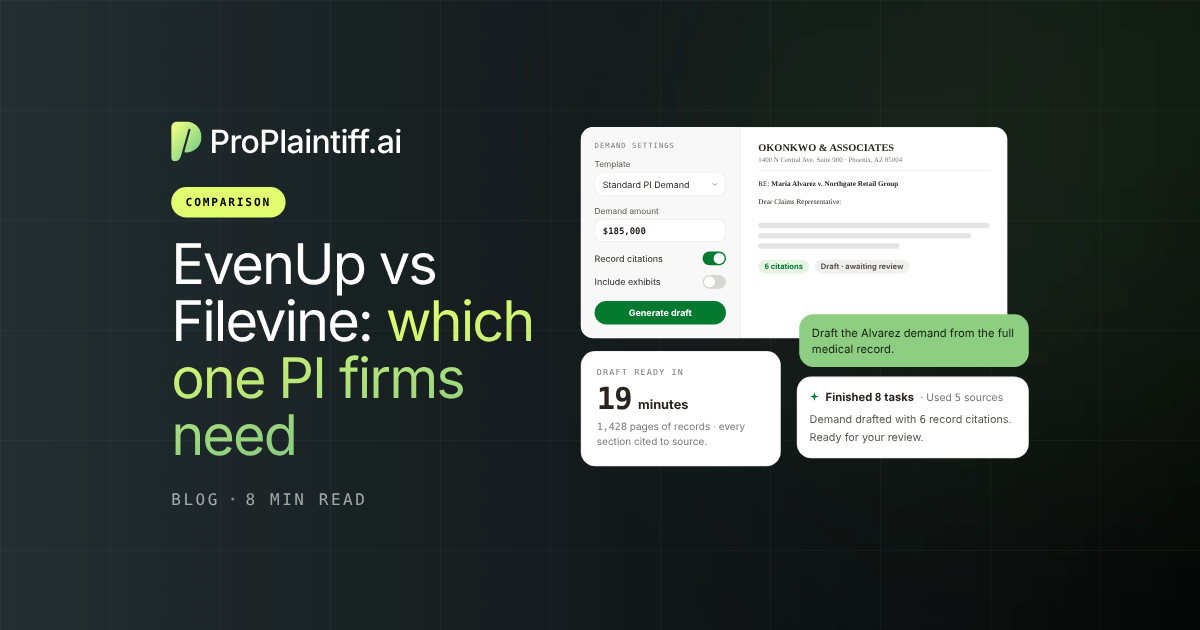
Have your medical records arrived, but the demand is still waiting on manual review?Explore ProPlaintiff's AI Medical Chronologies to see how source-linked treatment analysis can support demand preparation.
ProPlaintiff combines AI-native case management with plaintiff-specific evidence analysis, document production, and workflow capabilities.
Its role is particularly relevant when a firm needs to move from organized case information into substantive legal work.
Traditional CMS workflows help establish which stage a matter occupies, which documents are available, and who owns the next task.
ProPlaintiff adds case analysis and work-product generation through capabilities such as Ask Tiff, medical chronologies, demands, and DocGen.
For example, a case manager may confirm that all required medical records have arrived and the matter is ready for demand preparation.
The legal team can then analyze treatment events, verify relevant facts against source documents, and prepare a draft demand using the available case information.
Attorneys remain responsible for reviewing medical conclusions, evaluating damages, determining strategy, and approving the final work product.
That connection between case status and legal production is important because pre-litigation efficiency depends on both.
A dashboard that identifies a matter awaiting demand review provides visibility. A reliable drafting workflow helps the team act on that information.
Choosing pre-litigation software should begin with the firm's operational bottlenecks rather than vendor feature counts.
Before purchasing, identify where cases accumulate and how much staff time is devoted to moving them forward.
Then ask vendors to demonstrate the relevant work.
The strongest demonstration should follow a representative case from intake through treatment, records collection, demand drafting, and either settlement or litigation.
Ask the vendor to include a missing record, an overdue assignment, and an attorney review delay.
Those exceptions reveal whether the platform can identify operational problems and support corrective action.
Effective pre-litigation software gives plaintiff firms control over the work between retention and resolution. It should track treatment, records, insurance, liens, demands, negotiations, and deadlines while making stalled matters visible. PI-specific systems such as CASEpeer, CloudLex, and SmartAdvocate provide established workflows, while configurable platforms such as Filevine can accommodate more customized operating models.
However, software selection should begin with the firm's actual delays. A practice losing time to incomplete records needs better request tracking and follow-up. A firm with large demand-review queues needs greater drafting capacity and clearer attorney assignments. Days-on-desk reporting can identify those problems, but the firm must also establish procedures for resolving them.
ProPlaintiff connects AI-native case management with source-linked evidence analysis, medical chronologies, demand drafting, and legal document generation. Its workflows help attorneys and paralegals use verified case information to prepare reviewable work product while maintaining control over legal judgment and final approval. For firms trying to reduce avoidable pre-litigation delays, that connection between operational visibility and legal production deserves direct evaluation.
If your pre-litigation team can identify stalled cases but still spends substantial time preparing chronologies and demands, book a ProPlaintiff demo and follow a representative matter through records review, demand readiness, and document production. That exercise will show how the platform supports the work needed to move cases forward without losing source verification or attorney oversight.
The best software depends on the firm's workflows. CASEpeer offers structured PI case management, Filevine provides extensive customization, SmartAdvocate supports complex plaintiff operations, and CloudLex combines PI case management with Lexee AI. Firms should compare treatment tracking, records workflows, days-on-desk reporting, automation, and demand preparation using representative matters.
Not necessarily. Many PI case-management platforms include the workflows required for pre-litigation. Firms may also use a configurable CMS or add specialized AI and communication products to an existing system. The relevant question is whether the current software provides reliable case visibility and supports the work needed to advance matters.
CRM platforms can manage intake, qualification, follow-up, and lead conversion, but they generally don't provide complete pre-litigation case management. Active PI matters also require treatment tracking, medical-record collection, insurance information, liens, deadlines, demands, and settlement workflows. Firms should use appropriate downstream case-management tools after representation begins.
Firms calculate days on desk using dates associated with a case stage, assignment, or meaningful activity. Useful measures include days in phase, days since last activity, and days waiting on a particular employee or outside party. Separating internal delays from external waiting time makes the resulting dashboard more actionable.
Useful automation includes records-request follow-up, treatment check-ins, document requests, client reminders, task assignments, deadline alerts, demand-readiness checks, and negotiation follow-up. The system should create appropriate next actions based on case events while preserving clear responsibility. Attorneys must still make legal decisions requiring professional judgment.
That decision depends on attorney judgment and the circumstances of the matter. Relevant considerations include limitation periods, liability disputes, insurance coverage, evidence needs, discovery requirements, negotiation progress, and the client's objectives. Software can organize the necessary information and deadlines, but it shouldn't independently determine litigation strategy.
Yes. AI can help review medical records, prepare treatment chronologies, answer case-file questions, identify missing information, and draft demands. However, its usefulness depends on accurate source data and a clear human review process. Firms should evaluate factual accuracy, source citations, and total editing time rather than relying on generation speed alone.

Agentic case management platform designed to streamline the work of law firms.


Join our Newsletter
Welcome to ProPlaintiff!
Oops! Something went wrong, please try again