.webp)
.webp)
.webp)
.webp)

Updated September 2026
Can lawyers use ChatGPT in California?
Yes. But California is moving toward clearer rules for how attorneys use ChatGPT and other generative AI tools in legal practice.
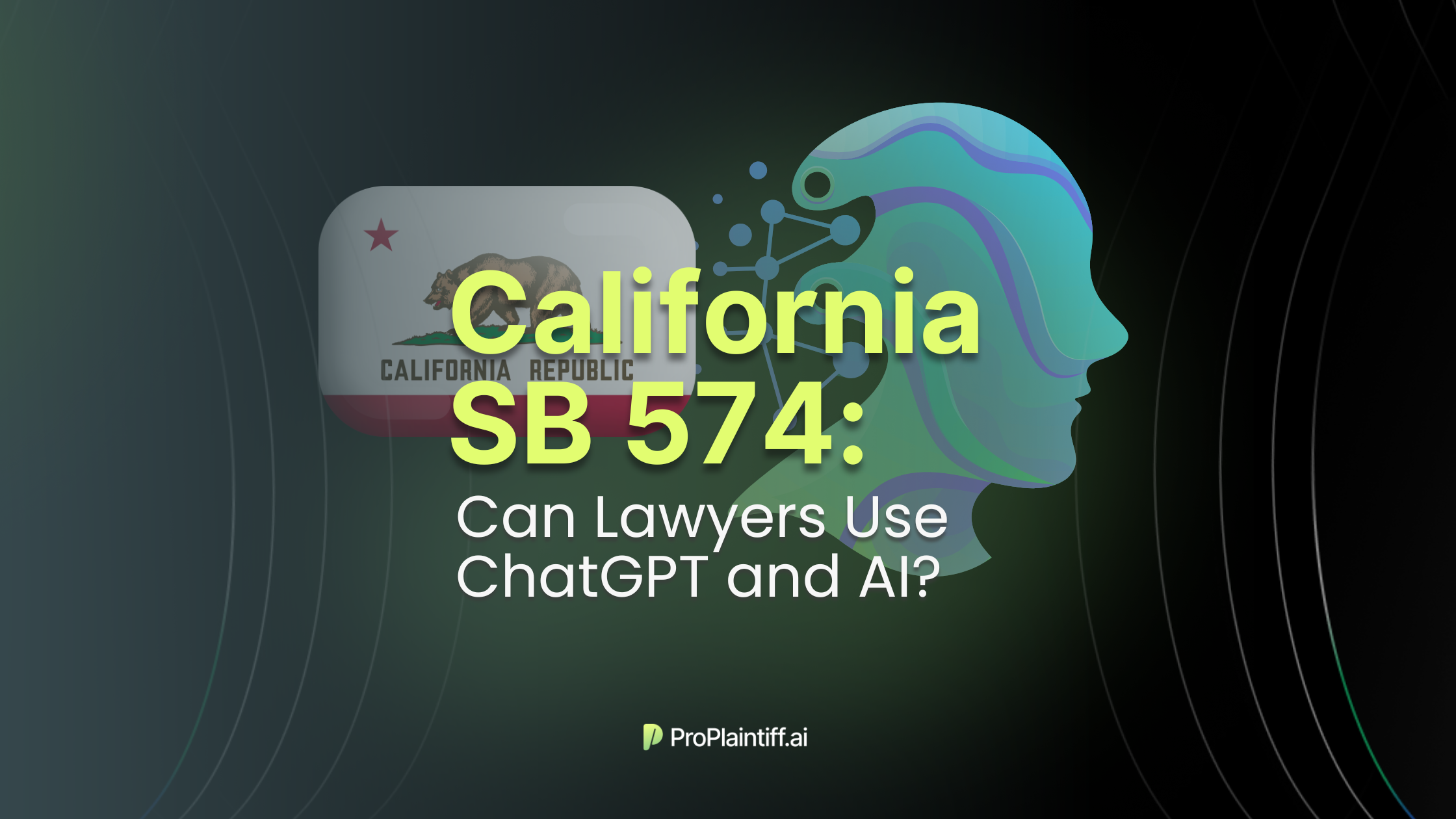
California Senate Bill 574, or SB 574, has passed the California Legislature and, as of September 2026, is awaiting action by Governor Gavin Newsom.
If signed into law, SB 574 would establish requirements related to client confidentiality, verification of AI-generated work, legal citations, attorney judgment, and certain disclosures to courts.
The key takeaway is simple: California is not banning lawyers from using AI. It is placing clearer responsibilities on attorneys who choose to use it.
For law firms already using ChatGPT, Claude, or legal-specific AI platforms, SB 574 makes AI policies, vendor selection, and attorney review increasingly important.
California SB 574 is proposed legislation governing certain uses of generative artificial intelligence by attorneys and arbitrators.
For attorneys, the bill would establish several core requirements. Lawyers using generative AI would be expected to:
SB 574 does not prohibit the use of generative AI. Instead, it creates a framework for using it with appropriate safeguards and attorney supervision.
SB 574 does not create a blanket ban on ChatGPT, Claude, or other generative AI tools.
Attorneys may still use AI to assist with tasks such as:
The important distinction is that AI may assist with legal work, but the attorney remains responsible for the final product and any legal judgment involved.
Confidentiality is one of the most significant concerns when lawyers use generative AI.
Law firms regularly handle sensitive information such as:
Under SB 574, attorneys would need to be particularly careful when entering this information into AI systems.
Before using an AI platform with client data, firms should understand:
The relevant question is not just whether an AI tool can analyze a document. It is whether the firm's use of that tool protects the client's information appropriately.
Under SB 574's proposed requirements, attorneys would need to take reasonable steps to verify AI-generated material they use.
This matters because generative AI can produce inaccurate or incomplete information that still sounds convincing.
For example, an AI system might:
AI can speed up legal work, but its output should still be reviewed before it is relied upon.
Yes. Under the proposed legislation, attorneys responsible for documents submitted to a court would need to personally verify the citations contained in those filings, including citations generated by AI.
That means attorneys should confirm that:
This is particularly important when using general-purpose AI tools for legal research.
Yes, provided the attorney reviews the resulting work and remains responsible for it.
Generative AI can assist with drafting documents such as:
The attorney must still determine whether the final document is accurate, appropriate, and ready to use.
SB 574's approach is not to prohibit AI-assisted drafting. It is to make clear that using AI does not transfer professional responsibility away from the lawyer.
SB 574 does not create separate rules for ChatGPT and legal-specific AI platforms.
Attorneys remain responsible for complying with their obligations regardless of which software they use.
However, different AI systems can create very different workflows.
A general-purpose chatbot typically starts with a prompt and whatever information the user provides.
A legal AI platform can instead be built around case files, source documents, permissions, legal workflows, and attorney review.
When evaluating an AI platform, law firms should consider:
These questions are becoming more important as AI moves from occasional experimentation into everyday legal operations.
ProPlaintiff is an AI-native case management platform built specifically for personal injury law firms.
Instead of requiring attorneys and paralegals to move case information between disconnected AI tools, ProPlaintiff integrates AI into the case management workflow.
The platform can assist with:
This gives legal teams a structured environment for using AI alongside the case information they already manage.
ProPlaintiff's AI tools operate within the context of the firm's case workflow.
Case documents, medical records, evidence, tasks, deadlines, and other case information can live within the same environment used by the legal team.
This reduces the need to repeatedly move sensitive information between a case management system and standalone consumer AI tools.
AI-generated documents and analysis can be reviewed and refined by the legal team before they are used.
For example, ProPlaintiff can help prepare a demand letter or medical chronology using information contained in the case file. The attorney can then review and revise that work before finalizing it.
ProPlaintiff's AI paralegal, Tiff, can also help teams search case documents, retrieve information, summarize evidence, and prepare drafts using the context of the case.
ProPlaintiff can provide source references in applicable workflows, helping attorneys trace information back to the underlying material.
For tasks such as demand letters, medical chronologies, case summaries, and document analysis, source-grounded information can make review and verification more efficient.
That does not replace attorney verification. It makes the process easier to perform.
SB 574 primarily establishes obligations for attorneys. It does not create a government certification program for legal AI products.
For that reason, simply purchasing a particular AI platform would not automatically make a law firm compliant.
A more useful question is:
Does the platform help the firm build AI workflows that support its obligations under SB 574?
ProPlaintiff is designed around principles that align with many of the issues addressed by the bill, including attorney oversight, controlled handling of case information, reviewable AI-assisted work, and source-grounded outputs.
Individual attorneys and law firms remain responsible for determining and maintaining compliance with applicable laws and professional rules.
Law firms using generative AI should consider adopting a formal AI policy rather than allowing employees to establish their own practices.
A firm policy should address:
Firms should also review how AI is already being used internally.
Employees may already be using ChatGPT or similar tools for drafting, summarization, research, or document analysis without a consistent firm-wide process.
Understanding current usage is an important first step toward managing AI responsibly.
Yes. California does not currently impose a blanket prohibition on attorneys using ChatGPT or other generative AI tools. SB 574 would establish requirements governing how attorneys use AI while preserving their responsibility for the legal work.
SB 574 is proposed California legislation addressing attorneys' and arbitrators' use of generative artificial intelligence. As of September 2026, it has passed the Legislature and is awaiting action by Governor Gavin Newsom.
No. The bill does not ban ChatGPT or generative AI. It establishes requirements related to confidentiality, accuracy, legal citations, disclosures, and attorney responsibility.
Attorneys should carefully evaluate any AI platform before entering confidential or nonpublic client information into it. Firms should understand the provider's security, access controls, data-handling policies, and model-training practices.
Yes. AI can assist with drafting, but attorneys remain responsible for reviewing the final work and ensuring that it is accurate and appropriate.
Yes, but AI-generated research and citations should be independently verified. Under SB 574, attorneys responsible for court filings would need to personally verify the citations contained in those documents.
No. SB 574 does not establish a government-approved list of AI platforms. Firms should evaluate software based on confidentiality, security, source verification, attorney oversight, and data-handling practices.
No. The proposed legislation does not permit attorneys to delegate the practice of law to generative AI. AI may assist with legal work, but professional legal judgment remains with the attorney.
SB 574 does not signal the end of AI in legal practice.
It reflects a shift toward more structured and accountable use of the technology.
For law firms, the question is becoming less about whether lawyers should use AI and more about how to use it responsibly.
Generative AI can help attorneys analyze records, organize case information, prepare drafts, research issues, and automate repetitive work.
The attorney remains responsible for judgment, verification, strategy, and advocacy.
For personal injury firms, ProPlaintiff provides an AI-native case management environment designed to bring those capabilities into the legal workflow while keeping the legal team in control.
Learn more about ProPlaintiff's AI-powered legal workflows at ProPlaintiff.ai.
This article is provided for informational purposes only and does not constitute legal advice. As of the publication date, SB 574 had passed the California Legislature and was awaiting action by Governor Gavin Newsom. Attorneys and law firms should review the final enacted text, if any, along with applicable professional-responsibility and court requirements when developing their AI policies.



.svg)