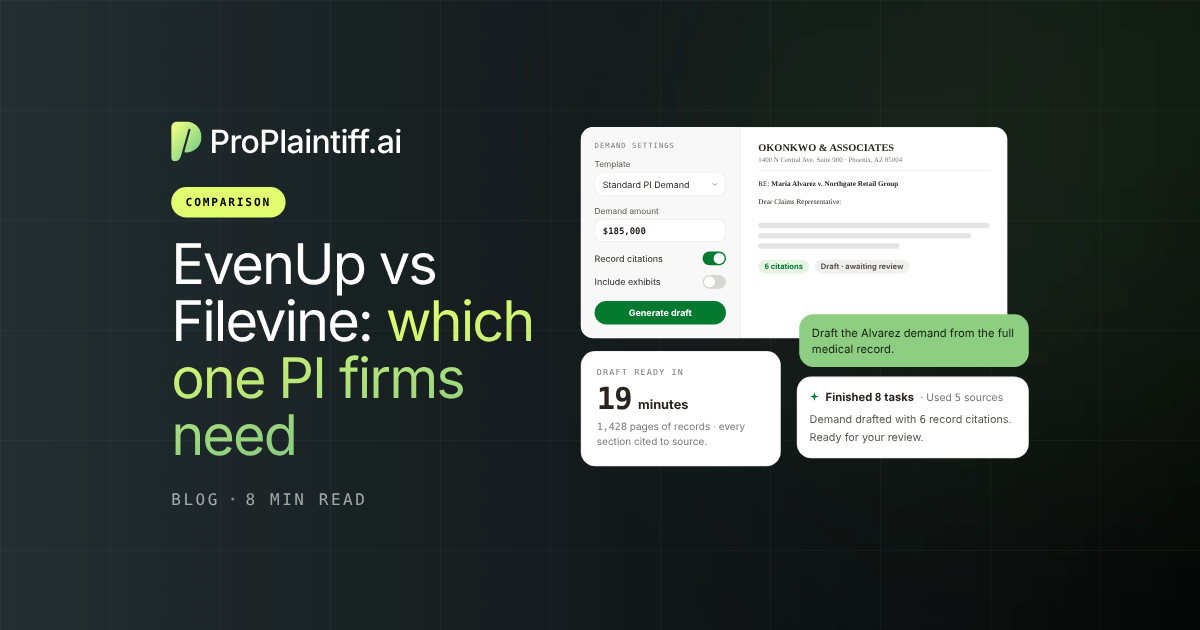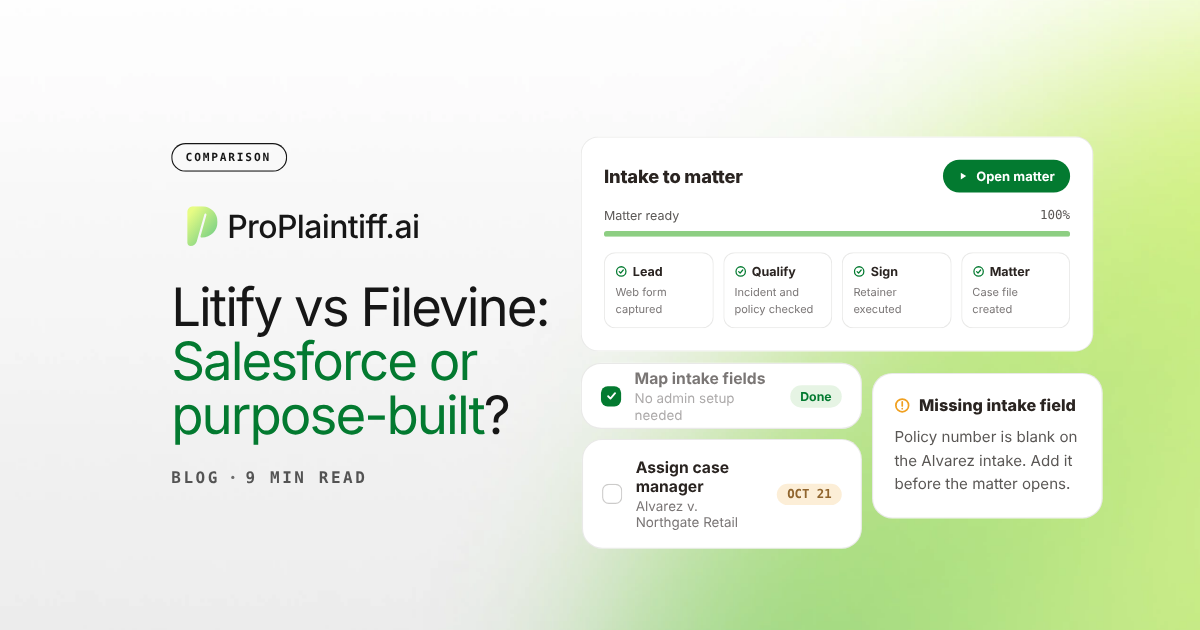





Case-management software and legal AI serve different functions in a personal injury practice. Case-management software organizes matters, contacts, deadlines, tasks, documents, communication, and workflow status. Legal AI analyzes information, answers case-file questions, summarizes records, prepares chronologies, and drafts legal documents. Most PI firms need both types of capability, but they don't necessarily need two separate software products.
That distinction has become more important in 2026 because established case-management vendors now offer substantial AI functionality. Filevine has LOIS, CloudLex has Lexee AI, SmartAdvocate includes its own AI tools, and Litify offers ACE and related AI workflows. At the same time, specialized plaintiff AI providers continue to develop deeper capabilities for medical evidence, demands, and litigation work product.
This guide explains what belongs in case management, what AI should handle, how the two systems connect, and when software consolidation makes financial sense. It also examines how ProPlaintiff's AI-native case-management platform brings operational case information together with source-linked evidence analysis and plaintiff-side document production.
Case-management software maintains the operational record of a legal matter, while legal AI helps attorneys and staff analyze information and produce work from that record.
The CMS answers questions about the case's status and administration. Legal AI addresses questions about the contents of the available evidence and the documents that need to be prepared.
|
Category |
Case-Management Software |
Legal AI |
|
Primary Purpose |
Organize and manage matters |
Analyze information and generate work product |
|
Case Identity |
Authoritative record |
Uses case context |
|
Contacts |
Stores parties and relationships |
May extract or reference information |
|
Deadlines |
Tracks assigned dates and tasks |
May identify relevant dates for review |
|
Documents |
Stores and organizes files |
Reads, summarizes, and drafts |
|
Medical Records |
Tracks and stores records |
Analyzes treatment and builds chronologies |
|
Demand Preparation |
Tracks workflow and approval |
Assists with drafting and evidence analysis |
|
Client Communication |
Maintains the communication record |
May assist with drafting responses |
|
Reporting |
Measures workload and case progression |
May identify patterns and answer questions |
|
Final Legal Judgment |
Does not replace attorneys |
Does not replace attorneys |
The distinction is functional rather than strictly determined by vendor category.
A modern CMS may include AI, while an AI-native platform may provide full matter-management functionality.
For buyers, the important question is which capabilities are included and how reliably they work together.
Personal injury case-management software organizes the information and activities required to manage a claim from intake through resolution.
Its primary function is maintaining a reliable operational record that attorneys and staff can use throughout the case lifecycle.
Typical responsibilities include:
These functions help prevent case information from becoming fragmented across email, spreadsheets, local folders, and disconnected applications.
However, storing information doesn't automatically establish what that information means.
A CMS may track 2,000 pages of medical records without independently explaining the client's treatment chronology or identifying conflicting diagnoses.
Those activities involve analysis rather than ordinary matter management.
Legal AI helps plaintiff firms analyze case materials, identify relevant information, answer questions, and prepare draft legal work.
Its strongest applications often involve large amounts of unstructured evidence and repetitive document production.
Relevant PI workflows include:
For example, a case manager may have uploaded records from several medical providers into the CMS.
AI can examine those records and prepare a structured timeline identifying treatment dates, diagnoses, procedures, and supporting documents.
However, the system's output still needs review for extraction errors, missing records, and medical or legal interpretations that aren't supported by the underlying evidence.
The attorney remains responsible for deciding how the information should be used.
The clearest division is between maintaining the authoritative case record and producing analysis from that record.
However, the two workflows should remain connected.
|
Task |
Primary System |
Supporting Role |
|
Open a New Matter |
CMS |
AI may extract intake information |
|
Store Contact Details |
CMS |
AI may identify missing parties or providers |
|
Assign Case Tasks |
CMS |
AI may recommend or create approved tasks |
|
Calculate and Monitor Deadlines |
CMS with attorney verification |
AI may identify relevant dates for review |
|
Store Medical Records |
CMS |
AI analyzes their contents |
|
Build Medical Chronology |
AI with human review |
CMS preserves source documents and final output |
|
Prepare Demand |
AI-assisted drafting |
CMS tracks workflow and approval |
|
Maintain Settlement Offers |
CMS |
AI may summarize negotiation history |
|
Prepare Discovery Documents |
AI-assisted drafting |
CMS stores and tracks approved documents |
|
Approve Legal Strategy |
Attorney |
Both systems provide supporting information |
The systems are most effective when information doesn't need to be reconstructed every time it moves between them.
For example, once the firm verifies an accident date or identifies a medical provider, those facts should remain available to appropriate downstream workflows.
However, the system should preserve the distinction between verified evidence and an AI-generated interpretation.
Potentially. Several established case-management platforms now offer AI demand drafting and medical-record analysis, so a separate demand product isn't always necessary.
However, feature availability doesn't guarantee that a vendor's AI produces the quality or workflow efficiency a particular firm requires.
CloudLex includes Lexee AI, which supports medical summaries, chronologies, demand drafting, intake, and case-file questions.
Its strongest argument is that AI operates within a PI-focused case-management environment.
Firms should test whether Lexee produces demands that meet their evidentiary and formatting standards.
SmartAdvocate offers AI capabilities involving case summaries, document analysis, medical information, case questions, translation, and other workflows.
These tools can reduce repetitive review while working with the firm's matter records.
However, buyers should verify which drafting capabilities and usage limits apply to their subscription.
Litify provides ACE and related AI functionality within its Salesforce-based legal platform.
Its 2026 product developments also include LitifyAI Instant Demands through a partnership with Supio.
That gives Litify customers a more direct path from matter information and medical evidence into demand production.
However, buyers should confirm current packaging and the workflow required for their particular matters.
Filevine's LOIS ecosystem includes matter-grounded questions, document analysis, medical chronologies, demand drafting, and other legal AI functions.
LOIS for Word also supports drafting using available matter information within Microsoft Word.
This may reduce the need for an additional demand tool when the firm's records already live in Filevine.
However, output quality, source verification, exhibits, editing time, and usage costs still require evaluation.
The practical conclusion is that a separate AI demand product is optional when native CMS AI adequately supports the firm's work.
Specialized AI remains relevant when it provides meaningfully better results or reduces more staff time.
Not necessarily. Filevine already offers native AI, so firms should evaluate their existing LOIS capabilities before adding a separate vendor.
However, specialized AI may still be appropriate when the firm needs different outputs, deeper plaintiff-specific analysis, or workflows not adequately supported by its current subscription.
Filevine's native AI may satisfy the firm's needs when:
However, the firm should verify which LOIS features are included in its current subscription and whether processing limits apply.
A separate product may be worthwhile when:
However, the value of an additional vendor must exceed its subscription, integration, and administrative costs.
Already using a CMS but unsure whether its AI is enough?Explore ProPlaintiff's source-linked case analysis and compare the actual outputs using the same personal injury matter.
An AI-native case-management platform combines ordinary matter-management functionality with AI designed to operate throughout the legal workflow.
Rather than treating AI as a disconnected writing tool, the platform makes case information available to analysis, document preparation, and supported workflow actions.
That can reduce the need for employees to repeatedly export documents, reconstruct context, and transfer generated work into another system.
However, the term AI-native doesn't establish a particular technical architecture or guarantee better outcomes.
Buyers should examine how the software actually accesses matter information, performs tasks, preserves sources, and returns outputs to the authoritative record.
Filevine, CloudLex, Litify, and other established platforms have expanded their native AI capabilities.
ProPlaintiff similarly positions itself as an AI-native plaintiff case-management platform with connected evidence analysis and document-production workflows.
The relevant distinction is therefore functional rather than merely whether a vendor uses the term AI-native.
An AI-native CMS and a separate specialist AI platform can both support substantive legal work.
The difference is how closely AI operates with the firm's case-management data and workflows.
|
Factor |
AI-Native CMS |
CMS + Separate AI |
|
Case Context |
Potentially available natively |
Depends on integration |
|
Documents |
Stored within matter environment |
May require synchronization |
|
Workflow Automation |
Can connect directly to matter actions |
Depends on supported API and permissions |
|
Specialized AI Depth |
Varies by vendor |
May be stronger in narrow workflows |
|
Procurement |
Fewer vendors |
Multiple subscriptions |
|
Security Review |
More consolidated |
Additional vendor assessment |
|
Implementation |
May require broader CMS change |
May preserve existing CMS |
|
Data Portability |
Depends on CMS export capabilities |
Depends on both vendors |
|
Best Fit |
Firms prioritizing connected operations |
Firms seeking specialized functionality |
Neither model is inherently superior.
A firm with an effective CMS may gain more by adding one specialized AI workflow than by replacing its entire operating system.
Another firm may benefit from consolidating several disconnected applications into a connected platform.
The decision depends on the quality of the work produced and the cost of maintaining the complete workflow.
Legal AI can connect with case-management software through native features, APIs, connectors, or manual document transfers.
Each approach affects how information moves, how updates are handled, and how much administrative work remains.
Native AI operates within the case-management environment.
Examples include Lexee in CloudLex, LOIS in Filevine, Litify ACE, and SmartAdvocate's AI tools.
The main advantage is access to matter context without requiring users to recreate it in a separate application.
However, the firm must still verify which information the AI can access and how permission controls apply.
An API integration allows a separate AI product to exchange supported information with the CMS.
Depending on the implementation, the integration may transfer matter fields, documents, status updates, or generated work product.
This can be effective when a firm wants specialized AI without replacing its established CMS.
However, buyers should distinguish one-way transfers from bidirectional synchronization.
An integration that imports case documents but doesn't return completed drafts may still require substantial manual work.
Some tools access case information through browser extensions or application connectors.
These approaches may reduce deployment complexity when native integrations aren't available.
However, access may be limited to supported screens, fields, or documents.
Firms should verify whether the connection remains reliable when the CMS changes its interface or permissions.
Manual transfer is the simplest arrangement technically.
Staff download documents from the CMS, upload them into the AI product, review the output, and save the completed work back into the matter.
However, this process creates additional administrative work and opportunities for version confusion.
For example, a chronology may be generated before newly received medical records are uploaded.
If the employee doesn't recognize the change, the final document may omit later treatment.
Manual workflows can still be appropriate for occasional tasks, but firms should measure the coordination they require.
The CMS should remain the authoritative source for the firm's case information unless the organization deliberately adopts another system-of-record architecture.
That includes matter identity, contacts, deadlines, assignments, case status, official documents, communications, settlements, and critical case notes.
AI-generated outputs should generally return to the appropriate matter record after review and approval.
For example, an AI tool may create a medical chronology, but the finalized document and its supporting records should remain accessible to the attorneys and staff responsible for the case.
The same principle applies to demand drafts, discovery responses, and other legal documents.
Preserving the authoritative record helps prevent different employees from relying on inconsistent versions.
It also makes supervision, reassignment, and later review more manageable.
However, the firm's records-management requirements may vary according to applicable professional obligations, litigation holds, and document-retention policies.
AI is most useful for document-heavy analysis and repetitive drafting that can be reviewed against reliable source material.
Appropriate tasks may include extracting structured information, organizing records, preparing timelines, comparing documents, identifying potential inconsistencies, answering case-file questions, and producing first drafts.
For PI firms, the practical value often comes from reducing the time needed to understand medical evidence and prepare related documents.
However, AI shouldn't have final authority over:
Attorneys must still verify material facts, evaluate the available evidence, and exercise professional judgment.
The most reliable workflow uses AI to prepare reviewable work rather than treating its first output as a final legal conclusion.
One vendor is generally simpler to procure and administer, but a single platform isn't automatically cheaper or more efficient than a CMS paired with specialized AI.
The meaningful comparison is total cost of ownership, including software, implementation, administration, integration, and the labor required to complete legal work.
An AI-enabled CMS may involve:
A firm should verify which AI features are included and which require additional purchases.
Using a separate AI vendor may involve:
However, the specialist product may still be economically preferable if it reduces more attorney and paralegal labor.
Consider a hypothetical firm preparing 500 demands annually.
Its native CMS AI might produce a first draft that requires 90 minutes of correction, while a specialized product produces an acceptable draft requiring 20 minutes.
The difference is 70 minutes per demand.
Across 500 demands, that represents approximately 583 hours of staff capacity.
However, those hours become economic value only if the firm uses the recovered capacity productively.
The comparison should therefore account for actual editing time, staffing costs, output quality, and the additional software expense.
This is a hypothetical model, not a measured performance claim about any vendor.
A firm may need both when its existing case-management system works well but its AI workflows don't adequately support evidence review and legal drafting.
This is particularly relevant to practices handling large medical productions, complex liability evidence, substantial demand volume, or recurring litigation documents.
However, adding another product should address a measurable problem rather than simply increase the number of available features.
A separate specialist may be worthwhile when:
Native AI may satisfy the firm's needs when:
The decision should follow a structured pilot using representative matters.
Buyers should compare completed work product and total review time rather than the number of AI features advertised.
An effective plaintiff technology stack supports client acquisition, intake, matter management, evidence analysis, communication, and reporting.
However, those capabilities don't necessarily require a separate vendor for every category.
Acquisition tools help generate inquiries through advertising, referrals, websites, and other channels.
These systems should preserve accurate source information so the firm can evaluate which marketing activities produce qualified matters.
CRM and intake software captures prospective client information, manages follow-up, supports qualification, and helps convert approved prospects into retained matters.
Lawmatics and Lead Docket are examples of platforms focused on these activities.
The CMS maintains active matter information, deadlines, tasks, contacts, documents, financial records, communications, and case status.
Filevine, CASEpeer, CloudLex, SmartAdvocate, and other legal platforms address this requirement.
AI analyzes evidence and helps produce chronologies, demands, pleadings, discovery documents, and other attorney-reviewed work.
That functionality may be native to the CMS or provided through a connected specialist.
ProPlaintiff combines source-linked case analysis, medical chronologies, AI demands, and DocGen within its plaintiff-focused platform.
Client communication systems provide updates, messaging, document requests, and appropriate case visibility.
These tools may be included in the CMS or provided through a specialized product such as Case Status.
Analytics help management understand intake performance, case aging, staff workload, demand preparation time, settlement activity, and operational bottlenecks.
The most useful reports combine reliable data with clear responsibility for corrective action.
A dashboard that identifies stalled matters is valuable only when the firm can determine why those matters are stalled and what needs to happen next.
PI firms should consolidate software when doing so reduces cost, duplicate work, inconsistent data, and administrative complexity without sacrificing essential functionality.
However, consolidation isn't automatically beneficial.
A single vendor may offer adequate tools across many categories while performing less effectively in the specialized workflow that consumes the most staff time.
For example, a firm may save subscription costs by using its CMS's native demand drafting.
However, those savings could disappear if every demand requires substantially more editing than a specialist product would.
The same principle applies to intake, reporting, and client communication.
Firms should consolidate based on measured operational value rather than a preference for the smallest number of vendors.
The ideal arrangement keeps authoritative information accessible and minimizes unnecessary transfers between systems.
The distinction between case management and legal AI becomes clearer when applied to ordinary PI workflows.
|
Scenario |
Case-Management Role |
Legal AI Role |
|
New MVA Client |
Open matter, assign staff, store intake |
Extract relevant facts and identify information for review |
|
Medical Records Arrive |
Track receipt and associate documents |
Analyze treatment and prepare chronology |
|
Demand Preparation |
Track readiness, assignment, and approval |
Draft narrative using supporting evidence |
|
Deposition Preparation |
Store notices, transcripts, and deadlines |
Summarize testimony and identify potential inconsistencies |
|
Discovery |
Track requests, responses, and due dates |
Prepare first drafts and organize supporting information |
|
Settlement Negotiation |
Maintain offers, expenses, and status |
Summarize evidence and negotiation history |
|
Litigation Handoff |
Preserve matter history and create tasks |
Organize evidence and assist with draft pleadings |
These examples show why the two capabilities are complementary.
Case management establishes the matter's operational context. AI helps the legal team use the evidence and information associated with that context.
ProPlaintiff combines AI-native case management with plaintiff-specific legal work-production capabilities.
Its platform is designed to preserve matter context while supporting analysis, medical chronologies, demands, pleadings, discovery, and related documents.
That positioning makes it relevant to firms evaluating both case-management consolidation and specialized plaintiff AI.
Through Ask Tiff, attorneys and paralegals can ask questions about case materials and inspect source-linked responses.
Its DocGen platform also supports drafting legal documents using existing matter information and reusable firm templates.
For example, information verified during medical-record review can inform a demand draft without requiring staff to reconstruct the same treatment history from scratch.
However, attorneys still need to check factual support, damages, legal arguments, and the final document.
ProPlaintiff therefore deserves consideration when firms want case management and AI-assisted casework to operate as connected processes rather than independent applications.
Want to test AI-native case management against your current software stack?Explore ProPlaintiff's AI Case Manager and compare how matter information supports evidence analysis and downstream legal drafting.
A useful evaluation should determine where case information lives, how AI accesses it, and what happens after the output is generated.
Before purchasing, ask:
The strongest demonstration should follow one representative PI matter from raw evidence through analysis, chronology, demand drafting, attorney review, and final storage in the case-management environment.
That exercise tests the complete workflow rather than isolated product features.
Case-management software and legal AI solve different problems within a personal injury firm. The CMS maintains the authoritative record of matters, people, deadlines, tasks, communications, documents, and workflow status. Legal AI helps attorneys and paralegals analyze the information inside those matters, identify relevant evidence, prepare chronologies, and draft legal work for review.
In 2026, the categories increasingly overlap. Filevine, CloudLex, SmartAdvocate, and Litify all offer substantive AI alongside case management, while specialized plaintiff AI products continue to develop deeper evidence and drafting capabilities. A firm doesn't necessarily need two separate vendors, but it should avoid assuming that native AI is sufficient without testing the output. The best arrangement is the one that produces reliable work with the least unnecessary coordination and expense.
ProPlaintiff offers an AI-native approach that connects plaintiff case management with source-linked analysis, medical chronologies, demand drafting, and document generation. Its workflows allow attorneys and staff to reuse verified matter information across the case lifecycle while maintaining responsibility for factual accuracy, legal strategy, and final approval. For firms evaluating whether to consolidate their software or strengthen an existing CMS, that continuity is a practical purchasing consideration.
If your firm is deciding between native CMS AI and a separate plaintiff AI platform, book a ProPlaintiff demo and ask the team to process a representative matter from uploaded evidence through chronology, demand drafting, and attorney review. Comparing that complete workflow against your current software will show where case information can be reused and how much manual work remains.
Case-management software maintains the operational record of a legal matter, including contacts, deadlines, tasks, documents, communication, and status. Legal AI analyzes information and helps generate summaries, chronologies, demands, and other legal work. Modern platforms increasingly combine both functions, so firms should evaluate the available workflows rather than relying solely on product categories.
Potentially. Filevine, CloudLex, Litify, and other established platforms now offer AI-assisted demand or related drafting capabilities. Firms should compare native output against specialized tools using the same case evidence. A separate demand product remains worthwhile when it provides better source verification, document quality, workflow support, or lower total preparation costs.
Not necessarily. Filevine already offers LOIS AI for document analysis, case questions, drafting, and related work. A separate specialist may still be appropriate when the firm's requirements exceed its native capabilities. The decision should account for output quality, review time, integrations, subscription costs, and any additional administrative work.
An AI-native CMS combines matter management with AI that operates using available case information. It can support evidence analysis, drafting, and workflow assistance without requiring employees to reconstruct context in a separate tool. However, the term doesn't guarantee a particular capability or quality level. Firms should test the actual integration and outputs.
The CMS should generally maintain authoritative matter information, contacts, assignments, deadlines, communications, documents, case status, settlement records, and important notes. Reviewed AI outputs should also return to the appropriate matter record. This helps preserve continuity when cases change staff members or progress into litigation.
Legal AI is useful for summarization, information extraction, evidence comparison, chronology preparation, source-linked case questions, and first drafts of legal documents. Attorneys remain responsible for reviewing material facts, checking legal authority, exercising professional judgment, and approving final work. AI output shouldn't independently determine strategy, deadlines, or settlement decisions.
Not always. One platform can reduce vendor management and integration costs, but specialized AI may save more attorney or paralegal time. Firms should compare software subscriptions, implementation, administration, integration, and the labor required to finalize work. A lower subscription price doesn't necessarily produce a lower total operating cost.
An effective plaintiff technology stack supports acquisition, intake, matter management, AI-assisted evidence review, document production, client communication, and reporting. Those capabilities may come from one integrated platform or several connected products. The important requirements are reliable case information, appropriate access controls, minimal duplicate entry, and reviewable legal work.

Agentic case management platform designed to streamline the work of law firms.


Join our Newsletter
Welcome to ProPlaintiff!
Oops! Something went wrong, please try again