.webp)
.webp)
.webp)
.webp)

Case analysis in a PI firm usually means pulling the important facts out of records, reports, bills, correspondence, and testimony, then working out how those facts affect liability, causation, damages, and negotiation. The challenge isn't that the information doesn't exist; it's that the attorney may have to piece it together from hundreds or thousands of pages before the case can be evaluated properly. AI can reduce that assembly work, but the value depends on whether the attorney can verify the evidence behind the analysis.
AI case analysis software can organize that evidence, surface treatment gaps or prior injuries, reconcile damages, and flag missing information. But a score such as "83/100" doesn't help much unless the attorney can see what produced it and trace the underlying evidence. The useful systems therefore show the facts, sources, risks, and open questions behind the assessment.
This guide compares how ProPlaintiff, EvenUp, Supio, Filevine LOIS, and simpler valuation tools approach that work, including where AI can support case evaluation and where attorney judgment still controls the decision.
ProPlaintiff, EvenUp, Supio, and Filevine LOIS all analyze case evidence, but they concentrate on different parts of the workflow. The comparison below separates case-wide assessment, medical intelligence, negotiation support, and integration with the broader case-management system.
Platform | Best For | Case-Wide Analysis | Strength / Risk Analysis | Damages | Value Insights | Evidence Traceability |
ProPlaintiff.ai | PI firms wanting analysis inside case management | High | High | High | Settlement range | Case-file driven |
EvenUp | Negotiation and case-preparation intelligence | High | High | High | Value-focused insights | Line-level evidence |
Supio | Medical-record intelligence and issue detection | High | High | High | Case-economic insights | Evidence-linked |
Filevine LOIS | Case-aware AI inside an established CMS | High | High | High | Strategic insights | Case-aware |
Basic valuation calculators | Rough arithmetic estimates | Low | Low | Basic | Formula-driven | Low |
AI case analysis software reviews evidence across a legal matter and organizes facts, timelines, damages, risks, and missing information into a structured assessment. For PI firms, that may include police reports, medical records, imaging, bills, liens, wage evidence, expert opinions, correspondence, and depositions. A treatment gap carries different weight when it appears beside a prior injury and an insurer's causation argument than when each fact is reviewed alone.
Ask whether the product analyzes the matter or merely summarizes individual documents. Case-wide analysis should explain relationships between evidence, not just make PDFs shorter.
Case strength isn't one mathematical variable. It reflects several dimensions that can support or weaken different parts of the claim, and those dimensions can point in opposite directions.
Liability analysis asks how strongly the evidence supports the defendant's responsibility, using sources such as police findings, witnesses, photographs, video, admissions, and competing accounts.
Causation asks how clearly the evidence connects the incident to the claimed injuries, including provider findings, prior conditions, intervening events, and contradictory records.
Damages depend on what the file supports, including medical expenses, wage loss, future care, and functional limitations; a bill total alone doesn't establish that treatment was related or complete.
Objective diagnostics, consistent treatment, independent witnesses, and complete records can strengthen the file, while missing records, delayed care, or contradictions can create defense leverage. The platform should separate those dimensions so the attorney can see whether the problem is liability, causation, damages, or evidence quality.
AI can compare liability evidence across reports, statements, photographs, videos, depositions, correspondence, citations, and expert material. That lets the system surface conflicting accounts, potential admissions, comparative-fault issues, missing evidence, or facts that corroborate one version of the incident.
Liability analysis should stay tied to evidence the attorney can verify. "Police report attributes fault to defendant" points to a specific source, while "Defendant is 80% liable" is difficult to evaluate unless the vendor can explain exactly how that number was produced. During a demo, include favorable and adverse liability facts and confirm that the system surfaces both rather than only reinforcing the stronger side of the case.
AI can organize medical bills, wage evidence, out-of-pocket costs, liens, and other documented losses, then connect the amounts to providers and source records. That makes totals easier to reconcile than a number copied into a note months earlier.
Non-economic damages require more restraint because pain, limitation, and loss of enjoyment aren't arithmetic fields. AI can surface supporting evidence, but the attorney decides how it affects valuation. Any reported medical-expense total should also trace back to the bills so staff can correct duplicates or omissions before reuse.
Medical evidence is especially suited to case analysis because a file may contain thousands of pages across providers and treatment phases. AI can identify diagnoses, procedures, imaging, referrals, restrictions, treatment gaps, prior conditions, and future-care recommendations, then connect those findings to the broader matter.
Supio Case Signals currently flags treatment gaps, missing records, missing bills, and potentially overlooked injuries, while EvenUp's Case Preparation surfaces strengths and weaknesses such as prior incidents and negative diagnostics. Treat those findings as leads for investigation. If AI flags a neck complaint but no MRI is present, confirm whether imaging was ordered or obtained before drawing a conclusion.
AI is well suited to finding signals spread across many documents because it can compare patterns across the file. Potential strengths include consistent treatment, objective diagnostics, corroborating witnesses, documented wage loss, surgery, or clear liability evidence, while potential weaknesses include delayed care, prior similar injuries, negative imaging, contradictory symptoms, comparative-fault evidence, or missing records. The attorney still decides how much each signal matters, so the software should show the source rather than reduce the case to an unexplained score.
Software can review the full uploaded file each time the analysis runs, which gives the firm a more consistent check for facts that may be easy to miss during a rushed manual review. The finding still needs an owner and a next step: a missing bill may require retrieval, while a prior injury may require attorney review before the demand is drafted.
AI can score or categorize specific factors, but the firm should understand exactly what the score represents. A confidence score that says the system is highly confident it found a treatment gap is fundamentally different from a score claiming the case has a particular probability of success.
A confidence score for a narrow classification, such as detecting a treatment gap, is different from a prediction about the outcome of the entire case. An outcome score would have to account for law, credibility, venue, experts, and strategy. A useful AI score should tell you what is being scored, so ask which inputs feed it and how attorneys are expected to use the result.
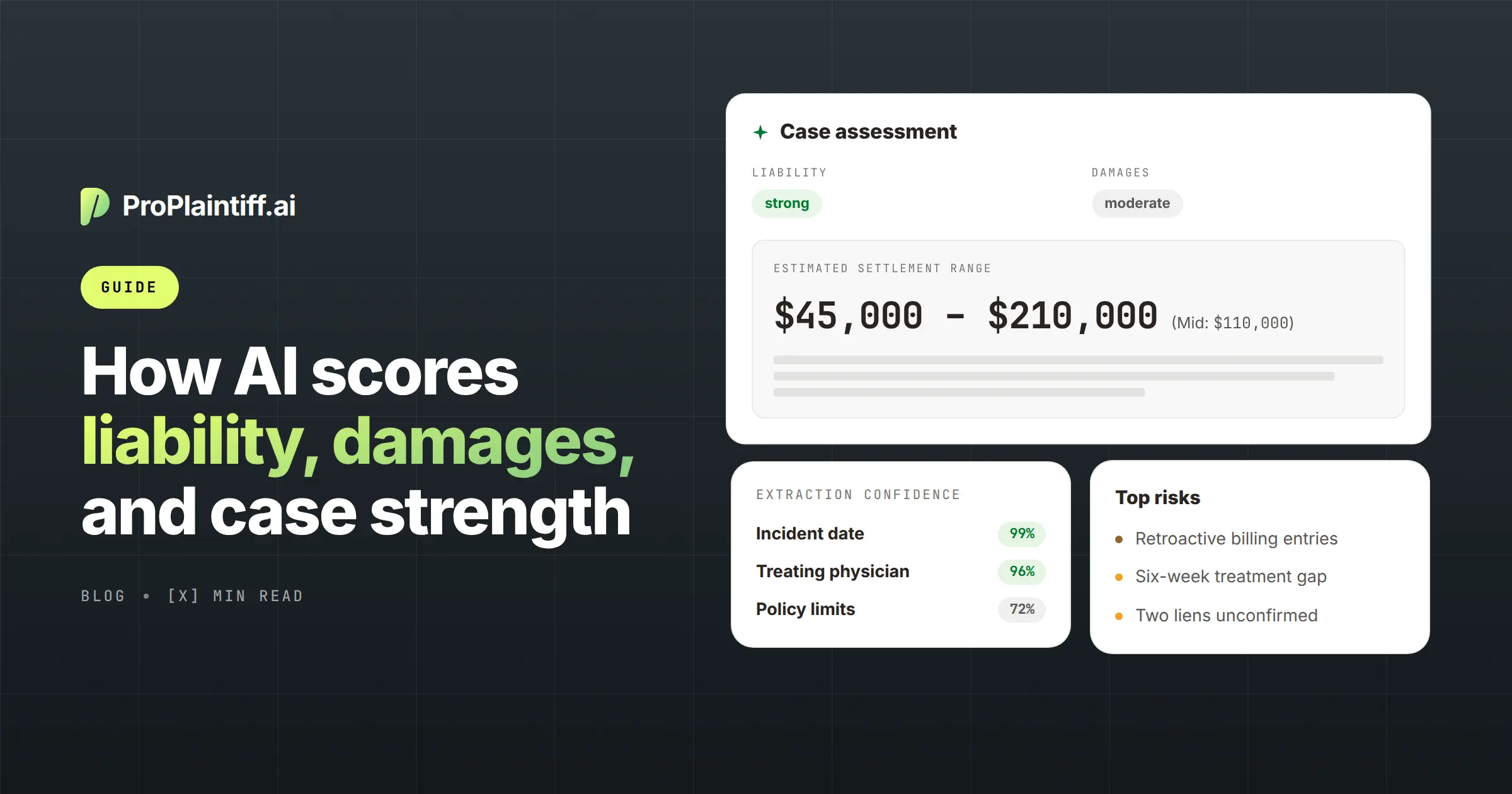
Some PI platforms generate settlement ranges or valuation insights, but those outputs should support attorney judgment rather than replace it. ProPlaintiff Case Analysis currently produces an estimated settlement range from the liability and damages evidence in the file, with the estimate becoming more informed as documentation improves.
The estimate can't account for evidence the platform never received, so missing bills, prior treatment, policy information, or liability evidence can change it materially. Use the range as a prompt for review, and inspect which facts changed when the estimate moves.
A settlement estimate usually describes a potential resolution range based on the information currently available. Case valuation can be broader because it may also consider trial exposure, policy limits, collectability, litigation cost, legal risk, and expected net recovery.
A settlement estimate and a broader case valuation can overlap, but they answer different questions. A case may have substantial damages and still face recovery limits, while discovery can strengthen liability and change the negotiating range. Revisit valuation as the evidence and procedural posture change instead of treating the first estimate as a fixed number.
A case changes as evidence arrives, so the analysis should change with it. Later uploads may add imaging, specialist care, wage documentation, prior injuries, or treatment gaps.
ProPlaintiff specifically describes Case Analysis as a tool firms can rerun after major document uploads, before demand drafting, and before settlement discussions. That approach is more useful than a one-time report because the attorney can see how new evidence changes the risks, damages, and next steps.
Build analysis into milestone reviews. Re-run it after meaningful evidence arrives, then compare the new findings with the prior assessment and assign any follow-up the change creates.
Best for: PI firms that want case analysis connected to AI-native case management.
ProPlaintiff currently analyzes records, police reports, expert opinions, bills, EOBs, correspondence, depositions, audio, and video. Its Case Analysis builds an assessment, timeline, damages view, risks, next steps, and estimated settlement range.
Because ProPlaintiff also includes Tiff, medical chronologies, demand drafting, tasks, and Automations, a finding can lead directly to casework. Missing orthopedic records, for example, can trigger follow-up before the firm reruns the assessment and reuses the revised evidence downstream.
Best for: PI firms focused on negotiation preparation and case-value optimization.
EvenUp's Case & Negotiation Preparation product surfaces strengths and weaknesses such as negative diagnostics and prior incidents, while Case Companion provides case-aware analysis with line-level supporting evidence.
EvenUp is particularly relevant when negotiation preparation consumes the most staff time. During a demo, check what happens after the analysis identifies a problem, including whether the platform can create follow-up work, update the matter, or carry verified findings into drafting without another manual handoff.
Best for: Firms prioritizing detailed medical-record intelligence and evidence discovery.
Supio's Case Signals flags treatment gaps, missing bills, missing records, and potentially undiagnosed injuries with supporting evidence for review. Supio also offers case economics and broader case-aware AI tools.
Supio is especially relevant when the firm's main risk is missing medical signals inside large record sets. Test it with duplicates, prior conditions, and incomplete documentation, because a messy file shows how well the system separates genuine issues from noise.
Best for: Firms that want case-aware AI inside an established case-management ecosystem.
Filevine LOIS works from existing Filevine case data, including records, timelines, damages, deadlines, and narrative. It can answer case-specific questions and support drafting without rebuilding the matter elsewhere.
Filevine combines mature case-management infrastructure with an expanding intelligence layer through LOIS. Compare its evidence traceability and workflow automation with the alternatives, then check how easily a finding can become a task, field update, document, or other downstream action inside the existing matter.
A credible assessment should draw from liability evidence, medical records and imaging, bills and liens, wage evidence, pleadings, discovery, depositions, expert reports, and relevant communications. A three-document assessment isn't equivalent to a complete-file review, so ask what the system knows is missing.
AI can only analyze what it can access, so missing provider records, wage evidence, imaging, or witness accounts can make the assessment look cleaner than the underlying file warrants. Treat missing inputs as an analysis limitation rather than as evidence that the issue doesn't exist, and request the missing material before relying on the assessment.
Confidence in the assessment should rise only as the file becomes more complete. A platform that analyzes uploaded documents without identifying likely gaps can make an incomplete case look cleaner than it is, so the firm should favor systems that surface missing evidence before attorneys rely on the assessment.
Use an incomplete test file during the demo. If the system confidently analyzes the case without acknowledging obvious missing evidence, that's a more important finding than how polished the summary looks.
Evidence-based analysis gives the attorney both the conclusion and the facts supporting it. Black-box scoring compresses those facts into a number, which makes errors and changes harder to audit.
Evidence-Based Analysis | Black-Box Scoring |
Shows underlying facts | Shows a number |
Separates strengths and weaknesses | Compresses factors together |
Links findings to documents | May lack traceability |
Changes visibly as evidence changes | Change may be hard to explain |
Supports attorney review | Encourages over-reliance on score |
A case score is only useful if the attorney can answer two questions: Why did the system reach that conclusion, and can I verify the evidence? If either answer is unclear, use the score as a prompt for review rather than as a basis for a case decision.
AI can identify factors associated with stronger or weaker positions, but it can't reliably guarantee whether a specific case will win. Outcomes depend on law, admissibility, credibility, venue, decision-makers, experts, and how the evidence develops. Treat prediction claims cautiously unless the vendor provides validation that matches the actual product and use case; evidence-linked risk analysis is usually more useful than a probability the firm can't audit.
Yes. Software can inspect a large file consistently and surface prior incidents, negative diagnostics, missing documents, treatment gaps, inconsistent dates, and other issues a busy team may not see together. Its advantage is coverage, not superior legal judgment, so material flags should go to a human reviewer who decides whether the case needs more records, client clarification, expert input, or a strategic change.
Use a repeatable review workflow:
The workflow keeps AI as a second check: it surfaces evidence and inconsistencies, while the attorney verifies material facts and decides what they mean for the case.
Prioritize capabilities that let attorneys verify the analysis and move a confirmed finding into the next case action:
During the demo, make the vendor show three things together: the conclusion, the evidence supporting it, and what the platform can do once the attorney confirms the finding:
Run analysis when new information could change strategy rather than simply on a fixed schedule. Intake review can focus on viability and missing evidence, demand review on damages and weaknesses, and mediation review on defense leverage, priors, and new litigation evidence. Giving each review a defined purpose makes it easier to decide which findings require follow-up.
A medical chronology explains what happened medically, while case analysis asks what the available evidence may mean for the broader case. Because the second question depends on the first, firms should treat the chronology as structured evidence and the case analysis as a review layer rather than using the two outputs interchangeably.
Case Analysis | Medical Chronology |
Strategic assessment | Medical timeline |
Includes liability and damages | Primarily treatment-focused |
Identifies case risks | Identifies medical events |
May include settlement insights | Usually doesn't value the case |
Uses broad case evidence | Primarily medical evidence |
The chronology organizes the treatment record, while case analysis connects that medical history with liability, damages, and strategy. Use the chronology to verify what happened medically, then use case analysis to decide which facts require investigation, drafting, or strategic attention.
Case analysis evaluates liability, causation, damages, weaknesses, and missing information, while case valuation focuses more narrowly on expected settlement, recovery, or case economics. Modern PI systems may combine both, but a valuation range still needs an explanation. Ask what evidence supports the range and how it changes when the underlying facts change.
ProPlaintiff is most relevant for firms that want AI-native case assessment inside the same environment used for case management and workflow automation, while EvenUp concentrates on negotiation preparation, Supio on deep medical intelligence, and Filevine LOIS on case-aware AI inside an established CMS. Because those products solve different parts of the review process, compare them against the workflow creating the most analysis, verification, or handoff work inside your firm.
Choose based on what happens after the analysis identifies a risk. The system should help the team assign follow-up, obtain missing evidence, update the chronology, or reuse verified information in drafting; otherwise, staff still have to rebuild the next workflow manually.
For PI firms that want analysis to remain connected to case operations, ProPlaintiff can carry findings into tasks, medical chronologies, document drafting, demands, and automated workflows while attorneys keep control of the final strategy and valuation decisions.
Explore ProPlaintiff Case Analysis or book a demo.
Case analysis software organizes case documents and matter data into facts, damages, risks, timelines, and possible next steps. The strongest PI systems show where material findings came from so attorneys can verify them.
AI can identify factors that support or weaken a case, including liability evidence, treatment consistency, prior injuries, and missing documentation. Attorneys still decide how law, credibility, and strategy affect the weight of those facts.
Some platforms provide settlement ranges based on the evidence available in the file. Those estimates can change materially when new records, policy information, prior treatment, or liability evidence is added, so they shouldn't be treated as guaranteed values.
Yes. AI can compare police reports, statements, photographs, video, depositions, correspondence, and other evidence to surface liability facts and inconsistencies, but identifying a pattern isn't the same as reaching the legal conclusion. Attorneys should therefore verify the underlying sources and apply the relevant law before relying on the analysis.
AI can identify and organize documented economic damages and surface evidence relevant to non-economic harm. It can also help reconcile bills and other figures, but recoverable damages and case valuation remain legal and strategic determinations for the attorney.
Yes. Current PI AI tools can identify periods where documented treatment appears to stop or where expected follow-up is missing, but the flag should be reviewed against the complete medical file because a gap in the uploaded records isn't always the same as a gap in actual care. If the file is incomplete, request the missing records before treating the signal as a treatment problem.
AI can identify references to prior injuries or treatment when that information appears in the case data it can access. If prior records are missing, however, the system may only be able to flag the reference and recommend follow-up.
A case-strength score is a numerical or categorical representation of selected case factors. Before using one, the firm should understand what is being measured, which inputs are included, how they are weighted, and whether the score describes evidence confidence, case quality, or a predicted outcome.
Use AI settlement estimates as an analytical input, not the final valuation. Attorneys should inspect the evidence behind the range and account for missing data, coverage, venue, credibility, and negotiation factors before setting case value.

Agentic case management platform designed to streamline the work of law firms.


Join our Newsletter
Welcome to ProPlaintiff!
Oops! Something went wrong, please try again


.svg)