.webp)
.webp)
.webp)
.webp)

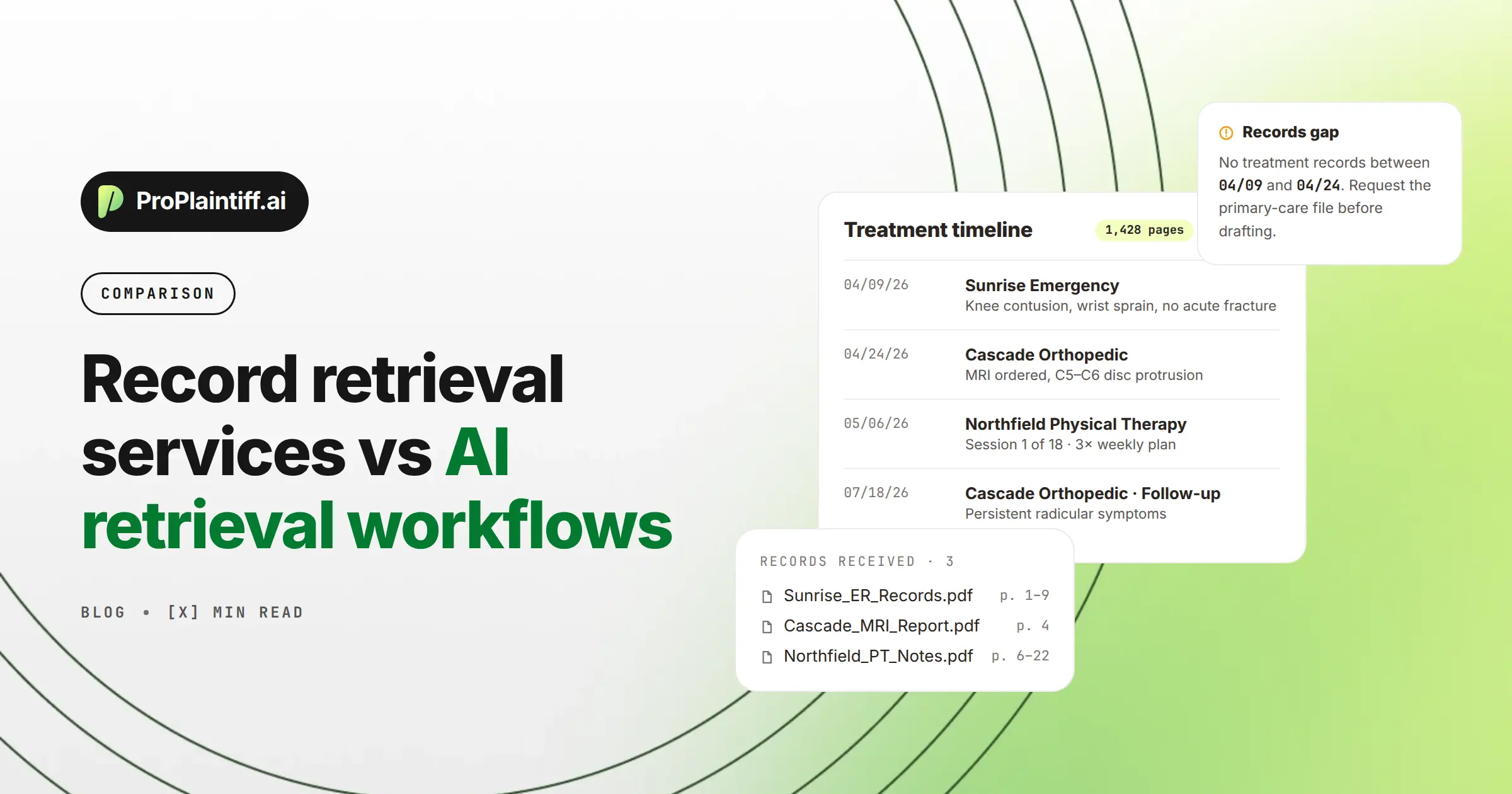
Medical record retrieval is more than sending a request and waiting for a PDF. PI staff still have to manage authorizations, follow up with providers, track separate bills and imaging, and confirm that the production actually contains what the case needs.
Traditional retrieval services take much of that provider-facing work off the firm's plate, which can be valuable when staff are spending hours chasing custodians and correcting rejected requests. AI retrieval workflows extend further into the process by organizing incoming files, flagging likely gaps, and routing the records into review, chronology, case analysis, or demand preparation. If the bottleneck is provider follow-up, outsourcing may be enough. If the bottleneck continues after the records arrive, the firm needs help with the downstream work too.
This guide compares traditional retrieval services, AI retrieval workflows, and hybrid approaches, including where ProPlaintiff fits for firms that want record retrieval connected to medical analysis and later case preparation.
Traditional retrieval services are strongest when the firm wants someone else to manage provider contact, follow-up, and exceptions. AI workflows add more value when staff also spend time checking what arrived, organizing the production, and preparing the evidence for the next stage of the case.
Factor | Traditional Retrieval Service | AI Retrieval Workflow |
Provider outreach | Usually handled by vendor staff | May be automated or workflow-driven |
Authorization management | Commonly included | Can prepare, validate, track, and flag issues |
Follow-up | Human outreach and escalation | Automated reminders, status triggers, and agent workflows |
Difficult provider escalation | Strong human advantage | Often still needs staff involvement |
Request tracking | Vendor portal or support team | Workflow status can remain inside the case system |
Missing-record detection | Depends on service | AI can compare received material with known case information |
File organization | Often delivery-focused | Can classify, route, and organize files automatically |
Medical review | Usually separate | Can flow directly into AI review |
Medical chronology | Usually separate | Can trigger chronology creation |
Demand preparation | Separate workflow | Can reuse structured case information downstream |
Best fit | Firms that want retrieval outsourced | Firms that want retrieval connected to broader case automation |
If the service stops at records delivered, your staff still owns completeness checking, review, chronology creation, and drafting. Connecting those steps in one workflow reduces handoffs, so the evidence can move into case preparation without waiting for someone to rebuild the file manually.
Medical record retrieval services obtain records, bills, imaging, and related documentation from healthcare providers on behalf of law firms. They typically manage the administrative work between the firm's request and the provider's production, which can include locating the correct custodian, submitting authorizations, following up, handling fees, and delivering the completed response.
Providers don't all use the same forms, portals, release departments, or response procedures, so human retrieval support still has a clear role. A request that looks routine can become complicated when a hospital requires its own authorization, an imaging department responds separately from billing, or a custodian rejects the requested date range. Experienced retrieval staff can handle those exceptions instead of pushing them back to the law firm.
Datavant, ChartRequest, and Ontellus all support legal retrieval workflows, although their service models differ. During a demo, ask who owns the next step when a provider rejects, partially fulfills, or ignores a request. That answer shows whether the vendor truly owns the exception or simply sends it back to your staff.
An AI medical record retrieval workflow combines request management with automation and case-file analysis. It may identify providers from existing case files, prepare request information, trigger follow-ups, classify returned documents, and flag missing bills, imaging, providers, or date ranges for staff review.
AI doesn't control the provider, so it can't make a hospital release records faster or independently decide that an authorization or production is legally sufficient. Its value is on the firm's side of the process, where it can make request status, missing information, and follow-up actions easier to identify before they become delays.
An AI-enabled workflow can identify providers, prepare request information, track exceptions, trigger follow-ups, classify incoming files, check likely gaps, and then send the usable record set into chronology, case analysis, or demand preparation. Because the same evidence continues into downstream work, staff don't have to stop at a download folder and restart the process in another tool.
The firm sends the vendor the client, provider, date range, record type, and authorization. The vendor submits the request, manages provider questions or fees, and follows up until the records are delivered.
Record delivery can move the bottleneck straight back inside the firm. Staff may still need to check the date range, locate missing imaging or bills, organize the files, and build the chronology. Ask the vendor to demonstrate what happens when only part of a requested production arrives, because that shows whether the system manages the exception or simply creates another task for your team.
AI doesn't change the provider's legal or operational obligations, but it can reduce repetitive work inside the firm. The strongest use cases are the recurring steps where staff search for the same information, update request status, or compare what was requested with what actually arrived.
AI can extract provider names, dates of service, and treatment references from existing case materials, then use that information to prepare request fields or draft request documents. Staff still need to verify the patient information, scope, and authorization, but they spend less time reconstructing those details from notes and PDFs.
Instead of a generic "check records" reminder, the workflow can distinguish a pending request from a rejected authorization or a fee awaiting approval. The assigned staff member then knows whether to contact the provider, correct a form, approve a charge, or escalate the request.
A useful status view should distinguish pending, rejected, partial, fee-required, incomplete, and complete requests. If it only says "open" or "closed," managers still have to inspect each matter to find the blockage.
AI can compare the records received with information already in the case. If an ER note refers the client to an orthopedic specialist but no orthopedic records are present, the system can flag a possible gap. If a surgery is mentioned but the operative report is missing, that can also be surfaced for review.
Those flags should be treated as possible gaps, not proof that a record is missing. A trained staff member still needs to confirm whether the referenced material should exist and whether it falls within the requested scope before another request goes out.
Once the records are usable, the same workflow can move them into medical review, chronology creation, case-file Q&A, damages analysis, or demand drafting. That reduces repetitive re-entry because treatment dates, diagnoses, bills, and provider information don't have to be rebuilt every time the case reaches a new stage.
ProPlaintiff connects medical-record retrieval with the casework that follows. Its current site says firms can ask Tiff to pull medical records, while the broader platform can analyze those records, create medical chronologies, answer case-specific questions, and reuse verified case information in later drafting and workflow automation.
Once records arrive, the same case data can move into a source-linked medical chronology, case analysis, and demand drafting without rebuilding the evidence in separate tools. ProPlaintiff's Automations can also trigger work when case files are uploaded, so new evidence can create review tasks or start the next document workflow.
For a firm whose main problem is difficult provider outreach, a specialist retrieval service may still be the better first purchase. For a firm whose records arrive but then sit in a queue waiting for manual review, ProPlaintiff addresses a broader operational problem: turning retrieved evidence into usable case work.
A firm can use one model or combine them, depending on whether provider outreach, internal processing, or both are causing delay.
Model | Best For |
In-house retrieval | Lower-volume firms with experienced staff and simple provider patterns |
Traditional retrieval service | Firms that want provider outreach and escalation outsourced |
AI retrieval workflow | Firms that want visibility, automation, and downstream case processing |
Hybrid approach | Firms that want human provider escalation plus AI-supported case preparation |
A hybrid model can work well for record-heavy PI firms because each side handles the work it is better suited to perform. The retrieval company manages provider contact and exceptions, while AI checks and organizes returned evidence and routes it toward attorney review. That keeps human attention on unpredictable provider problems while reducing manual processing after the records arrive.
Vendor price alone doesn't show the total cost of retrieval because staff time can continue long after a request has been placed. A low per-request fee may look attractive, but the economics change if a paralegal still spends hours correcting authorizations, checking status, identifying partial productions, and organizing the final packet.
Traditional services may charge service, provider, copying, certification, imaging, or rush fees, while AI platforms may use subscriptions, per-user, case-based, or processing charges. Compare the full workflow cost instead: vendor/software cost + provider fees + staff follow-up + correction work + completeness review + downstream processing. Use several recent matters to estimate how much staff time each option would actually reduce, because a cheaper request can still cost more if the team spends hours fixing and processing it.
Neither model can guarantee when a healthcare provider will release records. Provider responsiveness, authorization quality, request scope, record type, fees, legal process, and state-specific requirements can all affect timing.
AI can reduce delays the firm creates for itself, such as forgotten follow-ups, unreviewed rejection notices, missing fee approvals, or incomplete productions that sit untouched. Traditional retrieval services can reduce a different source of delay because experienced staff may know how to escalate unresponsive custodians or correct provider-specific requirements.
The fastest overall process reduces both provider-side friction and firm-side administrative friction, because speeding up one side doesn't help much if the other still stalls. During a demo, use a request that was actually difficult for your firm and ask the vendor to show how it would handle the exception. A clean sample only shows that the normal path works, whereas the difficult request shows where your staff may still have to intervene.
Record delivery is only one stage of the PI evidence workflow. The file still has to move through completeness checking, organization, review, chronology, damages analysis, and demand preparation before it is ready to support the case.
A 1,500-page production can therefore arrive on time and still delay the case if nobody reviews it for a week. The firm has improved access to records but hasn't improved case velocity, because the evidence is still waiting for manual processing.
Track the time between records received and records ready for casework. If that gap is consistently large, the next investment should address document processing and review rather than provider outreach alone.
AI can identify likely gaps when the case file contains evidence that another record, provider, bill, or imaging study should exist. For example, a treatment note may reference an orthopedic referral, prior MRI, therapy course, ambulance transport, or surgery that doesn't appear elsewhere in the file.
A gap flag narrows the review to a specific question, which can save staff from rereading the entire production. It still isn't proof that the legal production is incomplete, so a reviewer should confirm the reference, determine whether the material falls within the requested scope, and decide whether another request is needed.
A chart request doesn't necessarily capture every document needed to support damages. Hospitals, physician groups, imaging centers, ambulance services, pharmacies, and therapy providers may maintain different portions of the medical and billing record, and some imaging files are handled separately from the radiology report.
Completeness tracking should therefore distinguish charts, bills, ledgers, reports, image files, and other relevant categories. Marking a provider "complete" because one PDF arrived can hide missing financial or diagnostic evidence until demand review.
Evaluate the system against the points where retrieval usually breaks, because those are the features most likely to reduce staff work:
Use the demo to find out exactly who owns the work when a request is rejected, delayed, or only partly fulfilled:
A traditional retrieval service makes sense when provider contact is the main burden. If staff spend large portions of the week calling custodians, correcting authorization problems, handling fees, or navigating unusual legal-process requirements, outsourcing those steps can give the firm back meaningful operational capacity.
A traditional retrieval service also makes sense when the firm already has an efficient downstream review process. In that situation, adding another analysis layer may create complexity without addressing the provider-contact burden that staff actually need to reduce.
An AI workflow becomes more compelling when the retrieval process is fragmented across inboxes, spreadsheets, portals, and downstream review tools. If staff can't quickly see which requests are partial, records sit unreviewed after arrival, or chronologies and demands wait for manual re-entry, the firm has a process problem that extends beyond provider outreach.
Test that workflow with a real matter. Upload a mixed production containing charts, bills, and one deliberately missing referenced record, then see whether the system organizes the files, flags the likely gap, and routes the usable information into the next case-preparation step.
AI isn't likely to eliminate retrieval services altogether, but it can change where humans are needed in the process. Routine work such as request preparation, tracking, reminders, document classification, and potential-gap detection can increasingly be automated, while difficult providers, authorization disputes, unusual records, and ambiguous responses can still require experienced human follow-up.
For many firms, repeatable steps can be automated while provider exceptions still escalate to experienced staff. That division reduces predictable administrative work without pretending that provider behavior can be fully automated.
Choose a traditional retrieval service when your main problem is getting records from providers. Choose an AI retrieval workflow when the bigger problem is tracking, checking, organizing, and using those records across the case. If both problems exist, a hybrid model can let a retrieval vendor handle difficult provider contact while AI manages more of the evidence-processing work after delivery.
Before buying, map one representative matter from provider identification through demand preparation and mark every manual handoff. Then test which handoffs the product actually shortens or automates, because receiving the records doesn't save much staff time if the evidence still has to be rebuilt before the case can move.
For PI firms that want those stages connected, ProPlaintiff combines Tiff, medical record analysis, source-linked chronologies, case analysis, demand drafting, and case automation inside the same broader case-management environment. It is most relevant when retrieval is one step in a larger records-to-casework workflow rather than the end product.
See how ProPlaintiff connects medical records to the rest of the PI workflow.
A medical record retrieval service requests and obtains records, bills, imaging, and related documentation from healthcare providers, while some vendors also manage authorizations, follow-up, fees, escalation, and delivery. Because that scope varies, confirm where the vendor's responsibility ends when a request is rejected, delayed, or only partly fulfilled.
No single provider fits every firm because a vendor that excels at provider outreach may not address the work that begins after the records arrive. Compare coverage, status visibility, exception handling, pricing, security, and how much staff follow-up remains, then decide whether you need retrieval only or a workflow that continues into medical review and case preparation.
AI-enabled systems can support request preparation, tracking, follow-up triggers, document processing, and potential-gap detection. Providers still control the actual release of records, however, and some requests require human intervention because of authorization issues, provider-specific procedures, fees, or legal-process requirements.
AI can flag likely gaps by comparing received material with known providers, referrals, treatment dates, imaging references, bills, and other case information. That flag should start a review rather than end it, because the system may not know whether the referenced material falls within the request scope or actually exists.
Yes. Plaintiff-focused AI platforms can ingest received records and generate structured treatment timelines. The useful systems preserve source references so attorneys or trained staff can verify dates, diagnoses, procedures, and other material facts before relying on the chronology in a demand or litigation document.
Outsourcing can make sense when internal staff spend substantial time contacting providers, correcting requests, tracking status, and managing exceptions. If provider outreach isn't the main bottleneck, however, outsourcing alone may not improve case velocity, so measure where staff time is actually being spent before changing the process.
There isn't a universal answer. HIPAA obligations depend on the entities and handling arrangement, while vendor security also depends on contracts, access controls, encryption, retention, and subprocessors. Review current documentation and agreements instead of treating a marketing label as the entire security assessment.
Pricing varies by provider and model, so firms may encounter service fees, provider charges, copying or imaging fees, subscriptions, per-case pricing, usage charges, or implementation costs. Direct vendor price therefore doesn't tell the whole story. Compare those charges with the staff time spent on follow-up, correction, completeness review, and downstream processing to understand the full workflow cost.
There is no universal turnaround time because provider responsiveness, authorization quality, record type, request scope, fees, and legal process all affect timing. Software can reduce delays caused by the firm's own follow-up process, but it can't guarantee when a healthcare provider will release the requested material.

Agentic case management platform designed to streamline the work of law firms.


Join our Newsletter
Welcome to ProPlaintiff!
Oops! Something went wrong, please try again


.svg)