.webp)
.webp)
.webp)
.webp)

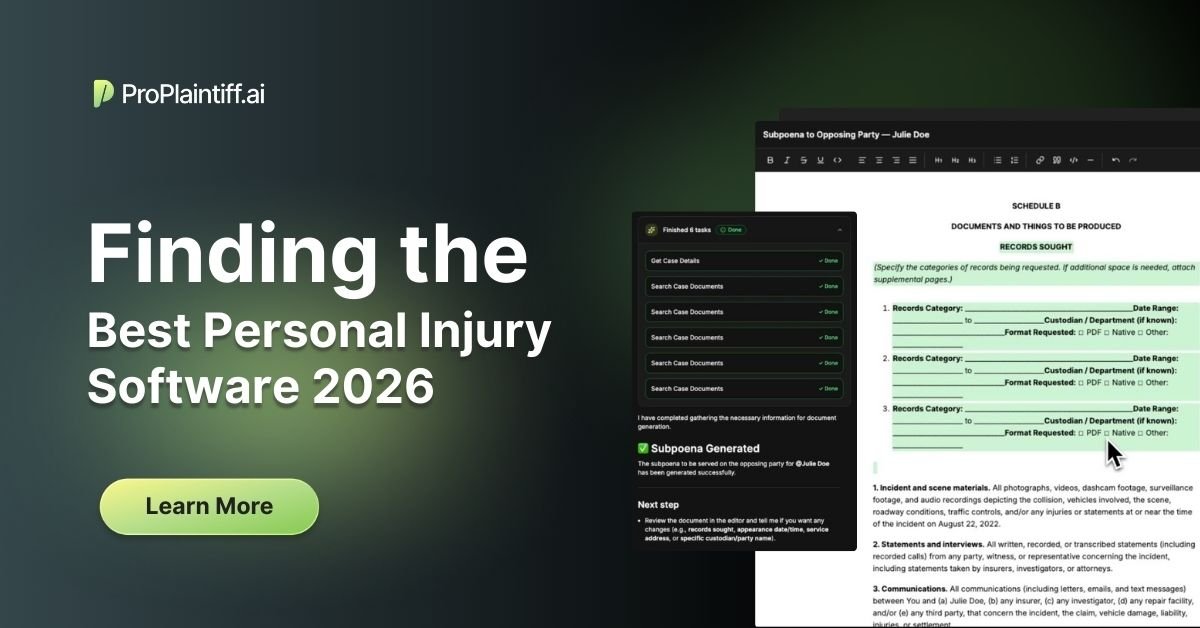
By 2026, the best personal injury law software will feel less like a digital filing cabinet and more like an active, intelligent partner for your firm. The top solutions are moving beyond simple case management and becoming AI-powered operating systems built to automate your most demanding pre-litigation work.
Think of it as the difference between a basic calculator and a dedicated financial analysis suite designed specifically for PI law. One just holds numbers; the other helps you win.
The day-to-day reality for most personal injury firms is shifting. Administrative bottlenecks—like manually building a medical chronology or trying to summarize thousands of pages of discovery—eat up far too many paralegal and attorney hours. The future of PI software is defined by one thing: its ability to crush those inefficiencies.
This shift frees your team to focus on high-value strategy and client advocacy. It’s not just about convenience; it’s a competitive necessity. The market for these tools is growing fast to meet the demand. The personal injury law software market was valued at $2.18 billion USD in 2024 and is expected to hit $5 billion USD by 2035, with North American firms leading the charge. You can dig into these market trends and what they mean for legal tech on wiseguyreports.com.
Modern platforms are now expected to function like a digital paralegal. Instead of just storing documents, the best personal injury software for 2026 will deliver actual work product. Your software should be able to:
The core measure of top-tier software in 2026 is its ability to deliver a clear competitive advantage. It must augment your legal team, not just organize their files, turning administrative hours into strategic leverage.
This guide will walk you through the essential features that provide this advantage, helping you identify the right solution to prepare your firm for what's next.
Not all AI is created equal. For a personal injury firm, understanding this distinction is the difference between dabbling in new tech and truly gaining a competitive edge.
We’ve all seen how manual case processing grinds a firm to a halt. It’s the traditional model, but it’s one that drains resources and creates frustrating delays for everyone. A single, comprehensive medical chronology can easily burn through 100 or more paralegal hours. It’s just not sustainable.
Many firms are dipping their toes into AI, often starting with general-purpose tools like ChatGPT or Claude. While these platforms are impressive and can handle a wide range of tasks, they just aren’t built for the specific, high-stakes demands of legal work.
Using a general AI for personal injury law is like asking a talented family doctor to perform brain surgery. They understand the basics of medicine, but they lack the specialized knowledge, tools, and experience to handle the complex, nuanced procedure. They don't understand the specific language of medical billing codes, deposition transcripts, or police reports—the very documents your cases are built on.
This is where specialized legal AI, particularly an agentic AI like ProPlaintiff.ai, changes the game entirely. It’s not just a chatbot you ask questions to; it’s an operational system designed to execute complex, multi-step legal work on its own. You don’t just prompt it for an answer—you give it a goal, like "create a medical chronology from these 500 pages of records," and it manages the entire workflow for you.
This diagram shows just how far things have come, moving from basic software to a true AI operating system.
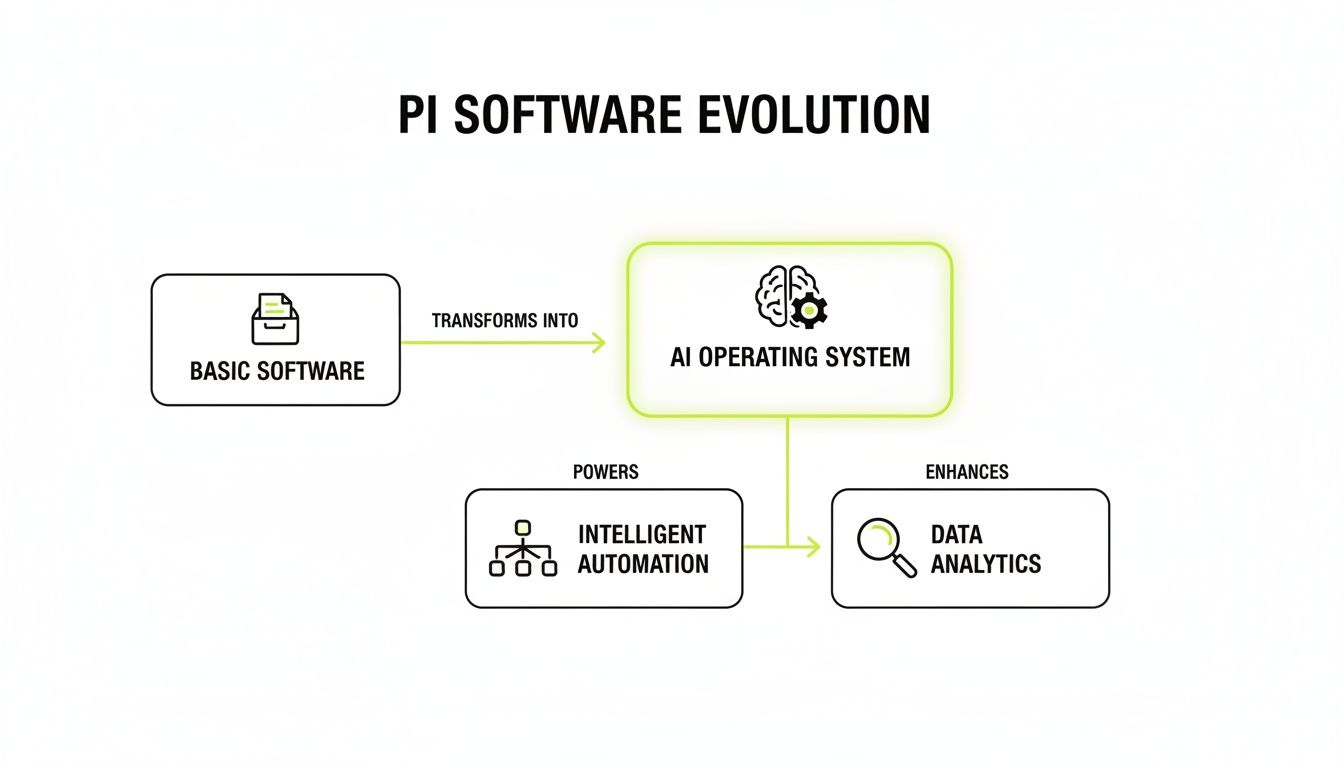
The leap is from passive data storage—a digital filing cabinet—to active, intelligent work product generation. This shift is the core of what makes for the best personal injury law software in 2026.
The real-world differences become painfully obvious when you compare how these tools handle everyday PI tasks. The security risks alone are a major concern, which is why we wrote a detailed article on why ChatGPT isn't safe for legal work.
To make it crystal clear, let's break down how these different approaches stack up for the work your team does every day. The table below shows the stark contrast between manual methods, a general tool, and an AI platform built from the ground up for personal injury law.
As you can see, it's not even a close contest. While a general AI might feel like a step up from purely manual work, a purpose-built legal AI operates on a completely different level of efficiency, accuracy, and security. It's the only viable path forward for serious PI firms.
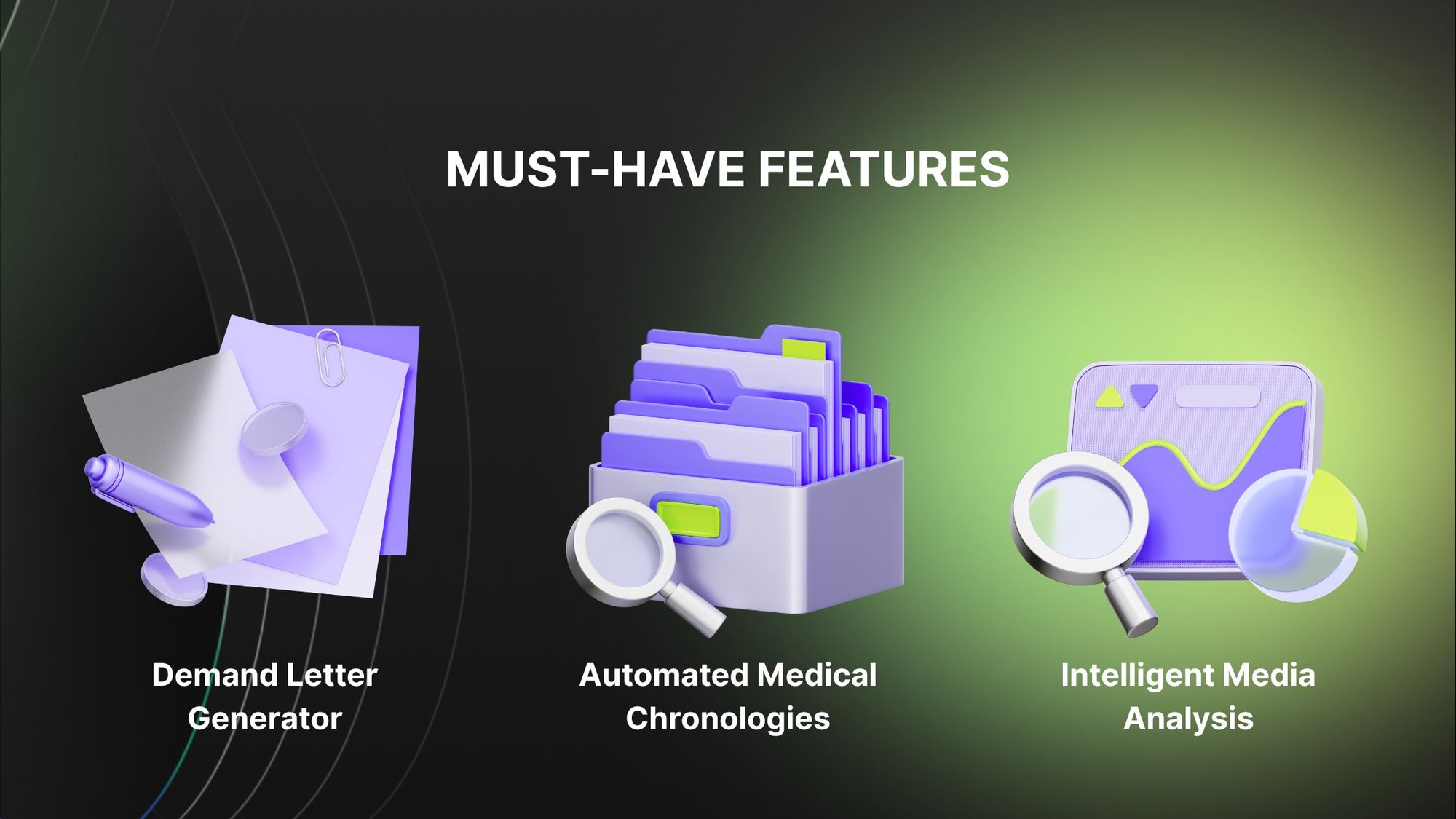
Let's be honest: generic case management just doesn't cut it anymore. For a modern personal injury firm, the best personal injury law software in 2026 is all about high-impact, AI-powered tools that crush the biggest bottlenecks in your workflow. These aren't just nice-to-have bells and whistles; they are absolute must-haves for any firm that wants to win.
The stakes are high. The personal injury legal services market hit a massive $57 billion USD in 2023, and it's growing every year. This means more competition, but also a huge opportunity for firms equipped with the right tech. To get a better sense of this growth, check out the insights over at Casepeer.com.
A strong demand letter can make or break a settlement negotiation. But we all know the drill: a paralegal or attorney spends hours—sometimes days—poring over hundreds of pages of case files, medical bills, and police reports just to piece together a compelling narrative.
An agentic AI assistant turns this entire process on its head. It reads the complete case file, from the initial client intake form to the very last physical therapy note, and produces a structured, fact-based draft. You get a detailed summary of events, a clear breakdown of medical treatments, and a solid argument for damages, all perfectly cited back to the source documents.
The difference is night and day. A task that used to eat up 15-20 hours of skilled legal work can now deliver a polished first draft in less than an hour.
Building a medical chronology is the task every PI paralegal dreads. It’s a painful, manual process of digging through stacks of disorganized records, spotting key dates, and compiling it all into a coherent timeline. For a moderately complex case, this can easily take 40-60 hours.
This is where AI delivers its most jaw-dropping results. An AI agent can ingest thousands of pages of medical documents in one go. It automatically pulls out dates, diagnoses, treatments, and providers, then arranges everything into a clean, fully sourced chronology in minutes.
A task that traditionally eats up a full week of manual work can now be finished in the time it takes to grab a coffee. This one feature alone will fundamentally change your firm's capacity.
Batch document summarization follows the same logic. Instead of losing days reading through depositions or police reports, your team gets accurate, concise summaries instantly. This allows you to assess a case and build a strategy in a fraction of the time.
Evidence isn't just on paper anymore. Accident scene photos, dashcam footage, and police bodycam videos hold critical details that can decide a case. Reviewing all that media manually is not only tedious but also leaves too much room for human error.
The best PI software for 2026 comes with intelligent media analysis built-in. The AI can scan a folder of accident photos and automatically flag points of impact, vehicle damage, and even read license plates. It can watch video footage to create a timeline of events or transcribe audio from bodycam recordings, saving your team hundreds of hours of mind-numbing work.
Of course, beyond these high-tech features, you still need solid fundamentals. Strong case and document management are the backbone of any great platform. Understanding what makes good Law Firm Project Management Software is crucial, and a comprehensive solution will integrate these core organizational tools seamlessly.
It’s a crowded market out there. While plenty of platforms offer basic case management, very few deliver true AI that actively completes work for your team. This is the single biggest difference that defines the best personal injury law software in 2026.
To make a smart decision, you need a clear framework for evaluation. Don't just compare feature lists; compare the outcomes each platform delivers. Ask these critical questions when looking at ProPlaintiff.ai versus competitors like EvenUp, CASEpeer, Filevine, CloudLex, or SmartAdvocate:
An "agentic" AI operating system like ProPlaintiff.ai is built on a totally different foundation than both specialized single-task tools and traditional case managers. Let's break down exactly what that means for your practice.
Tools like EvenUp have carved out a niche by doing one thing well: generating demand packages. This is valuable, but it's just one piece of the puzzle. Your team still does the heavy lifting to get there—manually organizing records, building the chronology, and preparing the file just to feed the machine.
Then you have powerful case management systems like CASEpeer and Filevine. Their automation is typically template-based. It’s like a sophisticated mail merge—it pulls a client’s name into a document but can’t actually read, understand, or synthesize new information from case files.
An agentic AI works on another level entirely. You don't give it a template; you give it a goal.
When you upload 2,000 pages of jumbled medical records and tell ProPlaintiff.ai to "create a medical chronology," it isn’t just filling out a form. It's performing the actual cognitive work of reading, identifying key dates and diagnoses, and constructing a brand-new, accurate report from scratch—just like a human would, but in a matter of minutes.
This table offers a direct comparison of the core AI functionalities that separate a true AI operating system from other tools in the personal injury space.
Ultimately, the goal is to find a platform that acts as a genuine force multiplier for your team. Understanding where each tool fits—and what it doesn't do—is the key to making the right choice.
To see how these AI capabilities fit into the bigger picture, explore our full guide on the best case management software for attorneys.

Bringing new technology into your firm is a big decision. It all comes down to trust, the potential for growth, and what you’ll get back on your investment. For any firm leader choosing the best personal injury law software for 2026, those three things are everything.
Security, in particular, isn’t something you can compromise on. Period.
You’re handling protected health information (PHI) every single day, which means airtight data security and HIPAA compliance are table stakes. When your team is knee-deep in sensitive client medical records, knowing the ins and outs of HIPAA compliance for small business is non-negotiable. The best platforms are built for this reality, offering things like SOC 2 certification and end-to-end encryption to protect both your client data and your firm’s good name.
The firm you are today isn't the firm you'll be tomorrow. Scalability is all about making sure your software can keep up as you grow—whether you’re going from a solo practice to a multi-office operation—without forcing you into a massive, expensive overhaul.
This is where modern, cloud-based AI systems really shine. You can add new users, take on more cases, and unlock powerful new features as your firm hits new milestones. This approach tears down the old financial barriers that kept high-end tech out of reach for smaller firms.
Investing in this kind of tech is part of a massive shift. The global legal technology market was valued at $33.97 billion USD in 2025 and is on track to hit $77.93 billion USD by 2034. Law firms are the ones driving this, making up 56.43% of that spending. It's a clear signal that firms are leaning on technology to fuel their growth.
Most importantly, you need a simple way to figure out your return on investment (ROI). The right software isn't just another line item on your expense report; it's a strategic tool that pays for itself over and over through huge gains in efficiency. You can get more ideas on how to set up your practice for success in our guide to case management software.
Here’s a practical way to think about the value:
This kind of math completely reframes the software's price. It stops being a monthly cost and starts looking like what it is: an engine for profitability.
The right software doesn't cost your firm money; it makes your firm money. By automating low-value tasks, it frees your most valuable asset—your people—to focus on winning cases.
Making a big tech change always brings up a few important questions. Let's tackle the most common ones we hear from personal injury firms when they’re weighing their options for new software. These answers should give you the clarity you need to make a confident decision.
Most legal software on the market talks about "automation," but what they really mean is a glorified template filler. It’s like a macro that takes a client's name and drops it into a standard form letter. It saves a few clicks, but it isn’t doing any real legal work.
An agentic AI, the kind of system powering ProPlaintiff.ai, is on a completely different level. You don’t give it a simple instruction; you give it a complex goal. Think, "create a comprehensive medical chronology from these 1,500 pages of records," and it gets to work.
The AI autonomously figures out all the steps needed to get there. It reads and understands everything from handwritten doctor's notes to complex billing codes, pulls out the critical facts, organizes them into a coherent timeline, and even cites its sources. It's the difference between a tool that helps you do a task and a system that does the entire task for you.
Forget the nightmare IT projects of the past. Modern cloud platforms are built for a smooth, painless transition, and a system like ProPlaintiff.ai is designed to get your team up and running fast without disrupting your caseload.
The process starts with a secure data migration. Your existing case files are uploaded to the platform, and a dedicated team makes sure every piece of data makes it over intact. From there, training is quick—because the interface is intuitive, most teams are fully up to speed after just a few sessions.
The whole point is to get your team using the AI to make their lives easier within the first week, not months down the road. It’s all about rapid adoption and seeing an immediate return.
It's natural to look at the subscription fee as another line item on the budget, but that’s the wrong way to think about it. This isn't just an expense; it's a direct investment in your firm's efficiency and profitability.
The easiest way to see the return on investment (ROI) is to quantify the hours your team is currently burning on tasks the AI can completely automate.
Just start tracking the time spent on things like manually drafting demand letters or summarizing dense medical records. Then, multiply those hours by your team's hourly cost. That’s your "efficiency gain."
For example:
And that simple math doesn't even touch the "opportunity gain"—the value you get from turning cases over faster and taking on more clients without having to hire more staff. When the value the software creates blows past the subscription fee, it stops being a cost and becomes a clear engine for growth.
Ready to see how an agentic AI can transform your firm's productivity and profitability? Discover ProPlaintiff.ai and schedule a demo today to experience the future of personal injury law software. Visit https://www.proplaintiff.ai to learn more.



.svg)